Topic 4 · Navier-Stokes Equations

Solved Problems: Official Collection NS1 to NS17

Worked solutions to the Navier-Stokes collection of the Department of Thermal and Fluid Engineering, Universidad Carlos III de Madrid. Every problem restates the official statement word for word, then follows four phases: (1) hypotheses, data, unknowns and degrees of freedom; (2) coordinate system, form of the fields and boundary conditions; (3) the derivation, with continuity and each Navier-Stokes component simplified term by term, the integrations written out and every constant fixed with its boundary condition; (4) interpretation, limiting cases and the dimensional check. Where a computed result differs from the handwritten official solution, the discrepancy is flagged in the problem; anything beyond the course material is marked as an extension. References to Notes.pdf are to Chapter 4 (The Navier-Stokes equations) and Chapter 3 (Conservation laws).

Problem NS1

Porous Wall with Suction

Original statement · NS1.pdf
Unidirectional flowPorous wallViscous dissipationStreamline

Official Problem Statement

Consider the steady planar motion of a perfect liquid of density $\rho$, viscosity $\mu$, thermal conductivity $k$ and specific heat $c$ in the vicinity of a horizontal porous wall. Far from the wall, the horizontal velocity component is $v_x = U_\infty$, the pressure is given by $p + \rho g z = P_\infty$ and the temperature is $T = T_\infty$, different from the value $T_w$ at the wall. The liquid is sucked through the pores of the wall, resulting in a transverse velocity $v_z = -V_w$ at the wall surface. In the analysis, assume that the velocity and temperature fields are only a function of the distance to the wall $z$.

1. Determine the velocity components $v_x(z)$ and $v_z(z)$ and well as the pressure field $p(x, z)$.

2. Obtain the temperature field $T(z)$.

3. Calculate the streamline that crosses $x = x_o$ and $z = 0$.

4. Compute the viscous stress on the wall.

5. Determine the heat flux from the fluid to the wall.

Transcribed as printed, including "and well as" in item 1.
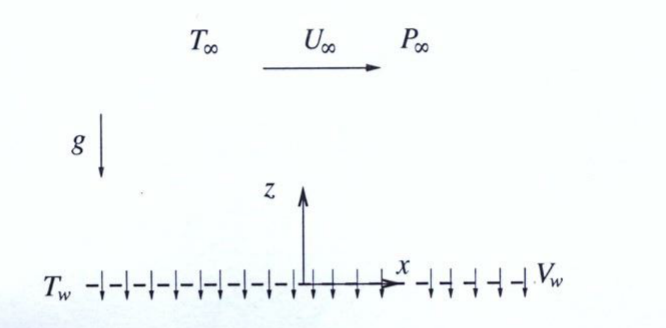
Horizontal porous wall at temperature T_w with suction velocity V_w, free stream U_inf, T_inf, P_inf, gravity g and axes x, z
Swipe sideways to see the whole figure.
Statement figure (crop of NS1.pdf, p. 1): horizontal porous wall at temperature $T_w$ with suction velocity $V_w$, free stream $U_\infty$, $T_\infty$, $P_\infty$, gravity $g$ and axes $x$, $z$
Open the figure full size

Source: NS1.pdf (page 1). Notes.pdf, Chapter 4: continuity Eq. 4.7, incompressible momentum Eq. 4.12, perfect-liquid energy Eq. 4.42, no-slip and far-field conditions (Section on initial and boundary conditions).

Worked solutionexpand / collapse

Hypotheses, Data and Unknowns

  • Steady planar flow of an incompressible liquid with constant $\rho$, $\mu$, $k$, $c$ (perfect liquid, Notes.pdf, Eq. 4.38): the equations to use are (4.40), (4.41) and (4.42).
  • Gravity acts along $-\bar{e}_z$ (the far-field pressure is $p + \rho g z = P_\infty$, so $\bar{f}_m = -g\,\bar{e}_z$).
  • Given: the fields depend only on the distance to the wall, $\partial/\partial x = \partial/\partial y = \partial/\partial t = 0$ for every variable, except that the pressure is allowed to depend on $x$ (it is determined below).
  • No chemical reaction and no radiation: $Q_c = Q_r = 0$.
  • The wall is at rest and porous: the tangential velocity is zero (no-slip) and the normal velocity is the suction velocity.
  • Data: $[\rho,\ \mu,\ k,\ c,\ U_\infty,\ P_\infty,\ T_\infty,\ T_w,\ V_w,\ g]$ with $V_w > 0$. Unknowns: $v_x(z)$, $v_z(z)$, $p(x,z)$, $T(z)$, the streamline, the wall stress and the wall heat flux.
  • Degrees of freedom: two velocity components, the pressure and the temperature, each a function of one coordinate (plus $x$ for the pressure): four unknown fields against continuity, two momentum components and the energy equation.
SymbolMeaningSI unit
$\rho$, $\mu$, $\nu = \mu/\rho$density, dynamic and kinematic viscositykg/m$^3$, Pa s, m$^2$/s
$k$, $c$, $\alpha = k/(\rho c)$thermal conductivity, specific heat, thermal diffusivityW/(m K), J/(kg K), m$^2$/s
$\mathrm{Pr} = \nu/\alpha = \mu c/k$Prandtl number1
$U_\infty$, $V_w$free-stream velocity, suction velocitym/s
$P_\infty$, $T_\infty$, $T_w$far-field reduced pressure, far-field and wall temperaturesPa, K, K

Frames, Field Form and Boundary Conditions

  • Cartesian frame $(x,y,z)$ with $x$ along the wall (in the direction of $U_\infty$), $z$ normal to it and pointing into the liquid, $y$ out of the plane. The basis $\{\bar{e}_x,\bar{e}_y,\bar{e}_z\}$ is orthonormal and right-handed, so no change of basis is needed ($\det R = 1$, $R R^T = I$ with $R = I$).
  • Field form: $\bar{v} = v_x(z)\,\bar{e}_x + v_z(z)\,\bar{e}_z$, $T = T(z)$, $p = p(x,z)$.
  • The wall is at $z = 0$ and the liquid occupies $z > 0$.
LocationConditionOrigin
$z = 0$$v_x = 0$no-slip on the wall at rest
$z = 0$$v_z = -V_w$suction through the pores (statement)
$z = 0$$T = T_w$thermal equilibrium at the wall
$z \to \infty$$v_x \to U_\infty$free stream (statement)
$z \to \infty$$p + \rho g z \to P_\infty$free stream (statement)
$z \to \infty$$T \to T_\infty$free stream (statement)

Step-by-Step Derivation

3.1 Continuity and the normal velocity

$$ \nabla\cdot\bar{v} = \frac{\partial v_x}{\partial x} + \frac{\partial v_z}{\partial z} = \underbrace{\cancel{\frac{\partial v_x}{\partial x}}}_{v_x = v_x(z)} + \frac{dv_z}{dz} = 0 \;\Longrightarrow\; \frac{dv_z}{dz} = 0 \;\Longrightarrow\; v_z = \text{const} \tag{1} $$

The constant is fixed at the wall: $v_z(0) = -V_w$, therefore

$$ \boxed{\,v_z(z) = -V_w\,} \tag{2} $$

3.2 Momentum equations

For $\bar{f}_m = -g\,\bar{e}_z$ the Cartesian components of (4.41) with constant $\mu$ are (Notes.pdf, Section on the Navier-Stokes equations in Cartesian coordinates). Every term that contains $\partial/\partial t$, $\partial/\partial x$ or $\partial/\partial y$ of a velocity component is zero.

z-component:

$$ \rho\Big(\underbrace{\cancel{\frac{\partial v_z}{\partial t}}}_{\text{steady}} + \underbrace{\cancel{v_x\frac{\partial v_z}{\partial x}}}_{v_z = v_z(z)} + v_z\underbrace{\frac{dv_z}{dz}}_{=0\ \text{by (1)}}\Big) = -\frac{\partial p}{\partial z} + \mu\underbrace{\frac{d^2 v_z}{dz^2}}_{=0} - \rho g \;\Longrightarrow\; \frac{\partial p}{\partial z} = -\rho g \tag{3} $$

Integrating (3) with respect to $z$ at fixed $x$ (the "constant" may depend on $x$):

$$ p + \rho g z = f(x) \tag{4} $$

The far-field condition $p + \rho g z \to P_\infty$ holds for every $x$, with $P_\infty$ a constant, so $f(x) = P_\infty$:

$$ \boxed{\,p(x,z) = P_\infty - \rho g z\,}, \qquad \frac{\partial p}{\partial x} = 0 \tag{5} $$

x-component:

$$ \rho\Big(\underbrace{\cancel{\frac{\partial v_x}{\partial t}}}_{\text{steady}} + \underbrace{\cancel{v_x\frac{\partial v_x}{\partial x}}}_{\partial_x = 0} + v_z\frac{dv_x}{dz}\Big) = -\underbrace{\frac{\partial p}{\partial x}}_{=0\ \text{by (5)}} + \mu\frac{d^2 v_x}{dz^2} \;\Longrightarrow\; -\rho V_w\frac{dv_x}{dz} = \mu\frac{d^2 v_x}{dz^2} \tag{6} $$

Dividing by $\mu$ and using $\nu = \mu/\rho$:

$$ \frac{d^2 v_x}{dz^2} + \frac{V_w}{\nu}\frac{dv_x}{dz} = 0 \tag{7} $$

This is a linear ODE with constant coefficients. Trying $v_x = e^{\lambda z}$ gives $\lambda^2 + (V_w/\nu)\lambda = 0$, so $\lambda = 0$ or $\lambda = -V_w/\nu$:

$$ v_x = C_1 + C_2\,e^{-V_w z/\nu} \tag{8} $$

Boundary conditions: $v_x(\infty) = U_\infty$ gives $C_1 = U_\infty$ (the exponential vanishes because $V_w > 0$); $v_x(0) = 0$ gives $C_1 + C_2 = 0$, so $C_2 = -U_\infty$:

$$ \boxed{\,v_x(z) = U_\infty\left(1 - e^{-V_w z/\nu}\right)\,} \tag{9} $$

3.3 Energy equation and the temperature field

With $e = e_o + cT$, $\bar{v} = v_x\bar{e}_x + v_z\bar{e}_z$ and $\partial/\partial x = \partial/\partial t = 0$, (4.42) reads

$$ \rho c\,v_z\frac{dT}{dz} = \phi_v + k\frac{d^2T}{dz^2} \tag{10} $$

The viscous dissipation of this flow, from the Cartesian expression of $\phi_v$ (Notes.pdf, Section on the Navier-Stokes equations in Cartesian coordinates), has a single non-zero shear rate $\partial v_x/\partial z$:

$$ \phi_v = \mu\left(\frac{dv_x}{dz}\right)^2, \qquad \frac{dv_x}{dz} = \frac{U_\infty V_w}{\nu}\,e^{-V_w z/\nu} \;\Longrightarrow\; \phi_v = \frac{\mu U_\infty^2 V_w^2}{\nu^2}\,e^{-2V_w z/\nu} \tag{11} $$

Substituting $v_z = -V_w$ and (11) in (10) and dividing by $k$, with $\alpha = k/(\rho c)$:

$$ \frac{d^2T}{dz^2} + \frac{V_w}{\alpha}\frac{dT}{dz} = -\frac{\mu U_\infty^2 V_w^2}{k\,\nu^2}\,e^{-2V_w z/\nu} \tag{12} $$

The solution is the sum of the homogeneous solution $B_1 + B_2e^{-V_w z/\alpha}$ and a particular solution $A\,e^{-2V_w z/\nu}$. Substituting the particular form in (12), with $T_p' = -(2V_w/\nu)A\,e^{-2V_wz/\nu}$ and $T_p'' = (4V_w^2/\nu^2)A\,e^{-2V_wz/\nu}$:

$$ A\left(\frac{4V_w^2}{\nu^2} - \frac{2V_w^2}{\alpha\nu}\right) = -\frac{\mu U_\infty^2V_w^2}{k\nu^2} \;\Longrightarrow\; A\,(4 - 2\,\mathrm{Pr}) = -\frac{\mu U_\infty^2}{k} = -\frac{\mathrm{Pr}\,U_\infty^2}{c} \tag{13} $$

where $\mathrm{Pr} = \nu/\alpha = \mu c/k$ was used. Hence (for $\mathrm{Pr} \neq 2$)

$$ A = \frac{\mathrm{Pr}}{2(\mathrm{Pr} - 2)}\frac{U_\infty^2}{c} \tag{14} $$

so that $T = B_1 + B_2e^{-V_wz/\alpha} + A\,e^{-2V_wz/\nu}$. The condition $T(\infty) = T_\infty$ gives $B_1 = T_\infty$ and $T(0) = T_w$ gives $B_2 = T_w - T_\infty - A$:

$$ \boxed{\,T(z) = T_\infty + \left(T_w - T_\infty - \frac{\mathrm{Pr}\,U_\infty^2}{2(\mathrm{Pr}-2)\,c}\right)e^{-V_wz/\alpha} + \frac{\mathrm{Pr}\,U_\infty^2}{2(\mathrm{Pr}-2)\,c}\,e^{-2V_wz/\nu}\,} \tag{15} $$

Note that $V_wz/\alpha = \mathrm{Pr}\,V_wz/\nu$. For $\mathrm{Pr} = 2$ the two exponents coincide and the particular solution is $D\,z\,e^{-2V_wz/\nu}$ with $D = \mu U_\infty^2V_w/(2k\nu)$ (as in NS15); (23) holds for every $\mathrm{Pr}$.

3.4 Streamline through $(x_o, 0)$

The streamlines are the integral curves of $\bar{v}$: $dx/v_x = dz/v_z$. With (2) and (9):

$$ \frac{dx}{dz} = \frac{v_x}{v_z} = -\frac{U_\infty}{V_w}\left(1 - e^{-V_wz/\nu}\right) \tag{16} $$

Integrating from $z' = 0$ (where $x = x_o$) to $z' = z$. The antiderivative of $1 - e^{-az'}$ with $a = V_w/\nu$ is $z' + e^{-az'}/a$, and Barrow's rule gives $[z' + e^{-az'}/a]_0^z = z + (e^{-az} - 1)/a$:

$$ \boxed{\,x - x_o = -\frac{U_\infty}{V_w}\left[z + \frac{\nu}{V_w}\left(e^{-V_wz/\nu} - 1\right)\right]\,} \tag{17} $$

3.5 Viscous stress on the wall

The wall is the surface $z = 0$. Take the unit normal pointing into the liquid, $\bar{n} = \bar{e}_z$: then $\bar{\bar{\tau}}'\cdot\bar{n}$ is the viscous force per unit area that the liquid exerts on the wall. The components of $\bar{\bar{\tau}}'$ with the Navier-Poisson law (Notes.pdf, Section on stress components, Cartesian coordinates) are

$$ \bar{\bar{\tau}}'\cdot\bar{e}_z = \tau'_{xz}\,\bar{e}_x + \tau'_{zz}\,\bar{e}_z, \qquad \tau'_{xz} = \mu\left(\frac{\partial v_x}{\partial z} + \frac{\partial v_z}{\partial x}\right) = \mu\frac{dv_x}{dz}, \qquad \tau'_{zz} = 2\mu\frac{dv_z}{dz} + \left(\mu_B - \tfrac{2}{3}\mu\right)\nabla\cdot\bar{v} = 0 \tag{18} $$

At the wall, from (9), $dv_x/dz\big|_{z=0} = U_\infty V_w/\nu$, so

$$ \boxed{\,\bar{\bar{\tau}}'\cdot\bar{n}\Big|_{w} = \mu\frac{U_\infty V_w}{\nu}\,\bar{e}_x = \rho V_w U_\infty\,\bar{e}_x\,} \tag{19} $$

The liquid drags the wall in the direction of the free stream.

3.6 Heat flux from the liquid to the wall

The heat flux from the liquid to the wall is $\bar{q}\cdot\bar{n}$ with $\bar{n} = -\bar{e}_z$ (outward from the liquid, into the wall), and $\bar{q} = -k\nabla T$ (Notes.pdf, Eq. 4.36):

$$ \bar{q}\cdot\bar{n}\Big|_w = -k\frac{dT}{dz}\bar{e}_z\cdot(-\bar{e}_z)\Big|_{z=0} = k\frac{dT}{dz}\Big|_{z=0} \tag{20} $$

Differentiating (15) and evaluating at $z = 0$:

$$ \frac{dT}{dz}\Big|_0 = -\frac{V_w}{\alpha}B_2 - \frac{2V_w}{\nu}A = -\frac{V_w}{\nu}\left(\mathrm{Pr}\,B_2 + 2A\right) \tag{21} $$

Using $k/\nu = \rho c/\mathrm{Pr}$ and $B_2 = T_w - T_\infty - A$:

$$ k\frac{dT}{dz}\Big|_0 = -\rho c V_w\left(B_2 + \frac{2A}{\mathrm{Pr}}\right) = -\rho cV_w\left[T_w - T_\infty - A\,\frac{\mathrm{Pr}-2}{\mathrm{Pr}}\right] = -\rho cV_w\left[T_w - T_\infty - \frac{U_\infty^2}{2c}\right] \tag{22} $$
$$ \boxed{\,\bar{q}\cdot\bar{n}\Big|_w = \rho c V_w\left[T_\infty - T_w + \frac{U_\infty^2}{2c}\right]\,} \tag{23} $$

The result does not depend on the Prandtl number.

Interpretation, Limits and Dimensional Check

  • Physical meaning. Suction pins the shear layer to the wall: the velocity reaches $99\%$ of $U_\infty$ at $z \approx 4.6\,\nu/V_w$ and the thickness $\nu/V_w$ does not grow with $x$. The liquid is pulled towards the wall by the pores, and the viscous diffusion away from the wall balances this convection (equation (6)).
  • Limits. For $V_w \to 0$ the layer thickens without bound, consistent with the absence of a steady unidirectional solution. For $z \to \infty$, $v_x \to U_\infty$ and $T \to T_\infty$. At $z = 0$, $v_x = 0$ and $T = T_w$.
  • Dimensional check. $V_wz/\nu$ and $V_wz/\alpha$ are dimensionless. In (23), $\rho cV_w\,\Delta T$ has units $(\mathrm{kg/m^3})(\mathrm{J/(kg\,K)})(\mathrm{m/s})\,\mathrm{K} = \mathrm{W/m^2}$, and $U_\infty^2/(2c)$ has units $(\mathrm{m^2/s^2})/(\mathrm{J/(kg\,K)}) = \mathrm{K}$. In (19), $\rho V_wU_\infty$ has units $\mathrm{kg/(m^2\,s)}\cdot\mathrm{m/s} = \mathrm{N/m^2}$.
  • Energy check. Equation (23) is the heat that must flow into the wall in steady state: per unit area the suction brings in from the free stream the energy $\rho V_w(cT_\infty + U_\infty^2/2)$ and the pores take out $\rho V_w\,cT_w$; the pressure work and the work of gravity cancel, and the shear does no work on the wall because it is at rest. The difference is $\rho cV_w[T_\infty - T_w + U_\infty^2/(2c)]$, the result (23).
  • Special case. For $U_\infty \to 0$ there is no dissipation and (23) reduces to $\rho cV_w(T_\infty - T_w)$, the advection-conduction balance of pure suction.
Problem NS2

Rotating Coaxial Cylinders

Original statement · NS2.pdf
Circular Couette flowTorque and powerViscous dissipationTemperature profile

Official Problem Statement

Consider the steady planar motion of a perfect liquid of density $\rho$, viscosity $\mu$, thermal conductivity $k$ and specific heat $c$ in the gap formed between two coaxial cylinders of radii $R_1$ and $R_2$ that are rotating with angular velocities $\Omega_1$ and $\Omega_2$, respectively. Because of the symmetry of the problem, $v_z = 0$ and $\partial/\partial z = \partial/\partial\theta = 0$.

1. Obtain the velocity and pressure fields.

2. Calculate the torque exerted on each cylinder, as well as the power needed to keep them rotating.

3. If the temperatures on the cylinder surfaces are $T_1$ and $T_2$, determine the temperature distribution $T(r)$.

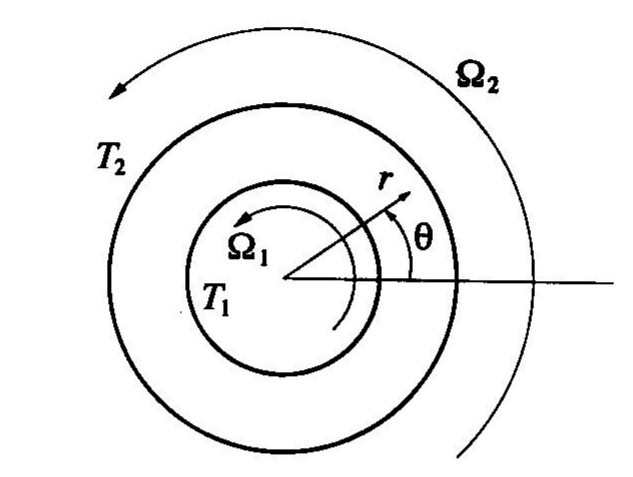
Two coaxial cylinders, inner of radius R1 at T1 rotating with Omega1, outer of radius R2 at T2 rotating with Omega2, polar coordinates r and theta
Swipe sideways to see the whole figure.
Statement figure (crop of NS2.pdf, p. 1): inner cylinder $R_1$ at $T_1$ rotating with $\Omega_1$, outer cylinder $R_2$ at $T_2$ rotating with $\Omega_2$, polar coordinates $r$, $\theta$
Open the figure full size

Source: NS2.pdf (page 1). Notes.pdf, Chapter 4: continuity Eq. 4.40, perfect-liquid momentum Eq. 4.41 in cylindrical coordinates, energy Eq. 4.42, stress components in cylindrical coordinates.

Worked solutionexpand / collapse

Hypotheses, Data and Unknowns

  • Steady planar motion ($v_z = 0$, $\partial/\partial z = 0$) of a perfect liquid with constant $\rho$, $\mu$, $k$, $c$: equations (4.40)-(4.42) in cylindrical coordinates.
  • Axisymmetric: $\partial/\partial\theta = 0$ for every variable.
  • No mass force enters the problem in the plane of motion (the statement lists none; gravity, if present, only shifts the pressure by a hydrostatic term and is absorbed in the reduced pressure of Notes.pdf, Eq. 4.13). No chemical reaction and no radiation: $Q_c = Q_r = 0$.
  • The cylinder surfaces are impermeable and move with their own angular velocity (no-slip).
  • Data: $[\rho,\ \mu,\ k,\ c,\ R_1,\ R_2,\ \Omega_1,\ \Omega_2,\ T_1,\ T_2]$ with $R_2 > R_1$. Unknowns: $v_r(r)$, $v_\theta(r)$, $p(r)$, the torques, the powers and $T(r)$.
  • Degrees of freedom: two velocity components, the pressure and the temperature, each a function of $r$ alone.
SymbolMeaningSI unit
$R_1$, $R_2$inner and outer radiim
$\Omega_1$, $\Omega_2$angular velocities (positive counter-clockwise, towards increasing $\theta$)rad/s
$T_1$, $T_2$temperatures of the inner and outer surfacesK
$\rho$, $\mu$, $k$density, viscosity, thermal conductivitykg/m$^3$, Pa s, W/(m K)
$C_1$, $C_2$integration constants of $v_\theta$1/s, m$^2$/s

Frames, Field Form and Boundary Conditions

  • Cylindrical frame $(r,\theta,z)$ centred on the common axis, with $\bar{e}_r$, $\bar{e}_\theta$, $\bar{e}_z$ orthonormal and right-handed ($\bar{e}_r\wedge\bar{e}_\theta = \bar{e}_z$); the frame is attached to the laboratory, which is inertial.
  • Field form: $\bar{v} = v_r(r)\,\bar{e}_r + v_\theta(r)\,\bar{e}_\theta$, $p = p(r)$, $T = T(r)$.
LocationConditionOrigin
$r = R_1$$v_r = 0$, $v_\theta = \Omega_1R_1$impermeable inner cylinder, no-slip
$r = R_2$$v_r = 0$, $v_\theta = \Omega_2R_2$impermeable outer cylinder, no-slip
$r = R_1$$T = T_1$thermal equilibrium at the wall
$r = R_2$$T = T_2$thermal equilibrium at the wall

Step-by-Step Derivation

3.1 Continuity and the radial velocity

$$ \frac{1}{r}\frac{d(rv_r)}{dr} + \underbrace{\cancel{\frac{1}{r}\frac{\partial v_\theta}{\partial\theta}}}_{\partial_\theta = 0} + \underbrace{\cancel{\frac{\partial v_z}{\partial z}}}_{v_z = 0} = 0 \;\Longrightarrow\; r\,v_r = \text{const} \tag{1} $$

The constant is fixed at the inner wall, where $v_r(R_1) = 0$: $r\,v_r = 0$ for every $r$, therefore

$$ \boxed{\,v_r(r) = 0\,} \tag{2} $$

3.2 Azimuthal momentum and the velocity profile

The $\theta$ component of (4.41) in cylindrical coordinates, with $v_r = 0$, $\partial/\partial t = \partial_\theta = \partial_z = 0$ and no mass force:

$$ \rho\Big(\underbrace{\cancel{\frac{\partial v_\theta}{\partial t}}}_{\text{steady}} + \underbrace{\cancel{v_r\frac{\partial v_\theta}{\partial r}}}_{v_r = 0} + \underbrace{\cancel{\frac{v_\theta}{r}\frac{\partial v_\theta}{\partial\theta}}}_{\partial_\theta = 0} + \underbrace{\cancel{\frac{v_rv_\theta}{r}}}_{v_r = 0} + \underbrace{\cancel{v_z\frac{\partial v_\theta}{\partial z}}}_{v_z = 0}\Big) = -\underbrace{\cancel{\frac{1}{r}\frac{\partial p}{\partial\theta}}}_{\partial_\theta = 0} + \mu\frac{d}{dr}\left[\frac{1}{r}\frac{d(rv_\theta)}{dr}\right] \tag{3} $$

Hence $\dfrac{d}{dr}\left[\dfrac{1}{r}\dfrac{d(rv_\theta)}{dr}\right] = 0$. Integrating once, $\dfrac{1}{r}\dfrac{d(rv_\theta)}{dr} = 2C_1$ (the factor 2 is a convenient choice of constant). Multiplying by $r$ and integrating again, $rv_\theta = C_1r^2 + C_2$:

$$ v_\theta = C_1\,r + \frac{C_2}{r} \tag{4} $$

The boundary conditions $v_\theta(R_1) = \Omega_1R_1$ and $v_\theta(R_2) = \Omega_2R_2$, each multiplied by $R_i$, give a linear system:

$$ C_1R_1^2 + C_2 = \Omega_1R_1^2, \qquad C_1R_2^2 + C_2 = \Omega_2R_2^2 \tag{5} $$

Subtracting the first equation from the second, $C_1(R_2^2 - R_1^2) = \Omega_2R_2^2 - \Omega_1R_1^2$, and then $C_2 = \Omega_1R_1^2 - C_1R_1^2$:

$$ C_1 = \frac{\Omega_2R_2^2 - \Omega_1R_1^2}{R_2^2 - R_1^2}, \qquad C_2 = \frac{(\Omega_1 - \Omega_2)\,R_1^2R_2^2}{R_2^2 - R_1^2} \tag{6} $$
$$ \boxed{\,v_\theta(r) = \frac{\Omega_2R_2^2 - \Omega_1R_1^2}{R_2^2 - R_1^2}\,r + \frac{(\Omega_1 - \Omega_2)R_1^2R_2^2}{R_2^2 - R_1^2}\,\frac{1}{r}\,} \tag{7} $$

3.3 Radial momentum and the pressure field

The $r$ component of (4.41) with $v_r = 0$ keeps only the centrifugal term and the pressure gradient (all other terms vanish for the same reasons as in (3)):

$$ -\rho\frac{v_\theta^2}{r} = -\frac{dp}{dr} \;\Longrightarrow\; \frac{dp}{dr} = \rho\frac{v_\theta^2}{r} = \rho\left(C_1^2\,r + \frac{2C_1C_2}{r} + \frac{C_2^2}{r^3}\right) \tag{8} $$

Integrating from $R_1$ to $r$, the antiderivatives are $C_1^2r^2/2$, $2C_1C_2\ln r$ and $-C_2^2/(2r^2)$, and Barrow's rule gives

$$ \boxed{\,p(r) - p(R_1) = \rho\left[\frac{C_1^2}{2}\left(r^2 - R_1^2\right) + 2C_1C_2\ln\frac{r}{R_1} - \frac{C_2^2}{2}\left(\frac{1}{r^2} - \frac{1}{R_1^2}\right)\right]\,} \tag{9} $$

The constant $p(R_1)$ is set by the reference pressure of the problem; the pressure grows outwards because the fluid is whirling and needs a centripetal force.

3.4 Viscous stress and torque on each cylinder

The only non-zero viscous shear stress is (Notes.pdf, stress components in cylindrical coordinates, with $v_r = 0$):

$$ \tau'_{r\theta} = \mu\left[r\frac{d}{dr}\left(\frac{v_\theta}{r}\right) + \frac{1}{r}\underbrace{\cancel{\frac{\partial v_r}{\partial\theta}}}_{=0}\right] = \mu\,r\frac{d}{dr}\left(C_1 + \frac{C_2}{r^2}\right) = -\frac{2\mu C_2}{r^2} \tag{10} $$

The normal viscous stresses $\tau'_{rr}$ and $\tau'_{\theta\theta}$ are zero ($v_r = 0$, $\nabla\cdot\bar{v} = 0$), and the pressure force on a cylindrical surface is radial, so it has no moment about the axis. Only $\tau'_{r\theta}$ contributes to the torque.

*Inner cylinder* (surface $r = R_1$). The normal pointing into the liquid is $\bar{n} = +\bar{e}_r$, so $\bar{\bar{\tau}}'\cdot\bar{n} = \tau'_{r\theta}\,\bar{e}_\theta$ is the force per unit area that the liquid exerts on the cylinder. The torque per unit length about the axis, with $d\sigma = R_1\,d\theta\,(1)$ and arm $R_1\bar{e}_r$:

$$ \bar{M}_1 = \int_0^{2\pi}R_1\bar{e}_r\wedge\tau'_{r\theta}(R_1)\bar{e}_\theta\,R_1\,d\theta = 2\pi R_1^2\,\tau'_{r\theta}(R_1)\,\bar{e}_z = -4\pi\mu C_2\,\bar{e}_z \tag{11} $$

*Outer cylinder* (surface $r = R_2$). The normal pointing into the liquid is $\bar{n} = -\bar{e}_r$:

$$ \bar{M}_2 = \int_0^{2\pi}R_2\bar{e}_r\wedge\left[-\tau'_{r\theta}(R_2)\bar{e}_\theta\right]R_2\,d\theta = -2\pi R_2^2\,\tau'_{r\theta}(R_2)\,\bar{e}_z = +4\pi\mu C_2\,\bar{e}_z \tag{12} $$
$$ \boxed{\,\bar{M}_1 = -4\pi\mu\frac{(\Omega_1 - \Omega_2)R_1^2R_2^2}{R_2^2 - R_1^2}\,\bar{e}_z = -\bar{M}_2\,} \tag{13} $$

The two torques are equal and opposite, as the angular momentum balance of the liquid requires: in steady motion the total moment on the liquid between the cylinders is zero, so the moments that the cylinders exert on it, $-\bar{M}_1$ and $-\bar{M}_2$, cancel.

3.5 Power needed to keep the cylinders rotating

The external agent must exert on each cylinder the opposite of the liquid torque, so the power it supplies is $\dot{W}_i = -\bar{M}_i\cdot\Omega_i\bar{e}_z$:

$$ \dot{W}_1 = +4\pi\mu C_2\,\Omega_1, \qquad \dot{W}_2 = -4\pi\mu C_2\,\Omega_2 \tag{14} $$
$$ \boxed{\,\dot{W} = \dot{W}_1 + \dot{W}_2 = 4\pi\mu C_2\,(\Omega_1 - \Omega_2) = 4\pi\mu\frac{(\Omega_1 - \Omega_2)^2R_1^2R_2^2}{R_2^2 - R_1^2}\,} \tag{15} $$

The total power is non-negative, as it must be: it equals the viscous dissipation in the gap (checked in 3.6).

3.6 Temperature distribution

With $v_r = 0$ the convective terms of (4.42) vanish. The energy equation for the steady, axisymmetric flow reads

$$ 0 = \phi_v + \frac{k}{r}\frac{d}{dr}\left(r\frac{dT}{dr}\right) \tag{16} $$

and the viscous dissipation of this flow (cylindrical $\phi_v$ of Notes.pdf, keeping the only non-zero shear $\tau'_{r\theta}$) is

$$ \phi_v = \mu\left[r\frac{d}{dr}\left(\frac{v_\theta}{r}\right)\right]^2 = \mu\left(\frac{2C_2}{r^2}\right)^2 = \frac{4\mu C_2^2}{r^4} \tag{17} $$

Substituting (17) in (16) and multiplying by $r/k$:

$$ \frac{d}{dr}\left(r\frac{dT}{dr}\right) = -\frac{4\mu C_2^2}{k\,r^3} \tag{18} $$

Integrating once, $r\,dT/dr = \dfrac{2\mu C_2^2}{k\,r^2} + B_1$; dividing by $r$ and integrating again:

$$ T(r) = -\frac{\mu C_2^2}{k\,r^2} + B_1\ln r + B_2 \tag{19} $$

Write $a = \mu C_2^2/k$. The conditions $T(R_1) = T_1$ and $T(R_2) = T_2$ give, after eliminating $B_2$,

$$ T - T_1 = a\left(\frac{1}{R_1^2} - \frac{1}{r^2}\right) + B\ln\frac{r}{R_1}, \qquad B\ln\frac{R_2}{R_1} = T_2 - T_1 - a\left(\frac{1}{R_1^2} - \frac{1}{R_2^2}\right) \tag{20} $$
$$ \boxed{\,T(r) - T_1 = \frac{\mu C_2^2}{k}\left(\frac{1}{R_1^2} - \frac{1}{r^2}\right) + \left[T_2 - T_1 - \frac{\mu C_2^2}{k}\left(\frac{1}{R_1^2} - \frac{1}{R_2^2}\right)\right]\frac{\ln(r/R_1)}{\ln(R_2/R_1)}\,} \tag{21} $$

*Check of the power.* Integrating the dissipation over the gap per unit length, with $dV = 2\pi r\,dr$ and the antiderivative of $r^{-3}$ equal to $-1/(2r^2)$:

$$ \int\phi_v\,dV = 2\pi\int_{R_1}^{R_2}\frac{4\mu C_2^2}{r^4}\,r\,dr = 8\pi\mu C_2^2\left[-\frac{1}{2r^2}\right]_{R_1}^{R_2} = 4\pi\mu C_2^2\,\frac{R_2^2 - R_1^2}{R_1^2R_2^2} = 4\pi\mu C_2\,(\Omega_1 - \Omega_2) \tag{22} $$

where $C_2(R_2^2 - R_1^2)/(R_1^2R_2^2) = \Omega_1 - \Omega_2$ from (6) was used. It coincides with (15): the power supplied by the cylinders is dissipated in the liquid and leaves as heat through the two walls.

Interpretation, Limits and Dimensional Check

  • Physical meaning. $v_\theta = C_1r + C_2/r$ is a rigid rotation (the $C_1r$ term) plus an irrotational vortex (the $C_2/r$ term). Only the vortex part is sheared, with $\tau'_{r\theta} \propto 1/r^2$, so the stress is larger on the inner cylinder.
  • Limits. For $\Omega_1 = \Omega_2 = \Omega$ the liquid rotates as a rigid body, $v_\theta = \Omega r$, $C_2 = 0$, the torques and the power vanish and $p - p(R_1) = \rho\Omega^2(r^2 - R_1^2)/2$. For $\Omega_2 = 0$ and $R_2 \to \infty$, $v_\theta = \Omega_1R_1^2/r$ and $\bar{M}_1 = -4\pi\mu\Omega_1R_1^2\,\bar{e}_z$, the viscous torque on a spinning cylinder in an unbounded liquid.
  • Dimensional check. $v_\theta = C_1r + C_2/r$: $C_1$ has units 1/s and $C_2$ has units m$^2$/s. The torque per unit length $4\pi\mu C_2$ has units $(\mathrm{Pa\,s})(\mathrm{m^2/s}) = \mathrm{N}$, that is N m per metre of length. The power per unit length is N m/s per metre $=$ W/m. In (21), $\mu C_2^2/(kr^2)$ has units $(\mathrm{Pa\,s})(\mathrm{m^4/s^2})/[(\mathrm{W/(m\,K)})\,\mathrm{m^2}] = \mathrm{K}$.
  • Role of the dissipation. If the viscous heating is negligible ($a \to 0$) the temperature is the purely logarithmic conduction profile between $T_1$ and $T_2$.
Problem NS3

Spherical Balloon of Variable Radius

Original statement · NS3.pdf
Spherical symmetryUnsteady flowInflation powerEnergy balance

Official Problem Statement

A spherical balloon of variable radius $R(t)$ is immersed in an infinite liquid medium of density $\rho$ and viscosity $\mu$. Far from the balloon, the liquid is at rest with pressure $p = p_\infty$. Determine the radial velocity $v_r(r,t)$ and pressure distribution $p(r,t)$ for the buoyancy-free spherically-symmetrical motion induced in the surrounding liquid. Obtain also the power required to inflate the balloon.

Additional question (handwritten on the sheet): where does the work go? Consider the following control volume.

The sheet carries no printed figure; the handwritten solution sketches the balloon of radius $r = R$ with surface velocity $v_r = \dot{R}$.

Source: NS3.pdf (page 1). Notes.pdf, Chapter 4: continuity Eq. 4.40, momentum Eq. 4.41 in spherical coordinates, mechanical-energy balance Eq. 4.24, viscous dissipation $\phi_v$ in spherical coordinates.

Worked solutionexpand / collapse

Hypotheses, Data and Unknowns

  • Incompressible liquid with constant $\rho$ and $\mu$; equations (4.40) and (4.41) in spherical coordinates $(r,\theta,\phi)$.
  • Spherical symmetry: $\bar{v} = v_r(r,t)\,\bar{e}_r$, $v_\theta = v_\phi = 0$, and $\partial/\partial\theta = \partial/\partial\phi = 0$.
  • Buoyancy-free: the mass force is neglected (or absorbed in the reduced pressure of Notes.pdf, Eq. 4.13).
  • Unsteady: the balloon radius changes with time, so $\partial/\partial t \neq 0$.
  • The liquid occupies $r > R(t)$; far from the balloon it is at rest with pressure $p_\infty$.
  • Data: $[\rho,\ \mu,\ p_\infty,\ R(t)]$. Unknowns: $v_r(r,t)$, $p(r,t)$ and the inflation power $\dot{W}$.
SymbolMeaningSI unit
$R(t)$, $\dot{R}$, $\ddot{R}$balloon radius, its rate of change and accelerationm, m/s, m/s$^2$
$\rho$, $\mu$liquid density and viscositykg/m$^3$, Pa s
$p_\infty$pressure far from the balloonPa
$\dot{W}$power delivered to the liquid by the balloonW

Frames, Field Form and Boundary Conditions

  • Spherical frame $(r,\theta,\phi)$ centred on the balloon centre, which stays fixed; $\bar{e}_r$ points away from the centre.
  • Field form: $\bar{v} = v_r(r,t)\,\bar{e}_r$, $p = p(r,t)$.
balloon R(t) vr(r,t) liquid at rest p∞ vr(R,t) = dR/dt control volume of the energy balance (dashed)
Swipe sideways to see the whole figure.
Balloon of radius $R(t)$ in the liquid: radial velocity $v_r(r,t) = R^2\dot{R}/r^2$, liquid at rest with pressure $p_\infty$ far from the balloon, and the (dashed) control volume of the energy balance of Phase 3
Open the figure full size
LocationConditionOrigin
$r = R(t)$$v_r = \dot{R}$the liquid in contact with the balloon moves with its surface (kinematic condition)
$r \to \infty$$v_r \to 0$liquid at rest far from the balloon
$r \to \infty$$p \to p_\infty$statement

Step-by-Step Derivation

3.1 Continuity and the radial velocity

$$ \nabla\cdot\bar{v} = \frac{1}{r^2}\frac{\partial(r^2v_r)}{\partial r} + \underbrace{\cancel{\frac{1}{r\sin\theta}\frac{\partial(v_\theta\sin\theta)}{\partial\theta}}}_{v_\theta = 0} + \underbrace{\cancel{\frac{1}{r\sin\theta}\frac{\partial v_\phi}{\partial\phi}}}_{v_\phi = 0} = 0 \;\Longrightarrow\; r^2\,v_r = C(t) \tag{1} $$

The kinematic condition $v_r(R,t) = \dot{R}$ gives $C(t) = R^2\dot{R}$:

$$ \boxed{\,v_r(r,t) = \frac{R^2\dot{R}}{r^2}\,} \tag{2} $$

The condition at infinity is satisfied automatically. The velocity at every point is fixed by the instantaneous radius and its rate of change.

3.2 Radial momentum and the pressure field

The viscous term of the $r$ component of (4.41) is $\mu\,\partial/\partial r\left[r^{-2}\,\partial(r^2v_r)/\partial r\right]$ (all other viscous terms contain $v_\theta$, $v_\phi$ or derivatives with respect to $\theta$, $\phi$). By (1), $r^2v_r = C(t)$ does not depend on $r$, so $\partial(r^2v_r)/\partial r = 0$ and the viscous force vanishes identically: the flow is irrotational, $\nabla\wedge\bar{v} = 0$. The momentum equation reduces to

$$ \rho\left(\frac{\partial v_r}{\partial t} + v_r\frac{\partial v_r}{\partial r}\right) = -\frac{\partial p}{\partial r} \tag{3} $$

The two accelerations are computed with the product and chain rules, using $d(R^2\dot{R})/dt = 2R\dot{R}^2 + R^2\ddot{R}$ and $\partial(r^{-2})/\partial r = -2r^{-3}$:

$$ \frac{\partial v_r}{\partial t} = \frac{2R\dot{R}^2 + R^2\ddot{R}}{r^2}, \qquad v_r\frac{\partial v_r}{\partial r} = \frac{R^2\dot{R}}{r^2}\left(-\frac{2R^2\dot{R}}{r^3}\right) = -\frac{2R^4\dot{R}^2}{r^5} \tag{4} $$
$$ \frac{\partial p}{\partial r} = -\rho\left[\frac{2R\dot{R}^2 + R^2\ddot{R}}{r^2} - \frac{2R^4\dot{R}^2}{r^5}\right] \tag{5} $$

Integrate (5) from $r$ to $\infty$, with $p(\infty) = p_\infty$. The antiderivatives are $\int r'^{-2}dr' = -1/r'$ and $\int r'^{-5}dr' = -1/(4r'^4)$, and Barrow's rule between $r$ and $\infty$ gives $\int_r^\infty r'^{-2}dr' = 1/r$ and $\int_r^\infty r'^{-5}dr' = 1/(4r^4)$:

$$ p_\infty - p(r,t) = -\rho\left[\frac{2R\dot{R}^2 + R^2\ddot{R}}{r} - \frac{R^4\dot{R}^2}{2r^4}\right] $$
$$ \boxed{\,p(r,t) = p_\infty + \rho\left[\frac{2R\dot{R}^2 + R^2\ddot{R}}{r} - \frac{R^4\dot{R}^2}{2r^4}\right]\,} \tag{6} $$

At the balloon surface $r = R$:

$$ p(R,t) = p_\infty + \rho\left[2\dot{R}^2 + R\ddot{R} - \frac{\dot{R}^2}{2}\right] = p_\infty + \rho\left(\frac{3}{2}\dot{R}^2 + R\ddot{R}\right) \tag{7} $$

3.3 Viscous stress at the balloon surface

With the Navier-Poisson law and $\nabla\cdot\bar{v} = 0$, the radial normal stress is (Notes.pdf, stress components in spherical coordinates)

$$ \tau'_{rr} = 2\mu\frac{\partial v_r}{\partial r} = 2\mu\left(-\frac{2R^2\dot{R}}{r^3}\right), \qquad \tau'_{rr}\Big|_{r=R} = -\frac{4\mu\dot{R}}{R} \tag{8} $$

The shear components $\tau'_{r\theta}$ and $\tau'_{r\phi}$ are zero by symmetry, so the viscous traction on the surface is purely radial.

3.4 Power required to inflate the balloon

The balloon surface moves with velocity $\dot{R}\,\bar{e}_r$. The liquid occupies $r > R$, so the unit normal pointing out of the liquid at the balloon surface is $-\bar{e}_r$. The traction that the balloon exerts on the liquid is $(-p\bar{\bar{I}} + \bar{\bar{\tau}}')\cdot(-\bar{e}_r) = (p - \tau'_{rr})\,\bar{e}_r$, and the power it delivers is the force times the velocity of the surface, integrated over the area $4\pi R^2$:

$$ \dot{W} = 4\pi R^2\,\dot{R}\left[p(R,t) - \tau'_{rr}(R)\right] = 4\pi R^2\dot{R}\,p(R,t) + 16\pi\mu R\dot{R}^2 \tag{9} $$

Substituting (7):

$$ \boxed{\,\dot{W} = 4\pi R^2\dot{R}\,p_\infty + 4\pi\rho R^2\dot{R}\left(\frac{3}{2}\dot{R}^2 + R\ddot{R}\right) + 16\pi\mu R\dot{R}^2\,} \tag{10} $$

3.5 Where does the work go? (additional question)

The three terms of (10) are identified by computing independently the rate of change of the kinetic energy of the liquid and its viscous dissipation.

*Kinetic energy of the liquid.* With $v_r^2 = R^4\dot{R}^2/r^4$ and $dV = 4\pi r^2\,dr$:

$$ E_k = \int_R^\infty\frac{\rho}{2}\frac{R^4\dot{R}^2}{r^4}\,4\pi r^2\,dr = 2\pi\rho R^4\dot{R}^2\left[-\frac{1}{r}\right]_R^\infty = 2\pi\rho R^3\dot{R}^2 \tag{11} $$

Differentiating with the product rule,

$$ \frac{dE_k}{dt} = 2\pi\rho\left(3R^2\dot{R}^3 + 2R^3\dot{R}\ddot{R}\right) = 4\pi\rho R^2\dot{R}\left(\frac{3}{2}\dot{R}^2 + R\ddot{R}\right) \tag{12} $$

which is exactly the second term of (10).

*Viscous dissipation.* In spherical coordinates with $v_\theta = v_\phi = 0$ the dissipation is $\phi_v = 2\mu\left[(\partial v_r/\partial r)^2 + 2(v_r/r)^2\right]$ (Notes.pdf, $\phi_v$ in spherical coordinates). With $\partial v_r/\partial r = -2R^2\dot{R}/r^3$ and $v_r/r = R^2\dot{R}/r^3$:

$$ \phi_v = 2\mu\left[\frac{4R^4\dot{R}^2}{r^6} + \frac{2R^4\dot{R}^2}{r^6}\right] = \frac{12\mu R^4\dot{R}^2}{r^6} \tag{13} $$
$$ \Phi = \int_R^\infty\frac{12\mu R^4\dot{R}^2}{r^6}\,4\pi r^2\,dr = 48\pi\mu R^4\dot{R}^2\left[-\frac{1}{3r^3}\right]_R^\infty = 16\pi\mu R\dot{R}^2 \tag{14} $$

which is the third term of (10).

*Pressure term.* $4\pi R^2\dot{R}\,p_\infty = p_\infty\,dV_b/dt$ with $V_b = 4\pi R^3/3$ the balloon volume: the work done against the ambient pressure: the outward volume flux through any sphere is $4\pi r^2v_r = 4\pi R^2\dot{R}$, so the liquid at infinity is pushed back at the pressure $p_\infty$ and this work is transmitted to infinity. The kinetic energy needed to set the liquid in motion is the separate term $dE_k/dt$.

$$ \boxed{\,\dot{W} = p_\infty\frac{dV_b}{dt} + \frac{dE_k}{dt} + \Phi\,} \tag{15} $$

The work supplied by the balloon increases the kinetic energy of the liquid, displaces the ambient pressure $p_\infty$ and is partly converted into internal energy by viscous dissipation. This agrees with the mechanical energy balance (Notes.pdf, Eq. 4.24) applied to the liquid volume between the balloon and a distant material sphere.

Interpretation, Limits and Dimensional Check

  • Physical meaning. The velocity decays as $1/r^2$ because the volume flux $4\pi r^2v_r$ through every sphere equals the rate of volume growth of the balloon. The motion is irrotational, so viscosity does not enter the pressure field (6); it appears only in the boundary traction (8) and the power (10).
  • Limits. For $r \to \infty$, $v_r \to 0$ and $p \to p_\infty$. For a balloon at constant radius ($\dot{R} = 0$) every term vanishes: no flow, $p = p_\infty$ and no power. For a constant inflation rate ($\ddot{R} = 0$) the pressure is above $p_\infty$ near the balloon, by the amount $\rho\dot{R}^2(3/2)$ at $r = R$.
  • Dimensional check. $v_r$: $\mathrm{m^2\cdot m/s}/\mathrm{m^2} = \mathrm{m/s}$. In (6), $\rho R\dot{R}^2/r$ has units $(\mathrm{kg/m^3})(\mathrm{m^2/s^2}) = \mathrm{Pa}$ and $\rho R^2\ddot{R}/r$ has units $(\mathrm{kg/m^3})\,\mathrm{m^2}\,(\mathrm{m/s^2})/\mathrm{m} = \mathrm{Pa}$. In (10), $p_\infty\,4\pi R^2\dot{R}$ is Pa $\cdot\,\mathrm{m^3/s} = \mathrm{W}$ and $16\pi\mu R\dot{R}^2$ is $(\mathrm{Pa\,s})\,\mathrm{m}\,(\mathrm{m^2/s^2}) = \mathrm{W}$.
  • Consistency. Equation (15) is verified term by term: (12) equals the second term of (10) and (14) equals the third, so the power computed from the surface traction equals the power accounted for inside the liquid.
Problem NS4

Couette Flow with Heat Transfer

Original statement · NS4.pdf
Plane Couette flowViscous dissipationHeat flux to the wallsEnergy balance

Official Problem Statement

Consider the steady planar motion of a perfect liquid of density $\rho$, viscosity $\mu$, thermal conductivity $k$, and specific heat $c$ in the gap of thickness $h$ that forms between two infinite horizontal walls. The upper wall, at temperature $T_u$, moves parallel to itself with velocity $U$, while the lower wall remains at rest, at temperature $T_l$.

1. Determine the velocity components $v_x(z)$ and $v_z(z)$, as well as the accompanying pressure field $p(x, z)$, assuming that the pressure on the upper wall has the constant value $p = p_u$.

2. Calculate the volume flux for the flow established in the gap.

3. Obtain the pressure distribution $T(z)$.

4. Compute the force per unit surface acting on the upper wall as well as the power needed to move it.

5. Determine the conductive heat flux from the fluid to the upper and lower walls.

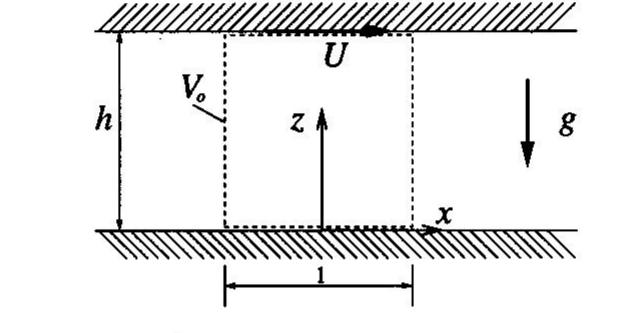
6. Use the fixed control volume $V_o$ indicated in the figure to show that the power employed to move the upper wall is dissipated inside the liquid, generating an excess internal energy that is transfered by heat condution to the walls.

Transcribed as printed: in item 3 the sheet says "pressure distribution" where the temperature distribution $T(z)$ is meant, and "transfered" and "condution" are spelling errors of the sheet.

Gap of thickness h between two horizontal walls, upper wall moving with velocity U, dashed control volume V_o of unit length, axes x, z and gravity g
Swipe sideways to see the whole figure.
Statement figure (crop of NS4.pdf, p. 1): gap of thickness $h$, upper wall moving with $U$, fixed control volume $V_o$ of unit length in $x$, axes $x$, $z$ and gravity $g$
Open the figure full size

Source: NS4.pdf (page 1). Notes.pdf, Chapter 4: continuity Eq. 4.40, momentum Eq. 4.41, energy Eq. 4.42, internal-energy balance Eq. 4.25, total-energy balance Eq. 4.3.

Worked solutionexpand / collapse

Hypotheses, Data and Unknowns

  • Steady planar flow of a perfect liquid (constant $\rho$, $\mu$, $k$, $c$): equations (4.40)-(4.42).
  • Infinite horizontal walls, gravity along $-\bar{e}_z$; no chemical reaction and no radiation ($Q_c = Q_r = 0$).
  • The velocity and temperature depend only on the distance $z$ to the lower wall: $\partial/\partial x = \partial/\partial y = 0$ for them. The pressure may depend on $x$ and $z$ until it is determined.
  • The walls are impermeable. The lower wall ($z = 0$) is at rest at $T_l$; the upper wall ($z = h$) moves with $U\,\bar{e}_x$ at $T_u$ and the pressure on it is $p_u$.
  • Data: $[\rho,\ \mu,\ k,\ c,\ h,\ U,\ T_l,\ T_u,\ p_u,\ g]$. Unknowns: $v_x(z)$, $v_z(z)$, $p(x,z)$, $T(z)$, the flow rate, the wall force and power, the wall heat fluxes.
  • Degrees of freedom: two velocity components, pressure and temperature, each a function of $z$ (the pressure also of $x$).
SymbolMeaningSI unit
$h$gap between the wallsm
$U$velocity of the upper wallm/s
$T_l$, $T_u$temperatures of the lower and upper wallsK
$p_u$pressure on the upper wallPa
$\rho$, $\mu$, $k$, $c$density, viscosity, conductivity, specific heatkg/m$^3$, Pa s, W/(m K), J/(kg K)

Frames, Field Form and Boundary Conditions

  • Cartesian frame $(x,y,z)$: $x$ along the walls in the direction of $U$, $z$ normal to the walls and upward from the lower wall, $y$ out of the plane. The basis is orthonormal and right-handed (no change of basis).
  • Field form: $\bar{v} = v_x(z)\,\bar{e}_x + v_z(z)\,\bar{e}_z$, $T = T(z)$, $p = p(x,z)$.
  • Fixed control volume $V_o$ of the figure: the box $0 < z < h$ of unit length in $x$ and unit width in $y$; its surfaces are the lower wall $\Sigma_l$ ($\bar{n} = -\bar{e}_z$), the upper wall $\Sigma_u$ ($\bar{n} = +\bar{e}_z$) and the two vertical faces $\Sigma_1$ ($\bar{n} = -\bar{e}_x$) and $\Sigma_2$ ($\bar{n} = +\bar{e}_x$).
LocationConditionOrigin
$z = 0$$v_x = 0$, $v_z = 0$, $T = T_l$lower wall at rest, impermeable
$z = h$$v_x = U$, $v_z = 0$, $T = T_u$upper wall moving, impermeable
$z = h$$p = p_u$statement

Step-by-Step Derivation

3.1 Continuity and the normal velocity

$$ \frac{\partial v_x}{\partial x} + \frac{dv_z}{dz} = \underbrace{\cancel{\frac{\partial v_x}{\partial x}}}_{v_x = v_x(z)} + \frac{dv_z}{dz} = 0 \;\Longrightarrow\; v_z = \text{const} \tag{1} $$

The wall is impermeable, $v_z(0) = 0$, so

$$ \boxed{\,v_z(z) = 0\,} \tag{2} $$

3.2 Momentum equations

z-component: with $v_z = 0$ every inertial and viscous term vanishes,

$$ 0 = -\frac{\partial p}{\partial z} - \rho g \;\Longrightarrow\; p + \rho g z = f(x) \tag{3} $$

x-component: the convective terms vanish ($\partial_x = 0$, $v_z = 0$),

$$ \rho\Big(\underbrace{\cancel{\frac{\partial v_x}{\partial t}}}_{\text{steady}} + \underbrace{\cancel{v_x\frac{\partial v_x}{\partial x}}}_{\partial_x = 0} + \underbrace{\cancel{v_z\frac{\partial v_x}{\partial z}}}_{v_z = 0}\Big) = -\frac{\partial p}{\partial x} + \mu\frac{d^2v_x}{dz^2} \;\Longrightarrow\; \mu\frac{d^2v_x}{dz^2} = \frac{\partial p}{\partial x} = f'(x) \tag{4} $$

The left side depends only on $z$ and the right side only on $x$, so both are equal to a constant. The pressure on the upper wall is $p(x,h) = p_u$ for every $x$, and by (3) $f(x) = p_u + \rho g h$ is a constant, so $f'(x) = 0$:

$$ \boxed{\,p(x,z) = p_u + \rho g\,(h - z)\,}, \qquad \frac{\partial p}{\partial x} = 0 \tag{5} $$

Equation (4) becomes $d^2v_x/dz^2 = 0$; integrating twice, $v_x = C_1 + C_2z$. The conditions $v_x(0) = 0$ and $v_x(h) = U$ give $C_1 = 0$ and $C_2 = U/h$:

$$ \boxed{\,v_x(z) = U\,\frac{z}{h}\,} \tag{6} $$

3.3 Volume flux

The flux per unit width in $y$ through a section $x = \text{const}$ is $Q = \int_0^h v_x\,dz$. The antiderivative of $Uz/h$ is $Uz^2/(2h)$ and Barrow's rule gives:

$$ \boxed{\,Q = \left[\frac{U}{h}\frac{z^2}{2}\right]_0^h = \frac{Uh}{2}\,} \tag{7} $$

3.4 Temperature distribution

The energy equation (4.42) with $v_z = 0$, $\partial_x = 0$ and $\phi_v = \mu(dv_x/dz)^2 = \mu U^2/h^2$:

$$ \underbrace{\cancel{\rho c\,v_x\frac{\partial T}{\partial x}}}_{\partial_x = 0} = \phi_v + k\frac{d^2T}{dz^2} \;\Longrightarrow\; \frac{d^2T}{dz^2} = -\frac{\mu U^2}{k\,h^2} \tag{8} $$

Integrating twice, $T = B_1 + B_2z - \dfrac{\mu U^2}{2kh^2}z^2$. The conditions $T(0) = T_l$ and $T(h) = T_u$ give $B_1 = T_l$ and $B_2 = \dfrac{T_u - T_l}{h} + \dfrac{\mu U^2}{2kh}$:

$$ \boxed{\,T(z) = T_l + \left(T_u - T_l\right)\frac{z}{h} + \frac{\mu U^2}{2k}\,\frac{z}{h}\left(1 - \frac{z}{h}\right)\,} \tag{9} $$

3.5 Force on the upper wall and power needed to move it

On the upper wall, the normal pointing into the liquid is $\bar{n} = -\bar{e}_z$, so $(-p\bar{\bar{I}} + \bar{\bar{\tau}}')\cdot\bar{n}$ is the force per unit area that the liquid exerts on the wall. The viscous components are $\tau'_{xz} = \mu\,dv_x/dz = \mu U/h$ and $\tau'_{zz} = 0$ (Notes.pdf, stress components, Cartesian coordinates):

$$ \bar{f}_u = -p_u(-\bar{e}_z) + \bar{\bar{\tau}}'\cdot(-\bar{e}_z) = p_u\,\bar{e}_z - \mu\frac{U}{h}\,\bar{e}_x \tag{10} $$

The viscous part opposes the motion of the wall. The external agent must supply $+\mu U/h\,\bar{e}_x$ per unit area, with the wall velocity $U\bar{e}_x$:

$$ \boxed{\,\bar{f}_u = p_u\,\bar{e}_z - \mu\frac{U}{h}\,\bar{e}_x, \qquad \dot{W} = \mu\frac{U^2}{h}\ \text{per unit area}\,} \tag{11} $$

The pressure force $p_u\bar{e}_z$ is normal to the wall and does no work on it.

3.6 Heat fluxes to the walls

The heat flux from the liquid to a wall is $\bar{q}\cdot\bar{n}$, with $\bar{n}$ pointing out of the liquid and $\bar{q} = -k\nabla T$. From (9),

$$ \frac{dT}{dz} = \frac{T_u - T_l}{h} + \frac{\mu U^2}{2kh} - \frac{\mu U^2}{kh^2}z \tag{12} $$

*Upper wall* ($\bar{n} = +\bar{e}_z$, $z = h$):

$$ q_u = -k\frac{dT}{dz}\Big|_{z=h} = k\frac{T_l - T_u}{h} + \frac{\mu U^2}{2h} \tag{13} $$

*Lower wall* ($\bar{n} = -\bar{e}_z$, $z = 0$):

$$ q_l = +k\frac{dT}{dz}\Big|_{z=0} = k\frac{T_u - T_l}{h} + \frac{\mu U^2}{2h} \tag{14} $$
$$ \boxed{\,q_u = k\frac{T_l - T_u}{h} + \frac{\mu U^2}{2h}, \qquad q_l = k\frac{T_u - T_l}{h} + \frac{\mu U^2}{2h}\,} \tag{15} $$

The conductive contributions are equal and opposite and the viscous heating splits equally between the walls. Their sum is $q_u + q_l = \mu U^2/h$.

3.7 Integral balance in the fixed control volume $V_o$

*Total energy* (Notes.pdf, Eq. 4.3 in integral form for the fixed volume, steady):

$$ \int_{\Sigma_o}\rho\left(e + \frac{\lvert\bar{v}\rvert^2}{2}\right)\bar{v}\cdot\bar{n}\,d\sigma = -\int_{\Sigma_o}p\,\bar{v}\cdot\bar{n}\,d\sigma + \int_{\Sigma_o}\bar{v}\cdot\bar{\bar{\tau}}'\cdot\bar{n}\,d\sigma + \underbrace{\int_{V_o}\rho\bar{g}\cdot\bar{v}\,dV}_{=0} - \int_{\Sigma_o}\bar{q}\cdot\bar{n}\,d\sigma \tag{16} $$

Each term, surface by surface (areas of unit length times unit width):

SurfaceConvective $\int\rho(e + v^2/2)\,\bar{v}\cdot\bar{n}$Pressure work $-\int p\,\bar{v}\cdot\bar{n}$Viscous work $\int\bar{v}\cdot\bar{\bar{\tau}}'\cdot\bar{n}$Heat $-\int\bar{q}\cdot\bar{n}$
$\Sigma_l$ ($z = 0$)$0$ ($\bar{v}\cdot\bar{n} = 0$)$0$$0$ ($\bar{v} = 0$)$-q_l$
$\Sigma_u$ ($z = h$)$0$ ($\bar{v}\cdot\bar{n} = 0$)$0$$U\,\tau'_{xz} = \mu U^2/h$$-q_u$
$\Sigma_1 + \Sigma_2$the two faces cancel ($\bar{v}$, $e$, $p$ do not depend on $x$; opposite normals)cancelcancel$0$ ($T$ independent of $x$)

The mass-force work vanishes because $\bar{g}\cdot\bar{v} = -g\,v_z = 0$. Equation (16) gives

$$ 0 = \mu\frac{U^2}{h} - q_u - q_l \;\Longrightarrow\; \boxed{\,\mu\frac{U^2}{h} = q_u + q_l\,} \tag{17} $$

*Internal energy* (Notes.pdf, Eq. 4.25, steady, $\nabla\cdot\bar{v} = 0$): $0 = -\int_{\Sigma_o}\bar{q}\cdot\bar{n}\,d\sigma + \int_{V_o}\phi_v\,dV$, with $\int_{V_o}\phi_v\,dV = \dfrac{\mu U^2}{h^2}\,h = \dfrac{\mu U^2}{h}$ (area $1$, height $h$), which again gives $q_u + q_l = \mu U^2/h$.

Equations (11), (15) and (17) show the whole chain: the power spent moving the upper wall, $\mu U^2/h$ per unit area, equals the viscous dissipation in the liquid and leaves the volume as the heat conducted to the two walls.

Interpretation, Limits and Dimensional Check

  • Physical meaning. The pressure is hydrostatic and the velocity is linear: viscous forces alone transmit the motion. The dissipation $\phi_v = \mu U^2/h^2$ is uniform, and it heats the liquid; the parabolic term of (9) is the temperature rise it produces, with its maximum in the middle of the gap.
  • Limits. For $U \to 0$ there is no flow and no dissipation: $T$ is the linear conduction profile between $T_l$ and $T_u$ and $q_u = -q_l = k(T_l - T_u)/h$. For $T_u = T_l$, the temperature is symmetric about $z = h/2$ and each wall receives $\mu U^2/(2h)$.
  • Dimensional check. $\mu U/h$: $(\mathrm{Pa\,s})(\mathrm{m/s})/\mathrm{m} = \mathrm{Pa}$. $\mu U^2/h$: $\mathrm{Pa\cdot m/s} = \mathrm{W/m^2}$. In (9), $\mu U^2/(2k)$ has units $(\mathrm{Pa\,s})(\mathrm{m^2/s^2})/[\mathrm{W/(m\,K)}] = \mathrm{K}$.
  • Mean velocity. From (7), $\bar{v} = Q/h = U/2$, half the wall velocity.
Problem NS5

Cylinder Dragging a Liquid Layer

Original statement · NS5.pdf
Annular filmGravity and dragVolume fluxAdiabatic outer surface

Official Problem Statement

The solid cylinder of radius $a$ shown in the figure moves vertically with velocity $U$, dragging in its motion a coaxial cylindrical layer of liquid of constant uniform thickness $h$. The liquid has constant values of its density $\rho$, viscosity $\mu$, thermal conductivity $k$, and specific heat $c$. The air surrounding the liquid has a density $\rho_a \ll \rho$ and viscosity $\mu_a \ll \mu$, so that in the first approximation it moves without significant pressure differences, exerting on the liquid a negligible viscous force. Because of the symmetry of the problem, $\partial/\partial\theta = 0$ and the only nonzero velocity component is $v_z$.

1. Obtain the velocity $v_z(r, z)$ and pressure $p(r, z)$ in the liquid.

2. Compute the force on the cylinder (per unit length).

3. Calculate the volume flux $Q$ dragged by the cylinder, as well as the value of $U$ for which $Q = 0$.

4. Assuming that the thermal conductivity of air is very small compared with that of the liquid and that the cylinder is at constant uniform temperature $T_c$, obtain the temperature distribution in the liquid $T(r)$ as well as the conductive heat flux to the wall.

U 2a h pa pa liquid liquid solid g z r
Swipe sideways to see the whole figure.
Statement figure (redrawn from NS5.pdf, p. 1): solid cylinder of radius $a$ moving upward with $U$, coaxial liquid layer of thickness $h$, surrounding air at pressure $p_a$, gravity $g$ and axes $r$, $z$
Open the figure full size

Source: NS5.pdf (page 1). Notes.pdf, Chapter 4: continuity Eq. 4.40, momentum Eq. 4.41 in cylindrical coordinates, energy Eq. 4.42, stress components in cylindrical coordinates.

Worked solutionexpand / collapse

Hypotheses, Data and Unknowns

  • Steady motion of a perfect liquid (constant $\rho$, $\mu$, $k$, $c$): equations (4.40)-(4.42) in cylindrical coordinates.
  • Axisymmetric ($\partial/\partial\theta = 0$) with $v_r = v_\theta = 0$ (given). Gravity acts along $-\bar{e}_z$, opposite to the motion of the cylinder.
  • The layer has uniform thickness $h$ and is far from its ends: the thickness does not change along $z$ (fully developed). No chemical reaction and no radiation.
  • The air exerts no pressure variation on the liquid and a negligible viscous force: at the free surface $r = a + h$, $p = p_a$ and the shear stress of the liquid is zero.
  • Data: $[\rho,\ \mu,\ k,\ c,\ a,\ h,\ U,\ g,\ p_a,\ T_c]$. Notation: $b = a + h$, $\nu = \mu/\rho$. Unknowns: $v_z(r)$, $p$, the force, $Q$, $U_0$ (the $U$ with $Q = 0$), $T(r)$ and the wall heat flux.
  • Degrees of freedom: one velocity component, the pressure and the temperature, each function of $r$ (and $z$ for the pressure until it is determined).
SymbolMeaningSI unit
$a$, $h$, $b = a + h$cylinder radius, layer thickness, outer radius of the layerm
$U$velocity of the cylinder (upward)m/s
$p_a$air pressurePa
$T_c$cylinder temperatureK
$\rho$, $\mu$, $k$, $c$liquid propertieskg/m$^3$, Pa s, W/(m K), J/(kg K)

Frames, Field Form and Boundary Conditions

  • Cylindrical frame $(r,\theta,z)$ with $z$ along the axis, upward (direction of $U$). The basis $\{\bar{e}_r,\bar{e}_\theta,\bar{e}_z\}$ is orthonormal and right-handed.
  • Field form: $\bar{v} = v_z\,\bar{e}_z$, $p = p(r,z)$, $T = T(r)$. The liquid occupies $a < r < b$.
LocationConditionOrigin
$r = a$$v_z = U$no-slip on the moving cylinder
$r = b$$\tau'_{rz} = \mu\,\partial v_z/\partial r = 0$negligible viscous force of the air
$r = b$$p = p_a$no significant pressure differences in the air
$r = a$$T = T_c$uniform temperature of the cylinder
$r = b$$\partial T/\partial r = 0$conductivity of the air much smaller than $k$: adiabatic free surface

Step-by-Step Derivation

3.1 Continuity

$$ \frac{1}{r}\frac{\partial(rv_r)}{\partial r} + \frac{1}{r}\frac{\partial v_\theta}{\partial\theta} + \frac{\partial v_z}{\partial z} = \underbrace{\cancel{\frac{1}{r}\frac{\partial(rv_r)}{\partial r}}}_{v_r = 0} + \underbrace{\cancel{\frac{1}{r}\frac{\partial v_\theta}{\partial\theta}}}_{v_\theta = 0} + \frac{\partial v_z}{\partial z} = 0 \;\Longrightarrow\; \frac{\partial v_z}{\partial z} = 0 \tag{1} $$

so $v_z = v_z(r)$ (the field does not change along the axis).

3.2 Momentum equations and the pressure

r-component: with $v_r = v_\theta = 0$ and $\partial/\partial\theta = 0$ every term vanishes except the pressure gradient,

$$ 0 = -\frac{\partial p}{\partial r} \;\Longrightarrow\; p = p(z) \tag{2} $$

z-component:

$$ \rho\Big(\underbrace{\cancel{\frac{\partial v_z}{\partial t}}}_{\text{steady}} + \underbrace{\cancel{v_r\frac{\partial v_z}{\partial r}}}_{v_r = 0} + \underbrace{\cancel{\frac{v_\theta}{r}\frac{\partial v_z}{\partial\theta}}}_{v_\theta = 0} + \underbrace{\cancel{v_z\frac{\partial v_z}{\partial z}}}_{\text{by (1)}}\Big) = -\frac{dp}{dz} + \mu\,\frac{1}{r}\frac{d}{dr}\left(r\frac{dv_z}{dr}\right) - \rho g \tag{3} $$

By (2), $p$ depends only on $z$; at $r = b$ it equals $p_a$ for every $z$, therefore

$$ \boxed{\,p(r,z) = p_a\,}, \qquad \frac{dp}{dz} = 0 \tag{4} $$

The liquid is at the pressure of the surrounding air everywhere: the weight of the layer is carried by the viscous stress, not by a pressure gradient. Equation (3) becomes

$$ \frac{1}{r}\frac{d}{dr}\left(r\frac{dv_z}{dr}\right) = \frac{\rho g}{\mu} = \frac{g}{\nu} \tag{5} $$

3.3 Velocity profile

Multiply (5) by $r$ and integrate: $r\,dv_z/dr = \dfrac{g}{2\nu}r^2 + C_1$. Divide by $r$ and integrate again, with $\int dr/r = \ln r$:

$$ v_z = \frac{g}{4\nu}r^2 + C_1\ln r + C_2 \tag{6} $$

The shear-free condition at $r = b$, $dv_z/dr\big|_b = \dfrac{g}{2\nu}b + \dfrac{C_1}{b} = 0$, gives $C_1 = -\dfrac{g}{2\nu}b^2$. The no-slip condition $v_z(a) = U$ gives $C_2 = U - \dfrac{g}{4\nu}a^2 + \dfrac{g}{2\nu}b^2\ln a$. Substituting,

$$ \boxed{\,v_z(r) = U + \frac{g}{2\nu}\left[\frac{r^2 - a^2}{2} - (a + h)^2\ln\frac{r}{a}\right]\,} \tag{7} $$

3.4 Force on the cylinder

The surface of the cylinder is $r = a$; the normal pointing into the liquid is $\bar{n} = +\bar{e}_r$, so $(-p\bar{\bar{I}} + \bar{\bar{\tau}}')\cdot\bar{n}$ is the force per unit area that the liquid exerts on the cylinder. The pressure is uniform ($p = p_a$) and radial, so it integrates to zero around the circumference. The viscous stress is $\tau'_{rz} = \mu\,dv_z/dr$ (Notes.pdf, stress components in cylindrical coordinates). From (7), $dv_z/dr = \dfrac{g}{2\nu}\left(r - \dfrac{b^2}{r}\right)$, so at the wall

$$ \tau'_{rz}\Big|_a = \mu\frac{g}{2\nu}\left(a - \frac{b^2}{a}\right) = -\frac{\rho g\,(b^2 - a^2)}{2a} = -\frac{\rho g\,h\,(2a + h)}{2a} \tag{8} $$

The force per unit length of cylinder (area $2\pi a$):

$$ \boxed{\,\bar{F} = 2\pi a\,\tau'_{rz}\Big|_a\,\bar{e}_z = -\rho g\,\pi\left[(a + h)^2 - a^2\right]\bar{e}_z = -2\pi a\,\rho g\,h\left(1 + \frac{h}{2a}\right)\bar{e}_z\,} \tag{9} $$

The liquid pulls the cylinder downward with a force equal to the weight of the layer per unit length, as the equilibrium of the whole layer requires (the pressure forces on it cancel).

3.5 Volume flux and the velocity for zero flux

$$ Q = \int_a^b v_z\,2\pi r\,dr \tag{10} $$

With $\kappa = g/(2\nu)$, three integrals are needed. The first is elementary, $\int_a^b r\,dr = (b^2 - a^2)/2$. For the second, the antiderivative of $r(r^2 - a^2)/2$ is $r^4/8 - a^2r^2/4$, and Barrow's rule gives $\dfrac{(b^2 - a^2)^2}{8}$. For the third, integration by parts with $u = \ln(r/a)$, $dv = r\,dr$ gives the antiderivative $\dfrac{r^2}{2}\ln\dfrac{r}{a} - \dfrac{r^2}{4}$, so $\displaystyle\int_a^b r\ln\frac{r}{a}\,dr = \frac{b^2}{2}\ln\frac{b}{a} - \frac{b^2 - a^2}{4}$. Then

$$ \frac{Q}{2\pi} = U\frac{b^2 - a^2}{2} + \kappa\left[\frac{(b^2 - a^2)^2}{8} - b^2\left(\frac{b^2}{2}\ln\frac{b}{a} - \frac{b^2 - a^2}{4}\right)\right] $$

and, simplifying $\frac{(b^2 - a^2)^2}{8} + \frac{b^2(b^2 - a^2)}{4} = \frac{(b^2 - a^2)(3b^2 - a^2)}{8}$,

$$ \boxed{\,Q = \pi U\,(b^2 - a^2) + \frac{\pi g}{\nu}\left[\frac{(b^2 - a^2)(3b^2 - a^2)}{8} - \frac{b^4}{2}\ln\frac{b}{a}\right]\,} \tag{11} $$

Setting $Q = 0$ and solving for $U$:

$$ \boxed{\,U_0 = \frac{g}{\nu}\left[\frac{b^4}{2\,(b^2 - a^2)}\ln\frac{b}{a} - \frac{3b^2 - a^2}{8}\right]\,} \tag{12} $$

For $U > U_0$ the cylinder carries a net upward flux; for $U < U_0$ the layer drains downward.

3.6 Temperature distribution and heat flux to the wall

With $v_r = 0$, $\partial T/\partial z = 0$ and the dissipation $\phi_v = \mu\,(dv_z/dr)^2$ (the only non-zero shear is $\tau'_{rz}$), the energy equation (4.42) reduces to

$$ 0 = \phi_v + \frac{k}{r}\frac{d}{dr}\left(r\frac{dT}{dr}\right), \qquad \phi_v = \mu\left[\frac{g}{2\nu}\left(r - \frac{b^2}{r}\right)\right]^2 = \frac{\rho^2g^2}{4\mu}\frac{(r^2 - b^2)^2}{r^2} \tag{13} $$

Let $\Lambda = \rho^2g^2/(4\mu k)$. Multiplying by $r/k$ and expanding $(r^2 - b^2)^2 = r^4 - 2b^2r^2 + b^4$:

$$ \frac{d}{dr}\left(r\frac{dT}{dr}\right) = -\Lambda\left(r^3 - 2b^2r + \frac{b^4}{r}\right) \tag{14} $$

Integrating once, $r\,dT/dr = -\Lambda\left(\dfrac{r^4}{4} - b^2r^2 + b^4\ln r\right) + D_1$. The adiabatic condition $dT/dr\big|_b = 0$ fixes $D_1$ and gives

$$ r\frac{dT}{dr} = -\Lambda\left[\frac{r^4}{4} - b^2r^2 + \frac{3b^4}{4} + b^4\ln\frac{r}{b}\right] \tag{15} $$

Dividing by $r$ and integrating again (the antiderivative of $\ln(r/b)/r$ is $\tfrac{1}{2}\ln^2(r/b)$) with $T(a) = T_c$:

$$ \boxed{\,T(r) = T_c - \frac{\rho^2g^2}{4\mu k}\left[\frac{r^4 - a^4}{16} - \frac{b^2(r^2 - a^2)}{2} + \frac{3b^4}{4}\ln\frac{r}{a} + \frac{b^4}{2}\left(\ln^2\frac{r}{b} - \ln^2\frac{a}{b}\right)\right]\,} \tag{16} $$

*Heat flux to the wall.* The heat flux from the liquid to the cylinder is $\bar{q}\cdot\bar{n}$ with $\bar{n} = -\bar{e}_r$ (out of the liquid): $q_w = k\,dT/dr\big|_a$, and from (15),

$$ \boxed{\,q_w = -\frac{\rho^2g^2}{4\mu}\left[\frac{a^3}{4} - ab^2 + \frac{3b^4}{4a} - \frac{b^4}{a}\ln\frac{b}{a}\right]\,}, \qquad \dot{Q}_w = 2\pi a\,q_w\ \text{per unit length} \tag{17} $$

*Check.* The outer surface is adiabatic, so all the viscous heating generated in the layer must leave through the wall: $\dot{Q}_w = \int_a^b\phi_v\,2\pi r\,dr$. Evaluating both sides numerically for $\rho = 1000$ kg/m$^3$, $\mu = 0.1$ Pa s, $k = 0.6$ W/(m K), $a = 20$ mm, $h = 5$ mm, $U = 0.7$ m/s and $g = 9.81$ m/s$^2$ gives the same value, $6.344$ W/m, to the precision of the integration.

Interpretation, Limits and Dimensional Check

  • Physical meaning. The velocity decreases from $U$ at the wall; the shear stress is largest at the wall and zero at the free surface. The cylinder must support the weight of the layer, which is what (9) says. The pressure plays no role because the free surface is at $p_a$ and the layer is fully developed.
  • Limits. For $h \ll a$ the layer behaves as a flat film: (11) tends to $Q \simeq 2\pi a\left(Uh - gh^3/(3\nu)\right)$ and (12) to $U_0 \simeq gh^2/(3\nu)$. For $h \to 0$ the force and the flux vanish. For $g \to 0$ the profile is uniform, $v_z = U$.
  • Dimensional check. $g/\nu$ has units $(\mathrm{m/s^2})/(\mathrm{m^2/s}) = 1/(\mathrm{m\,s})$; in (7) $(g/\nu)\,r^2$ has units m/s. The force per unit length $\rho g\pi b^2$ has units $(\mathrm{kg/m^3})(\mathrm{m/s^2})\,\mathrm{m^2} = \mathrm{N/m}$. In (16), $\Lambda r^4 = \rho^2g^2r^4/(\mu k)$ has units $(\mathrm{kg^2\,s^{-4}})/(\mathrm{kg^2\,s^{-4}\,K^{-1}}) = \mathrm{K}$, with $\mu k$ in $(\mathrm{kg\,m^{-1}s^{-1}})(\mathrm{kg\,m\,s^{-3}K^{-1}})$.
  • Heat balance. The wall heat flux (17) equals the viscous dissipation of the layer (per unit area of the wall), because no heat leaves through the free surface.
Problem NS6

Sphere with Radial Suction

Original statement · NS6.pdf
Spherical symmetrySuctionTrajectory and timeConvection-conduction

Official Problem Statement

A sphere of radius $a$ is immersed in a liquid of density $\rho$, viscosity $\mu$, thermal conductivity $k$, and specific heat $c$. The liquid is sucked with radial velocity $v_r = -V_o$ through the porous surface of the sphere. For the buoyancy-free, steady sphericosymmetrical motion induced in the surrounding liquid,

1. Obtain the velocity $v_r(r)$

2. Compute the trajectory of a fluid particle initially located at $r = r_i > a$, as well as the time $t_i$ at which the fluid particle is sucked by the sphere.

3. Determine the pressure distribution $p - p_\infty$, where $p_\infty$ is the pressure value far from the sphere.

4. Calculate the temperature distribution in the liquid $T(r)$ assuming that the temperature of the sphere is $T_s$, smaller then the value $T_\infty$ found in the surrounding ambient atmosphere.

5. Obtain the amount of heat transfered to the sphere per unit time.

Transcribed as printed: "sphericosymmetrical", "then" (for "than") and "transfered" are spelling errors of the sheet. The sheet carries no printed figure.

Source: NS6.pdf (page 1). Notes.pdf, Chapter 4: continuity Eq. 4.40, momentum Eq. 4.41 and energy Eq. 4.42 in spherical coordinates, viscous dissipation $\phi_v$ in spherical coordinates.

Worked solutionexpand / collapse

Hypotheses, Data and Unknowns

  • Steady, spherically symmetric flow of a perfect liquid (constant $\rho$, $\mu$, $k$, $c$): $\bar{v} = v_r(r)\,\bar{e}_r$, $v_\theta = v_\phi = 0$, $\partial/\partial\theta = \partial/\partial\phi = \partial/\partial t = 0$.
  • Buoyancy-free: the mass force is neglected. No chemical reaction and no radiation. The temperature depends only on $r$.
  • Suction: the porous sphere takes liquid in at the rate $4\pi a^2V_o$, with $V_o > 0$. Far from the sphere the liquid is at rest at $p_\infty$ and $T_\infty$.
  • Data: $[\rho,\ \mu,\ k,\ c,\ a,\ V_o,\ T_s,\ T_\infty,\ p_\infty,\ r_i]$ with $T_s < T_\infty$. Unknowns: $v_r(r)$, $r(t)$, $t_i$, $p(r)$, $T(r)$ and the heat rate to the sphere.
  • Dimensionless numbers used: the suction Péclet number $\mathrm{Pe} = \rho c a V_o/k$ and the length $\beta = \rho c a^2V_o/k = a\,\mathrm{Pe}$.
SymbolMeaningSI unit
$a$sphere radiusm
$V_o$suction velocity at the sphere surfacem/s
$r_i$, $t_i$initial position of the particle, time to reach the spherem, s
$T_s$, $T_\infty$sphere and ambient temperaturesK
$\mathrm{Pe}$, $\beta$suction Péclet number, length $\beta = a\,\mathrm{Pe}$1, m
$\Delta T_d = 12\mu V_o/(\rho c a)$temperature scale of the viscous heatingK

Frames, Field Form and Boundary Conditions

  • Spherical frame $(r,\theta,\phi)$ centred on the sphere; $\bar{e}_r$ points away from the centre; the liquid occupies $r > a$.
  • Field form: $\bar{v} = v_r(r)\,\bar{e}_r$, $p = p(r)$, $T = T(r)$.
LocationConditionOrigin
$r = a$$v_r = -V_o$suction through the porous surface
$r \to \infty$$p \to p_\infty$statement
$r = a$$T = T_s$temperature of the sphere
$r \to \infty$$T \to T_\infty$ambient temperature

Step-by-Step Derivation

3.1 Continuity and the radial velocity

$$ \frac{1}{r^2}\frac{d(r^2v_r)}{dr} = 0 \;\Longrightarrow\; r^2v_r = \text{const} = -a^2V_o \tag{1} $$

where the constant is fixed with $v_r(a) = -V_o$:

$$ \boxed{\,v_r(r) = -\frac{a^2V_o}{r^2}\,} \tag{2} $$

3.2 Trajectory and suction time

A fluid particle moves with the local velocity: $dr/dt = v_r = -a^2V_o/r^2$. Separating variables, $r^2\,dr = -a^2V_o\,dt$. Integrating from $r_i$ at $t = 0$:

$$ \frac{r^3 - r_i^3}{3} = -a^2V_o\,t \;\Longrightarrow\; \boxed{\,r(t) = \left(r_i^3 - 3a^2V_o\,t\right)^{1/3}\,} \tag{3} $$

The particle is sucked when $r = a$: $a^3 = r_i^3 - 3a^2V_o\,t_i$, so

$$ \boxed{\,t_i = \frac{r_i^3 - a^3}{3\,a^2V_o}\,} \tag{4} $$

3.3 Pressure distribution

In the $r$ component of (4.41) the viscous term $\mu\,\partial\left[r^{-2}\partial(r^2v_r)/\partial r\right]/\partial r$ vanishes because $r^2v_r$ is constant (1): the flow is irrotational. The rest is the steady Euler equation:

$$ \rho\,v_r\frac{dv_r}{dr} = -\frac{dp}{dr} \;\Longrightarrow\; p + \frac{\rho v_r^2}{2} = \text{const} = p_\infty \tag{5} $$

(the constant is evaluated at infinity, where $v_r \to 0$). Substituting (2):

$$ \boxed{\,p - p_\infty = -\frac{\rho\,a^4V_o^2}{2\,r^4}\,} \tag{6} $$

The pressure is below the ambient value, the minimum being at the sphere surface, where the liquid has the highest speed.

3.4 Temperature distribution

With $v_\theta = v_\phi = 0$ the energy equation (4.42) in spherical coordinates is

$$ \rho c\,v_r\frac{dT}{dr} = \phi_v + \frac{k}{r^2}\frac{d}{dr}\left(r^2\frac{dT}{dr}\right) \tag{7} $$

The viscous dissipation is $\phi_v = 2\mu\left[(dv_r/dr)^2 + 2(v_r/r)^2\right]$ with $dv_r/dr = 2a^2V_o/r^3$ and $v_r/r = -a^2V_o/r^3$:

$$ \phi_v = 2\mu\left[\frac{4a^4V_o^2}{r^6} + \frac{2a^4V_o^2}{r^6}\right] = \frac{12\mu\,a^4V_o^2}{r^6} \tag{8} $$

Substituting $v_r$ and $\phi_v$ in (7), dividing by $k$ and multiplying by $r^2$:

$$ \frac{d}{dr}\left(r^2\frac{dT}{dr}\right) + \beta\frac{dT}{dr} = -\frac{\Gamma}{r^4}, \qquad \beta = \frac{\rho c a^2V_o}{k}, \quad \Gamma = \frac{12\mu a^4V_o^2}{k} \tag{9} $$

*Homogeneous solution.* With $y = T'$: $r^2y' + (2r + \beta)y = 0$; the integrating factor is $\exp\int(2/r + \beta/r^2)\,dr = r^2e^{-\beta/r}$, so $y = D\,e^{\beta/r}/r^2$, and since $\int e^{\beta/r}r^{-2}dr = -e^{\beta/r}/\beta$:

$$ T_h = B_2 + B_1\,e^{\beta/r} \tag{10} $$

*Particular solution.* Work with $y = T_p'$ in the first-order form $r^2y' + (2r + \beta)y = -\Gamma/r^4$. The right-hand side is a power of $1/r$, so try a sum of powers, $y = -\Gamma\left(\dfrac{c_4}{r^4} + \dfrac{c_3}{r^3} + \dfrac{c_2}{r^2}\right)$, and match powers one at a time. The three terms of the equation are $r^2y' = \Gamma\left(\dfrac{4c_4}{r^3} + \dfrac{3c_3}{r^2} + \dfrac{2c_2}{r}\right)$, $2ry = -\Gamma\left(\dfrac{2c_4}{r^3} + \dfrac{2c_3}{r^2} + \dfrac{2c_2}{r}\right)$ and $\beta y = -\Gamma\left(\dfrac{\beta c_4}{r^4} + \dfrac{\beta c_3}{r^3} + \dfrac{\beta c_2}{r^2}\right)$. Their sum is $\Gamma\left[-\dfrac{\beta c_4}{r^4} + \dfrac{2c_4 - \beta c_3}{r^3} + \dfrac{c_3 - \beta c_2}{r^2}\right]$, which must equal $-\Gamma/r^4$: $c_4 = 1/\beta$, $c_3 = 2c_4/\beta = 2/\beta^2$ and $c_2 = c_3/\beta = 2/\beta^3$. Hence

$$ y = T_p' = -\Gamma\left(\frac{1}{\beta r^4} + \frac{2}{\beta^2r^3} + \frac{2}{\beta^3r^2}\right) $$

and integrating $y$ with respect to $r$ (the antiderivative of $r^{-n}$ is $-r^{1-n}/(n-1)$):

$$ T_p(r) = \Gamma\left(\frac{1}{3\beta r^3} + \frac{1}{\beta^2r^2} + \frac{2}{\beta^3r}\right) = \Delta T_d\left[\frac{1}{3}\left(\frac{a}{r}\right)^3 + \frac{1}{\mathrm{Pe}}\left(\frac{a}{r}\right)^2 + \frac{2}{\mathrm{Pe}^2}\frac{a}{r}\right] \tag{11} $$

with $\Delta T_d = 12\mu V_o/(\rho c a)$ (use $\Gamma/\beta = 12\mu a^2V_o/(\rho c)$ and $\beta = a\,\mathrm{Pe}$). The general solution is $T = B_2 + B_1e^{\beta/r} + T_p(r)$.

*Boundary conditions.* $T(\infty) = T_\infty$: $e^{\beta/r} \to 1$ and $T_p \to 0$, so $B_2 + B_1 = T_\infty$. $T(a) = T_s$: $B_2 + B_1e^{\mathrm{Pe}} + T_p(a) = T_s$, because $\beta/a = \mathrm{Pe}$. Subtracting,

$$ B_1 = -\frac{T_\infty - T_s + T_p(a)}{e^{\mathrm{Pe}} - 1}, \qquad T_p(a) = \Delta T_d\left(\frac{1}{3} + \frac{1}{\mathrm{Pe}} + \frac{2}{\mathrm{Pe}^2}\right) $$
$$ \boxed{\,T(r) = T_\infty + T_p(r) - \left[T_\infty - T_s + T_p(a)\right]\frac{e^{\mathrm{Pe}\,a/r} - 1}{e^{\mathrm{Pe}} - 1}\,} \tag{12} $$
Discrepancy with the official solution

The handwritten solution gets the particular solution $12\mu V_o/(\rho c\,r)$, as read from the handwriting. Its ODE has the dissipation term as $12\mu V_o^2a^2/(k\,r^2)$, but multiplying $\phi_v/k$ of (8) by $r^2$ gives $12\mu a^4V_o^2/(k\,r^4)$, as in (9). The term $A/r$ cannot satisfy (9), whose right-hand side decays as $r^{-4}$: the check above shows that (11) does. The computed result (12) is kept; with $\Delta T_d \to 0$ (negligible dissipation) it reduces to the sheet's result $T = T_\infty + (T_s - T_\infty)\dfrac{e^{\mathrm{Pe}\,a/r} - 1}{e^{\mathrm{Pe}} - 1}$.

3.5 Heat transferred to the sphere

The heat that flows from the liquid into the sphere per unit time is $4\pi a^2\,\bar{q}\cdot\bar{n}$ with $\bar{n} = -\bar{e}_r$ (outward from the liquid) and $\bar{q} = -k\nabla T$, that is $\dot{Q}_s = 4\pi a^2k\,dT/dr\big|_a$. From (12),

$$ \frac{dT}{dr}\Big|_a = T_p'(a) + \frac{\mathrm{Pe}}{a}\left[T_\infty - T_s + T_p(a)\right]\frac{e^{\mathrm{Pe}}}{e^{\mathrm{Pe}} - 1}, \qquad T_p'(a) = -\frac{\Delta T_d}{a}\left(1 + \frac{2}{\mathrm{Pe}} + \frac{2}{\mathrm{Pe}^2}\right) \tag{13} $$

Using $4\pi a\,k\,\mathrm{Pe} = 4\pi\rho c\,a^2V_o$ and $e^{\mathrm{Pe}}/(e^{\mathrm{Pe}} - 1) = 1/(1 - e^{-\mathrm{Pe}})$:

$$ \boxed{\,\dot{Q}_s = \frac{4\pi\rho c\,a^2V_o\left[T_\infty - T_s + T_p(a)\right]}{1 - e^{-\mathrm{Pe}}} - 4\pi a\,k\,\Delta T_d\left(1 + \frac{2}{\mathrm{Pe}} + \frac{2}{\mathrm{Pe}^2}\right)\,} \tag{14} $$

Interpretation, Limits and Dimensional Check

  • Physical meaning. The suction brings ambient liquid at $T_\infty$ towards the cold sphere, which compresses the thermal layer against the surface: $\beta = a\,\mathrm{Pe}$ is the length over which convection and conduction compete. Unlike the cylinder of NS9, the sphere has a regular solution for blowing too: for $V_o < 0$ the exponent $\mathrm{Pe}\,a/r$ changes sign but $e^{\mathrm{Pe}\,a/r} \to 1$ at infinity, so (12) still holds.
  • Limits. For negligible dissipation ($\Delta T_d \to 0$): $\dot{Q}_s = 4\pi\rho ca^2V_o\,(T_\infty - T_s)/(1 - e^{-\mathrm{Pe}})$. For $\mathrm{Pe} \gg 1$ this is $\dot{m}\,c\,(T_\infty - T_s)$ with $\dot{m} = 4\pi\rho a^2V_o$ the sucked mass flow: the sphere only has to cool the liquid it takes in. For $\mathrm{Pe} \to 0$ it tends to $4\pi a k\,(T_\infty - T_s)$, pure conduction to a sphere in an unbounded medium.
  • Dimensional check. $a^2V_o/r^2$ is a velocity. $\rho v_r^2$ in (6) is a pressure. $\beta = \rho ca^2V_o/k$ has units $(\mathrm{J/(m^3K)})\,\mathrm{m^3/s}/(\mathrm{W/(m\,K)}) = \mathrm{m}$. $\Delta T_d = 12\mu V_o/(\rho ca)$ has units $\mathrm{Pa\,s\cdot m/s}/[(\mathrm{Pa/K})\,\mathrm{m}] = \mathrm{K}$. $\dot{Q}_s$ in (14): $\rho ca^2V_o\,\Delta T$ has units $(\mathrm{Pa/K})\,\mathrm{m^3/s}\cdot\mathrm{K} = \mathrm{W}$.
  • Check of (11). Differentiating the three terms of (11) and substituting in (9) reproduces $-\Gamma/r^4$ term by term, as written in 3.4.
Problem NS7

Liquid Film on an Inclined Plane

Original statement · NS7.pdf
Free-surface filmGravity-driven flowViscous dissipationEnergy balance

Official Problem Statement

Consider the steady planar motion of a liquid of density $\rho$, viscosity $\mu$, thermal conductivity $k$, and specific heat $c$ that flows down over an inclined plane of angle $\alpha$ due to the action of gravity, forming a layer of constant thickness $h$. To solve the problem, use the coordinate system $(x, y)$ indicated in the figure, in which gravity can be expressed as $\bar{g} = g\sin(\alpha)\bar{e}_x - g\cos(\alpha)\bar{e}_y$. To analyze the resulting liquid flow, assume that the velocity components $v_x(y)$ and $v_y(y)$ are a function of the distance to the wall, and that the air surrounding the liquid has a density $\rho_a \ll \rho$ and a viscosity $\mu_a \ll \mu$, such that in the first approximation it moves without significant pressure differences, exerting on the liquid a negligible viscous force.

▪ Using continuity, determine the velocity component $v_y(y)$.

Obtain the pressure field $p(x, y)$ by integration of the $y$ component of the momentum equation, demonstrating in particular that $\partial p/\partial x = 0$.

Compute $v_x(y)$.

Calculate the force per unit surface that the liquid exerts on the wall.

Determine the temperature in the liquid $T(y)$. In the calculation, assume that the thermal conductivity of air is very small compared with that of the liquid ($k_a \ll k$) and that the wall is at constant uniform temperature $T_w$.

Obtain the conductive heat flux from the liquid to the wall $(\bar{q}\cdot\bar{n})_w$, where $\bar{n}$ is appropriately oriented.

To analyze the energy balances emerging in the problem, consider the fixed control volume $V_o$ of unity length indicated in the figure.

▪ Compute the total energy dissipated per unit time inside the control volume $\int_{V_o}\phi_v\,dV$.

▪ Calculate the work per unit time done by gravity $\int_{V_o}\rho\bar{v}\cdot\bar{g}\,dV$.

▪ Use convervation of energy in the control volume to explain why $(\bar{q}\cdot\bar{n})_w = \int_{V_o}\phi_v\,dV = \int_{V_o}\rho\bar{v}\cdot\bar{g}\,dV$.

Transcribed as printed, including the markers of the sheet and the spelling "convervation".

1 Vo h x y pa g α
Swipe sideways to see the whole figure.
Statement figure (redrawn from NS7.pdf, p. 1): layer of thickness $h$ on a plane inclined at $\alpha$, axes $x$ (down the plane) and $y$ (normal to it), gravity $\bar{g} = g\sin\alpha\,\bar{e}_x - g\cos\alpha\,\bar{e}_y$, air at $p_a$ and the fixed control volume $V_o$ of unit length
Open the figure full size

Source: NS7.pdf (page 1). Notes.pdf, Chapter 4: continuity Eq. 4.40, momentum Eq. 4.41, energy Eq. 4.42, internal-energy balance Eq. 4.25, total-energy balance Eq. 4.3.

Worked solutionexpand / collapse

Hypotheses, Data and Unknowns

  • Steady planar flow of a perfect liquid (constant $\rho$, $\mu$, $k$, $c$): equations (4.40)-(4.42).
  • The fields depend only on the distance $y$ to the plane: $\partial/\partial x = 0$ for $v_x$, $v_y$ and $T$. The pressure is determined below.
  • The plane is impermeable and fixed; the liquid layer has uniform thickness $h$; no chemical reaction and no radiation.
  • The air exerts no pressure variation and a negligible viscous force on the liquid, and its thermal conductivity is negligible: at the free surface $y = h$, $p = p_a$, $\tau'_{xy} = 0$ and $\partial T/\partial y = 0$.
  • Data: $[\rho,\ \mu,\ k,\ c,\ h,\ \alpha,\ g,\ p_a,\ T_w]$. Unknowns: $v_y$, $p(x,y)$, $v_x(y)$, the wall force, $T(y)$, the wall heat flux and the three energy integrals.
SymbolMeaningSI unit
$h$layer thicknessm
$\alpha$inclination of the planerad
$g\sin\alpha$, $g\cos\alpha$components of gravity along and normal to the planem/s$^2$
$p_a$, $T_w$air pressure, wall temperaturePa, K
$\rho$, $\mu$, $k$, $c$liquid propertieskg/m$^3$, Pa s, W/(m K), J/(kg K)

Frames, Field Form and Boundary Conditions

  • Cartesian frame $(x,y,z)$ attached to the plane: $x$ down the slope, $y$ normal to the plane and into the liquid, $z$ out of the plane; the basis is orthonormal and right-handed. Gravity has the components $g_x = g\sin\alpha$, $g_y = -g\cos\alpha$. The frame is rotated by $\alpha$ with respect to the horizontal-vertical frame; the rotation matrix between them is orthogonal with determinant $1$, since $\bar{e}_x = (\cos\alpha, -\sin\alpha)$ and $\bar{e}_y = (\sin\alpha, \cos\alpha)$ in horizontal-vertical components.
  • Field form: $\bar{v} = v_x(y)\,\bar{e}_x + v_y(y)\,\bar{e}_y$, $T = T(y)$, $p = p(x,y)$.
  • Fixed control volume $V_o$ of the figure: $0 < y < h$, unit length in $x$ and unit width; surfaces: the wall $\Sigma_w$ ($\bar{n} = -\bar{e}_y$), the free surface $\Sigma_s$ ($\bar{n} = +\bar{e}_y$) and the two faces normal to $x$.
LocationConditionOrigin
$y = 0$$v_x = 0$, $v_y = 0$, $T = T_w$fixed impermeable wall at $T_w$
$y = h$$p = p_a$no pressure variations in the air
$y = h$$\tau'_{xy} = \mu\,dv_x/dy = 0$negligible viscous force of the air
$y = h$$dT/dy = 0$$k_a \ll k$: adiabatic free surface

Step-by-Step Derivation

3.1 Continuity

$$ \frac{\partial v_x}{\partial x} + \frac{dv_y}{dy} = \underbrace{\cancel{\frac{\partial v_x}{\partial x}}}_{v_x = v_x(y)} + \frac{dv_y}{dy} = 0 \;\Longrightarrow\; v_y = \text{const} \tag{1} $$

The wall is impermeable, $v_y(0) = 0$, so

$$ \boxed{\,v_y(y) = 0\,} \tag{2} $$

3.2 y-momentum and the pressure field

With $v_y = 0$ and $\partial_x = 0$ for the velocity, the inertial and viscous terms of the $y$ component vanish:

$$ 0 = -\frac{\partial p}{\partial y} - \rho g\cos\alpha \;\Longrightarrow\; p = -\rho g\cos\alpha\,y + f(x) \tag{3} $$

The free-surface condition $p(x,h) = p_a$ for every $x$ gives $f(x) = p_a + \rho g h\cos\alpha$, a constant:

$$ \boxed{\,p(x,y) = p_a + \rho g\cos\alpha\,(h - y)\,}, \qquad \frac{\partial p}{\partial x} = 0 \tag{4} $$

3.3 x-momentum and the velocity profile

$$ \rho\Big(\underbrace{\cancel{v_x\frac{\partial v_x}{\partial x}}}_{\partial_x = 0} + \underbrace{\cancel{v_y\frac{\partial v_x}{\partial y}}}_{v_y = 0}\Big) = -\underbrace{\frac{\partial p}{\partial x}}_{=0} + \mu\frac{d^2v_x}{dy^2} + \rho g\sin\alpha \;\Longrightarrow\; \frac{d^2v_x}{dy^2} = -\frac{\rho g\sin\alpha}{\mu} \tag{5} $$

Integrating twice, $v_x = -\dfrac{\rho g\sin\alpha}{2\mu}y^2 + C_1y + C_2$. The wall condition $v_x(0) = 0$ gives $C_2 = 0$. The free-surface condition $dv_x/dy\big|_h = -\dfrac{\rho g\sin\alpha}{\mu}h + C_1 = 0$ gives $C_1 = \dfrac{\rho g\sin\alpha}{\mu}h$:

$$ \boxed{\,v_x(y) = \frac{\rho g\sin\alpha}{\mu}\left(hy - \frac{y^2}{2}\right) = \frac{gh^2\sin\alpha}{\nu}\left[\frac{y}{h} - \frac{1}{2}\left(\frac{y}{h}\right)^2\right]\,} \tag{6} $$

3.4 Force per unit surface on the wall

The normal pointing into the liquid is $\bar{n} = +\bar{e}_y$, so $(-p\bar{\bar{I}} + \bar{\bar{\tau}}')\cdot\bar{n}$ is the force per unit area that the liquid exerts on the wall. At $y = 0$, $p = p_a + \rho gh\cos\alpha$ from (4), $\tau'_{xy} = \mu\,dv_x/dy\big|_0 = \rho gh\sin\alpha$ and $\tau'_{yy} = 0$:

$$ \boxed{\,\bar{f}_w = -\left(p_a + \rho gh\cos\alpha\right)\bar{e}_y + \rho gh\sin\alpha\,\bar{e}_x\,} \tag{7} $$

The normal component pushes on the wall with the air pressure plus the hydrostatic pressure of the layer; the tangential component is the shear that drags the wall down the slope.

3.5 Temperature distribution

With $v_y = 0$ and $\partial_x = 0$ the energy equation (4.42) reduces to $0 = \phi_v + k\,d^2T/dy^2$, with $\phi_v = \mu\,(dv_x/dy)^2$ and, from (6), $dv_x/dy = (\rho g\sin\alpha/\mu)(h - y)$:

$$ \phi_v = \frac{(\rho g\sin\alpha)^2}{\mu}(h - y)^2, \qquad \frac{d^2T}{dy^2} = -\frac{(\rho g\sin\alpha)^2}{\mu k}(h - y)^2 \tag{8} $$

Integrate once: the antiderivative of $(h - y)^2$ is $-(h - y)^3/3$, so $dT/dy = \dfrac{(\rho g\sin\alpha)^2}{3\mu k}(h - y)^3 + B_1$. The adiabatic condition $dT/dy\big|_h = 0$ gives $B_1 = 0$. Integrating again, $T = -\dfrac{(\rho g\sin\alpha)^2}{12\mu k}(h - y)^4 + B_2$, and $T(0) = T_w$ gives $B_2 = T_w + \dfrac{(\rho g\sin\alpha)^2h^4}{12\mu k}$:

$$ \boxed{\,T(y) = T_w + \frac{(\rho g\sin\alpha)^2}{12\,\mu k}\left[h^4 - (h - y)^4\right]\,} \tag{9} $$

Expanding, $h^4 - (h - y)^4 = y\left(4h^3 - 6h^2y + 4hy^2 - y^3\right)$.

3.6 Heat flux to the wall

The heat flux from the liquid to the wall is $\bar{q}\cdot\bar{n}$ with $\bar{n} = -\bar{e}_y$ (out of the liquid) and $\bar{q} = -k\nabla T$:

$$ (\bar{q}\cdot\bar{n})_w = k\frac{dT}{dy}\Big|_{y=0} = k\,\frac{(\rho g\sin\alpha)^2h^3}{3\mu k} = \boxed{\,\frac{(\rho g\sin\alpha)^2h^3}{3\mu}\,} \tag{10} $$

3.7 Energy balances in the fixed control volume $V_o$

*Total viscous dissipation.* The volume $V_o$ has unit length and width and height $h$, so $dV = dy$:

$$ \int_{V_o}\phi_v\,dV = \int_0^h\frac{(\rho g\sin\alpha)^2}{\mu}(h - y)^2\,dy = \frac{(\rho g\sin\alpha)^2}{\mu}\left[-\frac{(h - y)^3}{3}\right]_0^h = \frac{(\rho g\sin\alpha)^2h^3}{3\mu} \tag{11} $$

*Work of gravity.* $\bar{v}\cdot\bar{g} = v_xg\sin\alpha$ since $v_y = 0$. The antiderivative of $hy - y^2/2$ is $hy^2/2 - y^3/6$ and Barrow's rule gives $h^3/2 - h^3/6 = h^3/3$:

$$ \int_{V_o}\rho\bar{v}\cdot\bar{g}\,dV = \rho g\sin\alpha\int_0^hv_x\,dy = \frac{\rho^2g^2\sin^2\alpha}{\mu}\left[\frac{hy^2}{2} - \frac{y^3}{6}\right]_0^h = \frac{(\rho g\sin\alpha)^2h^3}{3\mu} \tag{12} $$

*Conservation of energy.* In the steady total-energy balance of $V_o$ (Notes.pdf, Eq. 4.3 for a fixed volume), each surface contributes as follows:

SurfaceConvective fluxPressure workViscous workHeat
Wall $\Sigma_w$$0$ ($\bar{v}\cdot\bar{n} = 0$)$0$$0$ ($\bar{v} = 0$)$-(\bar{q}\cdot\bar{n})_w$
Free surface $\Sigma_s$$0$ ($v_y = 0$)$0$ ($v_y = 0$)$0$ ($\bar{\bar{\tau}}'\cdot\bar{n} = 0$)$0$ (adiabatic)
Faces normal to $x$cancel (profiles independent of $x$)cancelcancel$0$

The only remaining term besides the heat flux is the work of the mass force, so $0 = \int_{V_o}\rho\bar{g}\cdot\bar{v}\,dV - (\bar{q}\cdot\bar{n})_w$. The internal-energy balance (Notes.pdf, Eq. 4.25), $0 = \int_{V_o}\phi_v\,dV - (\bar{q}\cdot\bar{n})_w$ with no compression work, gives the second equality:

$$ \boxed{\,(\bar{q}\cdot\bar{n})_w = \int_{V_o}\phi_v\,dV = \int_{V_o}\rho\bar{v}\cdot\bar{g}\,dV = \frac{(\rho g\sin\alpha)^2h^3}{3\mu}\,} \tag{13} $$

Equations (10), (11) and (12) confirm it. The work of gravity on the liquid is entirely dissipated by viscosity and leaves through the wall as heat; the kinetic energy of the liquid in $V_o$ does not change.

Interpretation, Limits and Dimensional Check

  • Physical meaning. The profile (6) is half a parabola: the weight component along the slope is balanced by the shear on the wall, $\tau_w = \rho gh\sin\alpha$, and the pressure is hydrostatic with the normal component of gravity. The wall carries the weight component normal to the plane as pressure.
  • Limits. For $\alpha = 0$ the plane is horizontal and nothing drives the flow: $v_x = 0$, no dissipation, no heat flux. For $\alpha = 90^\circ$ (vertical wall) the pressure is uniform and equal to $p_a$ and the shear equals the weight of the layer per unit area. The mean velocity is $\bar{v} = gh^2\sin\alpha/(3\nu)$ (flux $Q = \int_0^hv_x\,dy = gh^3\sin\alpha/(3\nu)$).
  • Dimensional check. $gh^2/\nu$ has units $(\mathrm{m/s^2})\,\mathrm{m^2}/(\mathrm{m^2/s}) = \mathrm{m/s}$. $\rho gh\sin\alpha$ is a pressure. $(\rho g)^2h^3/\mu$ has units $(\mathrm{N/m^3})^2\,\mathrm{m^3}/(\mathrm{Pa\,s}) = \mathrm{N^2\,m^{-3}}/(\mathrm{N\,m^{-2}\,s}) = \mathrm{N/(m\,s)} = \mathrm{W/m^2}$. In (9), $(\rho g)^2h^4/(\mu k)$ has units $\mathrm{K}$.
  • Frame check. With $\bar{e}_X$ horizontal (towards the descending side) and $\bar{e}_Z$ vertical upward, $\bar{e}_x = \cos\alpha\,\bar{e}_X - \sin\alpha\,\bar{e}_Z$ and $\bar{e}_y = \sin\alpha\,\bar{e}_X + \cos\alpha\,\bar{e}_Z$. The matrix of components has $\det R = \cos^2\alpha + \sin^2\alpha = 1$ and $R\,R^T = I$. Then $\bar{g}\cdot\bar{e}_x = (-g\,\bar{e}_Z)\cdot\bar{e}_x = g\sin\alpha$ and $\bar{g}\cdot\bar{e}_y = -g\cos\alpha$, the components given in the statement.
Problem NS8

Porous Cylinder Moving Axially with Suction

Original statement · NS8.pdf
Axisymmetric flowPower-law profileSuction Reynolds numberPrandtl number

Official Problem Statement

An infinitely long porous cylinder of radius $R$ is surrounded by a liquid of density $\rho$, viscosity $\mu$, specific heat $c$, and thermal conductivity $k$. The cylinder moves axially with velocity $v_z = U$ and entrains liquid through its surface pores with a suction velocity $v_r = -V$, inducing (for $r > R$) an axisymmetric velocity field with components $v_r(r)$, $v_z(r)$ and $v_\theta = 0$. At large radial distances $r \gg R$ from the cylinder the liquid is at rest with uniform pressure $p_\infty$. Assume in the following analysis that the effect of gravity on the fluid motion can be neglected.

1. Use the continuity equation to determine the radial velocity component $v_r(r)$ for $R \leq r < \infty$.

2. From the radial component of the momentum equation compute the pressure distribution, demonstrating in particular that $\partial p/\partial z = 0$.

3. Determine the axial velocity distribution $v_z(r)$ as a function of the suction Reynolds number $\mathrm{Re} = \rho VR/\mu$ (to solve the problem, assume that the two independent solutions of the resulting linear ODE are of the form $v_z \propto r^\alpha$, obtaining the two values of $\alpha$ that are compatible with the equation).

4. Obtain the force acting on the cylinder (per unit length).

5. Calculate the trajectory of the fluid particle located initially at $r = r_o$ and $z = 0$.

6. Compute the temperature field $T(r)$ when the cylinder temperature $T_c$ is different from that of the surrounding atmosphere $T_\infty > T_c$. Neglect viscous dissipation and express the result with use made of the Prandtl number $\mathrm{Pr} = \mu c/k$.

7. Determine the heat transfered to the cylinder per unit time (per unit length).

Transcribed as printed (exam of Dec 16, 2011). On the sheet, the word "the" after "entrains" is struck out, "for $r > R$" is added by hand before "an axisymmetric", and in item 6 the words "$T(r)$" and the sentence "Neglect viscous dissipation and express the result with use made of the Prandtl number $\mathrm{Pr} = \mu c/k$" are handwritten additions. "transfered" is a spelling error of the sheet.

U Tc V p∞ T∞ r z
Swipe sideways to see the whole figure.
Statement figure (redrawn from NS8.pdf, p. 1): porous cylinder of radius $R$ at temperature $T_c$ moving with $U$ along $z$, suction velocity $V$ through its surface, ambient $p_\infty$, $T_\infty$ and axes $r$, $z$
Open the figure full size

Source: NS8.pdf (page 1). Notes.pdf, Chapter 4: continuity Eq. 4.40, momentum Eq. 4.41 and energy Eq. 4.42 in cylindrical coordinates, stress components in cylindrical coordinates.

Worked solutionexpand / collapse

Hypotheses, Data and Unknowns

  • Steady, axisymmetric flow of a perfect liquid (constant $\rho$, $\mu$, $k$, $c$) around an infinitely long cylinder: the fields depend only on $r$, $\partial/\partial\theta = \partial/\partial z = \partial/\partial t = 0$, with $v_\theta = 0$. Gravity is neglected; no chemical reaction and no radiation; viscous dissipation is neglected in the temperature equation (item 6).
  • The cylinder surface is porous: it entrains liquid with $v_r(R) = -V$, $V > 0$, and moves axially with velocity $U$.
  • Far from the cylinder the liquid is at rest at $p_\infty$ and $T_\infty$.
  • Data: $[\rho,\ \mu,\ c,\ k,\ R,\ U,\ V,\ p_\infty,\ T_c,\ T_\infty,\ r_o]$ with $T_\infty > T_c$. Unknowns: $v_r(r)$, $p(r)$, $v_z(r)$, the force, the particle trajectory, $T(r)$ and the heat rate.
  • Dimensionless numbers: the suction Reynolds number $\mathrm{Re} = \rho VR/\mu$ and the Prandtl number $\mathrm{Pr} = \mu c/k$.
SymbolMeaningSI unit
$R$cylinder radiusm
$U$axial velocity of the cylinderm/s
$V$suction velocitym/s
$\mathrm{Re}$, $\mathrm{Pr}$suction Reynolds number, Prandtl number1
$T_c$, $T_\infty$cylinder and ambient temperaturesK
$r_o$initial radius of the fluid particlem

Frames, Field Form and Boundary Conditions

  • Cylindrical frame $(r,\theta,z)$ with $z$ along the axis in the direction of $U$; the basis $\{\bar{e}_r,\bar{e}_\theta,\bar{e}_z\}$ is orthonormal and right-handed. The liquid occupies $r > R$.
  • Field form: $\bar{v} = v_r(r)\,\bar{e}_r + v_z(r)\,\bar{e}_z$, $p = p(r)$, $T = T(r)$.
LocationConditionOrigin
$r = R$$v_r = -V$suction through the porous surface
$r = R$$v_z = U$liquid in contact with the surface moves with the cylinder (no-slip)
$r \to \infty$$v_z \to 0$, $p \to p_\infty$, $T \to T_\infty$liquid at rest far away
$r = R$$T = T_c$uniform temperature of the cylinder

Step-by-Step Derivation

3.1 Continuity and the radial velocity

$$ \frac{1}{r}\frac{d(rv_r)}{dr} + \underbrace{\cancel{\frac{1}{r}\frac{\partial v_\theta}{\partial\theta}}}_{v_\theta = 0} + \underbrace{\cancel{\frac{\partial v_z}{\partial z}}}_{\partial_z = 0} = 0 \;\Longrightarrow\; r\,v_r = \text{const} = -RV \tag{1} $$

where the constant is fixed with $v_r(R) = -V$:

$$ \boxed{\,v_r(r) = -\frac{RV}{r}\,} \tag{2} $$

3.2 Radial momentum and the pressure

The viscous term of the $r$ component, $\mu\,\partial\left[r^{-1}\partial(rv_r)/\partial r\right]/\partial r$, is zero because $rv_r$ is constant (1); the terms in $v_\theta$ vanish. What is left is

$$ \rho\,v_r\frac{dv_r}{dr} = -\frac{dp}{dr} \;\Longrightarrow\; p + \frac{\rho v_r^2}{2} = \text{const} = p_\infty \tag{3} $$

(the constant is evaluated at infinity, where $v_r \to 0$):

$$ \boxed{\,p(r) = p_\infty - \frac{\rho R^2V^2}{2\,r^2}\,}, \qquad \frac{\partial p}{\partial z} = 0 \tag{4} $$

The pressure depends only on $r$, hence $\partial p/\partial z = 0$.

3.3 Axial momentum and the velocity profile

The $z$ component of (4.41) with $\partial/\partial z = 0$, $v_\theta = 0$, no gravity and $\partial p/\partial z = 0$:

$$ \rho\,v_r\frac{dv_z}{dr} = \mu\,\frac{1}{r}\frac{d}{dr}\left(r\frac{dv_z}{dr}\right) \tag{5} $$

Substituting $v_r = -RV/r$ and multiplying by $r/\mu$:

$$ -\frac{\rho RV}{\mu}\frac{dv_z}{dr} = \frac{d}{dr}\left(r\frac{dv_z}{dr}\right) \;\Longrightarrow\; \frac{d}{dr}\left(r\frac{dv_z}{dr}\right) + \mathrm{Re}\,\frac{dv_z}{dr} = 0 \tag{6} $$

Following the hint of the statement, try $v_z = r^\alpha$: then $r\,dv_z/dr = \alpha r^\alpha$, $\dfrac{d}{dr}(r\,dv_z/dr) = \alpha^2r^{\alpha-1}$ and $\mathrm{Re}\,dv_z/dr = \mathrm{Re}\,\alpha\,r^{\alpha-1}$. Substituting in (6) and dividing by $r^{\alpha-1}$:

$$ \alpha^2 + \mathrm{Re}\,\alpha = 0 \;\Longrightarrow\; \alpha = 0 \quad\text{or}\quad \alpha = -\mathrm{Re} \tag{7} $$

The two independent solutions are $r^0 = 1$ and $r^{-\mathrm{Re}}$, so $v_z = C_1 + C_2\,r^{-\mathrm{Re}}$. The condition $v_z \to 0$ for $r \to \infty$ requires $C_1 = 0$ (since $r^{-\mathrm{Re}} \to 0$ for $\mathrm{Re} > 0$), and $v_z(R) = U$ gives $C_2 = UR^{\mathrm{Re}}$:

$$ \boxed{\,v_z(r) = U\left(\frac{R}{r}\right)^{\mathrm{Re}}\,} \tag{8} $$

3.4 Force on the cylinder

The normal pointing into the liquid is $\bar{n} = +\bar{e}_r$, so $(-p\bar{\bar{I}} + \bar{\bar{\tau}}')\cdot\bar{n}$ is the force per unit area that the liquid exerts on the cylinder. The pressure and $\tau'_{rr}$ act radially and integrate to zero around the circumference. The axial component is $\tau'_{rz} = \mu\left(\partial v_z/\partial r + \partial v_r/\partial z\right) = \mu\,dv_z/dr$. From (8), $dv_z/dr = -\mathrm{Re}\,U R^{\mathrm{Re}}r^{-\mathrm{Re}-1}$, so at $r = R$:

$$ \tau'_{rz}\Big|_R = -\mu\,\mathrm{Re}\,\frac{U}{R} = -\rho\,V\,U \tag{9} $$

The force per unit length (area $2\pi R$):

$$ \boxed{\,\bar{F} = 2\pi R\,\tau'_{rz}\Big|_R\,\bar{e}_z = -2\pi R\,\rho\,V\,U\,\bar{e}_z\,} \tag{10} $$

The liquid pulls the cylinder back, with the magnitude of the mass flow rate sucked in per unit length, $\dot{m} = 2\pi R\rho V$, times $U$: the cylinder must supply to the entrained liquid the axial momentum $U$ per unit mass, which is zero far away.

3.5 Trajectory of a fluid particle

The particle moves with the local velocity: $dr/dt = v_r = -RV/r$ and $dz/dt = v_z$. For the radial motion, separating variables, $r\,dr = -RV\,dt$ and integrating from $r_o$ at $t = 0$:

$$ \frac{r^2 - r_o^2}{2} = -RV\,t \;\Longrightarrow\; r(t) = \sqrt{r_o^2 - 2RV\,t}, \qquad t_s = \frac{r_o^2 - R^2}{2RV} \tag{11} $$

where $t_s$ is the time at which the particle reaches the surface ($r = R$). The axial coordinate follows from $dz/dr = v_z/v_r$:

$$ \frac{dz}{dr} = -\frac{U}{RV}\left(\frac{R}{r}\right)^{\mathrm{Re}}r = -\frac{UR^{\mathrm{Re}-1}}{V}\,r^{1-\mathrm{Re}} \tag{12} $$

Integrating from $r_o$ (where $z = 0$) to $r$ with $\int r^{1-\mathrm{Re}}dr = r^{2-\mathrm{Re}}/(2 - \mathrm{Re})$ for $\mathrm{Re} \neq 2$ and Barrow's rule:

$$ \boxed{\,z = \frac{UR}{V\,(2 - \mathrm{Re})}\left[\left(\frac{r_o}{R}\right)^{2-\mathrm{Re}} - \left(\frac{r}{R}\right)^{2-\mathrm{Re}}\right]\,} \qquad (\mathrm{Re} \neq 2) \tag{13} $$

and, for $\mathrm{Re} = 2$, the integral of $1/r$ gives $z = (UR/V)\ln(r_o/r)$. The particle moves towards the cylinder and is carried along $z$ by the entrained flow; the total axial distance travelled until it reaches the surface is (13) with $r = R$.

3.6 Temperature field

Neglecting the viscous dissipation, the energy equation (4.42) reads

$$ \rho c\,v_r\frac{dT}{dr} = k\,\frac{1}{r}\frac{d}{dr}\left(r\frac{dT}{dr}\right) \;\Longrightarrow\; -\rho c\frac{RV}{r}\frac{dT}{dr} = \frac{k}{r}\frac{d}{dr}\left(r\frac{dT}{dr}\right) \tag{14} $$

Multiplying by $r/k$ and using $\rho cRV/k = \dfrac{\rho VR}{\mu}\dfrac{\mu c}{k} = \mathrm{Pr}\,\mathrm{Re}$:

$$ \frac{d}{dr}\left(r\frac{dT}{dr}\right) + \mathrm{Pr}\,\mathrm{Re}\,\frac{dT}{dr} = 0 \tag{15} $$

This is the same ODE as (6) with $\mathrm{Re}$ replaced by $\mathrm{Pr}\,\mathrm{Re}$, so $T = B_1 + B_2\,r^{-\mathrm{Pr}\,\mathrm{Re}}$. The conditions $T(\infty) = T_\infty$ and $T(R) = T_c$ give $B_1 = T_\infty$ and $B_2 = (T_c - T_\infty)R^{\mathrm{Pr}\,\mathrm{Re}}$:

$$ \boxed{\,\frac{T - T_\infty}{T_c - T_\infty} = \left(\frac{R}{r}\right)^{\mathrm{Pr}\,\mathrm{Re}}\,} \tag{16} $$

3.7 Heat transferred to the cylinder

The heat flux from the liquid to the cylinder is $\bar{q}\cdot\bar{n}$ with $\bar{n} = -\bar{e}_r$ (out of the liquid): $q_c = k\,dT/dr\big|_R$. From (16), $dT/dr\big|_R = -\mathrm{Pr}\,\mathrm{Re}\,(T_c - T_\infty)/R = \mathrm{Pr}\,\mathrm{Re}\,(T_\infty - T_c)/R$. With $k\,\mathrm{Pr}\,\mathrm{Re}/R = \rho cV$ and the area $2\pi R$ per unit length:

$$ \boxed{\,\dot{Q} = 2\pi R\,\rho\,c\,V\,(T_\infty - T_c)\,} \tag{17} $$

Interpretation, Limits and Dimensional Check

  • Physical meaning. The suction squeezes the momentum and thermal layers against the cylinder: the velocity decays as $r^{-\mathrm{Re}}$ and the temperature excess as $r^{-\mathrm{Pr}\,\mathrm{Re}}$, with the scales $R/\mathrm{Re}$ and $R/(\mathrm{Pr}\,\mathrm{Re})$ close to the wall for $\mathrm{Re} \gg 1$. The thermal layer is thinner than the viscous one when $\mathrm{Pr} > 1$.
  • Limits. For $V \to 0$ ($\mathrm{Re} \to 0$) the exponent vanishes and (8) tends to the uniform velocity $U$, which does not decay at infinity: a steady solution that vanishes far away needs the suction. For $U = 0$ there is no axial motion, the force vanishes and (17) remains: the heat is carried by the entrained liquid.
  • Dimensional check. $\mathrm{Re} = \rho VR/\mu$ is dimensionless: $(\mathrm{kg/m^3})(\mathrm{m/s})\,\mathrm{m}/(\mathrm{Pa\,s}) = 1$. $\rho VU$ in (9) has units $\mathrm{kg/(m^2\,s)}\cdot\mathrm{m/s} = \mathrm{N/m^2}$, and the force per unit length (10) has units N/m. In (17), $\rho cV\,\Delta T$ is W/m$^2$, times $2\pi R$: W/m.
  • Momentum check. On a cylindrical surface of any radius $r$ the axial momentum flux is $2\pi r\,\rho v_rv_z = -2\pi\rho RV\,v_z(r)$ and the viscous force is $2\pi r\,\mu\,dv_z/dr = -2\pi\mu\,\mathrm{Re}\,v_z(r) = -2\pi\rho RV\,v_z(r)$, using $r\,dv_z/dr = -\mathrm{Re}\,v_z$ from (8): the two are equal at every $r$, and at $r = R$ the viscous force is (10).
Problem NS9

Porous Cylinder Quiz with Viscous Heating

Original statement · NS9.pdf
Axisymmetric flowSuction Reynolds numberViscous heatingBlowing: no steady solution

Official Problem Statement

Consider the steady buoyancy-free motion of a perfect liquid of density $\rho$, viscosity $\mu$, thermal conductivity $k$, and specific heat $c$, induced by an infinitely long porous cylinder of radius $R$ that moves with a constant velocity $U_w$ parallel to its axis, while a constant flow rate $q = 2\pi RV_w$ per unit length is uniformly sucked in the radial direction through the porous wall of the cylinder. Far from the cylinder, $r \to \infty$, the fluid is at rest, at pressure $p_\infty$ and temperature $T_\infty$.

To solve the problem, use a cylindrical coordinate system $(r, \theta, z)$, where $z$ is the axis of the cylinder, and assume that the velocity field is axisymmetric, $\partial\bar{v}/\partial\theta = 0$, as well as fully developed, $\partial\bar{v}/\partial z = 0$, thus $\bar{v} = v_r(r)\bar{e}_r + v_z(r)\bar{e}_z$.

1. Using continuity, determine the velocity component $v_r(r)$. (1 point)

2. Obtain the pressure field $p(r, z)$ by integration of the $r$-momentum equation, demonstrating in particular that $\partial p/\partial z = 0$. (2 points)

3. Using the $z$-momentum equation, obtain the axial velocity distribution, $v_z(r)$. (2 points)

4. Compute the trajectory of a particle initially placed at $r = R_i > R$ and $z = z_i$, as well as the corresponding sucking time, $t_s$. (1 point)

5. Calculate the force per unit length that the liquid exerts on the cylinder. (1 point)

6. Write the differential equation that determines the temperature in the liquid $T(r)$. Obtain the function $T(r)$, assuming that the wall is at constant uniform temperature $T_w$. (2 points)

7. Obtain the conductive heat flux per unit length from the liquid to the wall $q_w$. (1 point)

8. Show that there is no steady solution if fluid is blown through the wall, instead of being sucked. (1 extra point)

The sheet is headed "INTRODUCTION TO FLUID MECHANICS, QUIZ # 2 (Nov 26, 2012)" and carries no figure.

Source: NS9.pdf (page 1). Notes.pdf, Chapter 4: continuity Eq. 4.40, momentum Eq. 4.41 and energy Eq. 4.42 in cylindrical coordinates, viscous dissipation $\phi_v$ and stress components in cylindrical coordinates.

Worked solutionexpand / collapse

Hypotheses, Data and Unknowns

  • Steady, buoyancy-free flow of a perfect liquid (constant $\rho$, $\mu$, $k$, $c$) around an infinitely long cylinder: the fields depend only on $r$ ($\partial/\partial\theta = \partial/\partial z = \partial/\partial t = 0$) and $v_\theta = 0$. No chemical reaction and no radiation.
  • The wall is porous: it sucks in the volume flow $q = 2\pi RV_w$ per unit length, uniformly, so $v_r(R) = -V_w$ with $V_w > 0$, and it moves axially with $U_w$.
  • Far from the cylinder the liquid is at rest at $p_\infty$ and $T_\infty$.
  • Data: $[\rho,\ \mu,\ k,\ c,\ R,\ U_w,\ V_w,\ p_\infty,\ T_\infty,\ T_w,\ R_i,\ z_i]$. Unknowns: $v_r$, $p$, $v_z$, the trajectory and $t_s$, the force, $T(r)$ and $q_w$.
  • Dimensionless numbers: the suction Reynolds number $\mathrm{Re} = \rho V_wR/\mu = \rho q/(2\pi\mu)$, the Prandtl number $\mathrm{Pr} = \mu c/k$ and the product $\Pi = \mathrm{Pr}\,\mathrm{Re} = \rho cV_wR/k$.
SymbolMeaningSI unit
$R$cylinder radiusm
$U_w$, $V_w$axial velocity of the cylinder, suction velocitym/s
$q = 2\pi RV_w$suction flow rate per unit lengthm$^2$/s
$\mathrm{Re}$, $\mathrm{Pr}$, $\Pi$suction Reynolds number, Prandtl number, their product1
$T_w$, $T_\infty$wall and ambient temperaturesK
$R_i$, $z_i$initial radial and axial position of the particlem

Frames, Field Form and Boundary Conditions

  • Cylindrical frame $(r,\theta,z)$ with $z$ along the axis of the cylinder; the basis $\{\bar{e}_r,\bar{e}_\theta,\bar{e}_z\}$ is orthonormal and right-handed. The liquid occupies $r > R$.
  • Field form: $\bar{v} = v_r(r)\,\bar{e}_r + v_z(r)\,\bar{e}_z$, $p = p(r,z)$ until determined, $T = T(r)$.
Uw Tw Vw p∞ T∞ r z
Swipe sideways to see the whole figure.
Setup of NS9 (drawn for the solution): porous cylinder of radius $R$ at temperature $T_w$ moving with $U_w$ along $z$, suction velocity $V_w$ ($q = 2\pi R V_w$ per unit length), fluid at rest at $p_\infty$, $T_\infty$ far away, axes $r$, $z$
Open the figure full size
LocationConditionOrigin
$r = R$$v_r = -V_w$uniform suction through the porous wall
$r = R$$v_z = U_w$no-slip on the moving cylinder
$r \to \infty$$v_z \to 0$, $p \to p_\infty$, $T \to T_\infty$fluid at rest far away
$r = R$$T = T_w$uniform wall temperature

Step-by-Step Derivation

3.1 Continuity (item 1)

$$ \frac{1}{r}\frac{d(rv_r)}{dr} + \underbrace{\cancel{\frac{1}{r}\frac{\partial v_\theta}{\partial\theta}}}_{v_\theta = 0} + \underbrace{\cancel{\frac{\partial v_z}{\partial z}}}_{\partial_z = 0} = 0 \;\Longrightarrow\; r\,v_r = \text{const} = -RV_w \;\Longrightarrow\; \boxed{\,v_r(r) = -\frac{RV_w}{r} = -\frac{q}{2\pi r}\,} \tag{1} $$

3.2 Radial momentum and the pressure (item 2)

The viscous term of the $r$ component vanishes because $rv_r$ is constant, and the $\theta$ and $z$ terms are zero:

$$ \rho\,v_r\frac{dv_r}{dr} = -\frac{\partial p}{\partial r} \;\Longrightarrow\; p + \frac{\rho v_r^2}{2} = f(z) \tag{2} $$

where integration at fixed $z$ leaves a function of $z$. The condition $p \to p_\infty$ for $r \to \infty$ (where $v_r \to 0$) holds for every $z$, so $f(z) = p_\infty$ is a constant:

$$ \boxed{\,p(r) = p_\infty - \frac{\rho R^2V_w^2}{2r^2}\,}, \qquad \frac{\partial p}{\partial z} = 0 \tag{3} $$

3.3 Axial momentum (item 3)

The $z$ component of (4.41), with $\partial_z = 0$, $v_\theta = 0$, no mass force and $\partial p/\partial z = 0$, is $\rho v_r\,dv_z/dr = \mu\,r^{-1}d(r\,dv_z/dr)/dr$. Substituting (1) and multiplying by $r/\mu$:

$$ \frac{d}{dr}\left(r\frac{dv_z}{dr}\right) + \mathrm{Re}\,\frac{dv_z}{dr} = 0 \tag{4} $$

Try $v_z = r^\alpha$: $\alpha^2 + \mathrm{Re}\,\alpha = 0$, so $\alpha = 0$ or $\alpha = -\mathrm{Re}$ and $v_z = C_1 + C_2r^{-\mathrm{Re}}$. The condition at infinity gives $C_1 = 0$ and $v_z(R) = U_w$ gives $C_2 = U_wR^{\mathrm{Re}}$:

$$ \boxed{\,v_z(r) = U_w\left(\frac{R}{r}\right)^{\mathrm{Re}}\,} \tag{5} $$

3.4 Trajectory and sucking time (item 4)

The velocity of the particle is the local velocity. Radial motion: $dr/dt = -RV_w/r$, so $r\,dr = -RV_w\,dt$; integrating from $R_i$ at $t = 0$, $(r^2 - R_i^2)/2 = -RV_wt$:

$$ r(t) = \sqrt{R_i^2 - 2RV_wt}, \qquad \boxed{\,t_s = \frac{R_i^2 - R^2}{2RV_w}\,} \tag{6} $$

Axial motion: $dz/dr = v_z/v_r = -\dfrac{U_wR^{\mathrm{Re}-1}}{V_w}r^{1-\mathrm{Re}}$. Integrating from $R_i$ (where $z = z_i$), with $\int r^{1-\mathrm{Re}}dr = r^{2-\mathrm{Re}}/(2 - \mathrm{Re})$ for $\mathrm{Re} \neq 2$:

$$ \boxed{\,z(r) = z_i + \frac{U_wR}{V_w\,(2 - \mathrm{Re})}\left[\left(\frac{R_i}{R}\right)^{2-\mathrm{Re}} - \left(\frac{r}{R}\right)^{2-\mathrm{Re}}\right]\,} \qquad (\mathrm{Re} \neq 2) \tag{7} $$

For $\mathrm{Re} = 2$, $z = z_i + (U_wR/V_w)\ln(R_i/r)$. The axial position at which the particle is sucked is (7) with $r = R$.

3.5 Force on the cylinder (item 5)

The normal pointing into the liquid is $\bar{n} = +\bar{e}_r$; the pressure and the radial normal stress act radially and integrate to zero around the circumference. The axial shear stress is $\tau'_{rz} = \mu\,dv_z/dr$, and from (5), $dv_z/dr\big|_R = -\mathrm{Re}\,U_w/R$:

$$ \tau'_{rz}\Big|_R = -\mu\,\mathrm{Re}\,\frac{U_w}{R} = -\rho V_wU_w, \qquad \boxed{\,\bar{F} = 2\pi R\,\tau'_{rz}\Big|_R\,\bar{e}_z = -\rho\,q\,U_w\,\bar{e}_z\,} \tag{8} $$

The force per unit length equals minus the axial momentum given per unit time to the sucked liquid, $\rho q\,U_w$.

3.6 Temperature: the equation (item 6)

The energy equation (4.42) with $v_r = -RV_w/r$, $\partial_z = \partial_\theta = 0$ and the dissipation of the cylindrical expression (Notes.pdf) keeping the non-zero terms, $\phi_v = \mu\left\{2\left[(dv_r/dr)^2 + (v_r/r)^2\right] + (dv_z/dr)^2\right\}$:

$$ \rho c\,v_r\frac{dT}{dr} = \phi_v + \frac{k}{r}\frac{d}{dr}\left(r\frac{dT}{dr}\right), \qquad \phi_v = \mu\left[\frac{4R^2V_w^2}{r^4} + \frac{\mathrm{Re}^2U_w^2}{r^2}\left(\frac{R}{r}\right)^{2\mathrm{Re}}\right] \tag{9} $$

since $dv_r/dr = RV_w/r^2$ and $v_r/r = -RV_w/r^2$. Multiplying by $r/k$ and using $\rho cRV_w/k = \Pi$:

$$ \frac{d}{dr}\left(r\frac{dT}{dr}\right) + \Pi\,\frac{dT}{dr} = -\frac{\mu}{k}\left[\frac{4R^2V_w^2}{r^3} + \frac{\mathrm{Re}^2U_w^2R^{2\mathrm{Re}}}{r^{2\mathrm{Re}+1}}\right] \tag{10} $$

with the boundary conditions $T(R) = T_w$ and $T(\infty) = T_\infty$.

3.7 Temperature: the solution (item 6)

Write $y = dT/dr$, so that (10) is $r\,y' + (1 + \Pi)\,y = -S_1r^{-3} - S_2r^{-2\mathrm{Re}-1}$ with $S_1 = 4\mu R^2V_w^2/k$ and $S_2 = \mu\,\mathrm{Re}^2U_w^2R^{2\mathrm{Re}}/k$. The homogeneous solution is $y = D\,r^{-1-\Pi}$ (substitute $r^{s}$: $s + 1 + \Pi = 0$). For each source term try a power of the same form: $y = A_1r^{-3}$ gives $r\,y' = -3A_1r^{-3}$ and $(\Pi - 2)A_1 = -S_1$; $y = A_2r^{-2\mathrm{Re}-1}$ gives $(\Pi - 2\mathrm{Re})A_2 = -S_2$. Hence, for $\Pi \neq 2$ and $\mathrm{Pr} \neq 2$,

$$ A_1 = \frac{S_1}{2 - \Pi}, \qquad A_2 = \frac{S_2}{\mathrm{Re}\,(2 - \mathrm{Pr})} $$

Integrating $y$ ($\int r^{-n}dr = -r^{1-n}/(n-1)$) and writing $\mu/k = \mathrm{Pr}/c$:

$$ T(r) = B - a_1\left(\frac{R}{r}\right)^2 - a_2\left(\frac{R}{r}\right)^{2\mathrm{Re}} + E\left(\frac{R}{r}\right)^{\Pi}, \qquad a_1 = \frac{2\,\mathrm{Pr}\,V_w^2}{c\,(2 - \Pi)}, \quad a_2 = \frac{\mathrm{Pr}\,U_w^2}{2c\,(2 - \mathrm{Pr})} \tag{11} $$

For $r \to \infty$ every power of $R/r$ vanishes, so $T(\infty) = T_\infty$ gives $B = T_\infty$; $T(R) = T_w$ gives $E = T_w - T_\infty + a_1 + a_2$:

$$ \boxed{\,T(r) = T_\infty - a_1\left(\frac{R}{r}\right)^2 - a_2\left(\frac{R}{r}\right)^{2\mathrm{Re}} + \left(T_w - T_\infty + a_1 + a_2\right)\left(\frac{R}{r}\right)^{\Pi}\,} \tag{12} $$

The terms $a_1$ and $a_2$ are the viscous heating by the radial and by the axial deformation. The cases $\Pi = 2$ and $\mathrm{Pr} = 2$ (resonance of the exponents) give logarithmic terms and are not worked out here.

3.8 Heat flux to the wall (item 7)

The heat flux from the liquid to the wall is $\bar{q}\cdot\bar{n}$ with $\bar{n} = -\bar{e}_r$: $k\,dT/dr\big|_R$. Differentiating (12) and setting $r = R$:

$$ \frac{dT}{dr}\Big|_R = \frac{1}{R}\left[2a_1 + 2\mathrm{Re}\,a_2 - \Pi\left(T_w - T_\infty + a_1 + a_2\right)\right] = \frac{1}{R}\left[\Pi\,(T_\infty - T_w) + (2 - \Pi)a_1 + (2\mathrm{Re} - \Pi)a_2\right] $$

with $(2 - \Pi)a_1 = 2\mathrm{Pr}\,V_w^2/c$ and $(2\mathrm{Re} - \Pi)a_2 = \mathrm{Re}(2 - \mathrm{Pr})a_2 = \mathrm{Pr}\,\mathrm{Re}\,U_w^2/(2c)$. Multiplying by $k$ and using $k\,\Pi/R = \rho cV_w$, $k\,\mathrm{Pr}/c = \mu$ and $\mu\,\mathrm{Re}/R = \rho V_w$:

$$ k\frac{dT}{dr}\Big|_R = \rho cV_w\,(T_\infty - T_w) + \frac{2\mu V_w^2}{R} + \frac{\rho V_wU_w^2}{2} $$

and, multiplying by the area per unit length $2\pi R$,

$$ \boxed{\,q_w = 2\pi R\rho V_w\left[c\,(T_\infty - T_w) + \frac{U_w^2}{2}\right] + 4\pi\mu V_w^2\,} \tag{13} $$

3.9 Blowing instead of suction (item 8)

If the liquid is blown, $V_w < 0$ and $\mathrm{Re} < 0$. Continuity still gives $v_r = -RV_w/r = R\lvert V_w\rvert/r > 0$, and the equation for $v_z$ is (4) with $\mathrm{Re} < 0$: $v_z = C_1 + C_2\,r^{\lvert\mathrm{Re}\rvert}$. The condition $v_z \to 0$ for $r \to \infty$ requires $C_2 = 0$ (the power grows) and then $C_1 = 0$, so $v_z(R) = U_w$ cannot be satisfied unless $U_w = 0$. Likewise $T = B + D\,r^{-\Pi}$ with $\Pi < 0$ is unbounded unless $D = 0$, which cannot satisfy $T(R) = T_w \neq T_\infty$. Therefore there is no steady solution with the fluid at rest and at $T_\infty$ far away: the blown liquid carries momentum and heat outward and they cannot be balanced by diffusion towards the cylinder.

Interpretation, Limits and Dimensional Check

  • Physical meaning. Suction confines the axial momentum to a layer of thickness of order $R/\mathrm{Re}$ and the thermal layer to $R/\Pi$: the thermal layer is thinner than the momentum layer when $\mathrm{Pr} > 1$. The cylinder pays for the entrained momentum with the force (8), and the wall receives the enthalpy, kinetic-energy and viscous-heating terms of (13).
  • Limits. For $U_w = 0$, $a_2 = 0$ and $E$ contains only $a_1$; for negligible dissipation ($a_1 = a_2 = 0$) the solution is $T = T_\infty + (T_w - T_\infty)(R/r)^{\Pi}$ and $q_w = 2\pi R\rho cV_w(T_\infty - T_w)$, the result of NS8. For $V_w \to 0$ the axial profile is uniform and there is no steady solution that vanishes at infinity.
  • Dimensional check. $\mathrm{Re} = \rho V_wR/\mu$ is dimensionless. $\rho V_wU_w$ has units N/m$^2$. $a_1$ and $a_2$ have units $\mathrm{Pr}\,V_w^2/c = \mathrm{m^2/s^2}/(\mathrm{J/(kg\,K)}) = \mathrm{K}$. In (13) every term is W/m: $\rho RV_wc\,\Delta T = (\mathrm{kg/m^3})\,\mathrm{m\cdot m/s\cdot J/(kg\,K)\cdot K} = \mathrm{W/m}$ and $\mu V_w^2 = (\mathrm{Pa\,s})(\mathrm{m^2/s^2}) = \mathrm{W/m}$.
  • Energy check. A steady total-energy balance on the liquid between the wall and infinity gives the same result (13): the energy flux $\rho q\,cT_\infty$ and the pressure work $p_\infty q$ enter at infinity, and the viscous stresses at the wall do the work $4\pi\mu V_w^2 + \rho q\,U_w^2$ on the liquid (from $\tau'_{rr}(R) = 2\mu V_w/R$ and $\tau'_{rz}(R) = -\rho V_wU_w$); through the wall leave $\rho q\,[cT_w + (U_w^2 + V_w^2)/2]$, the pressure work $p(R)\,q$ with $p(R) = p_\infty - \rho V_w^2/2$, and the heat $q_w$. Hence $\rho q\,cT_\infty + p_\infty q + 4\pi\mu V_w^2 + \rho qU_w^2 = \rho q\,[cT_w + (U_w^2 + V_w^2)/2] + p(R)\,q + q_w$; the radial kinetic energy cancels against $(p_\infty - p(R))\,q = \rho qV_w^2/2$, and what remains is (13).
Problem NS10

Underwater Explosion Cavity

Original statement · NS10.pdf
Spherical symmetryNull stress conditionNon-dimensionalizationLimits Re large and small

Official Problem Statement

As a consequence of an underwater explosion, a spherical cavity of initial radius $R_0$ and initial radial velocity $V_0$ is created inside the ocean. The growth of the cavity induces a flow in the surrounding liquid, whose density $\rho$ and viscosity $\mu$ can be considered constant. It is also assumed that the effect of gravity is negligible, and that the motion is sphericosymmetric, $\bar{v} = v_r(r, t)\,\bar{e}_r$, where $R_c(t) \leq r < \infty$, being $R_c(t)$ the radius of the cavity at time $t$. The liquid is at rest far from the cavity, $r \to \infty$, where the pressure is $p_\infty$, while the pressure inside the cavity can be neglected compared to $p_\infty$.

1. (1.5 points). Find the radial velocity of the liquid, $v_r(r, t)$, as a function of the radius of the cavity, $R_c(t)$, and of its associated expansion velocity, $\dot{R}_c(t) = dR_c/dt$. Show that the resulting flow is irrotational.

2. (1.5 points). Obtain the pressure field, $p(r, t)$, as a function of $R_c(t)$, $\dot{R}_c(t)$, $\ddot{R}_c(t)$, $\rho$ and $p_\infty$.

3. (1 point). Evaluate the resulting pressure distribution at $r = R_c(t)$, to find the ordinary differential equation (ODE) with initial conditions satisfied by $R_c(t)$, in terms of the unknown liquid pressure at the cavity boundary, $p_R(t)$.

4. (1.5 points). Find $p_R(t)$ by imposing the condition of null stress of the liquid at the cavity wall, $\bar{\bar{\tau}}\cdot\bar{n}\big|_{r = R_c(t)} = 0$, where $\bar{\bar{\tau}} = -p\bar{\bar{I}} + \bar{\bar{\tau}}'$ is the stress tensor.

5. (1.5 points). Using the answer to question #4, write the ODE obtained in question #3 in closed form. Nondimensionalize the corresponding initial value problem, using the following dimensionless variables: $R = R_c/R_0$, $\tau = tV_0/R_0$. Show that the problem is governed by two dimensionless parameters, namely the Reynolds number, $\mathrm{Re} = \rho V_0R_0/\mu$, and $\Lambda = p_\infty/(\rho V_0^2)$.

6. (1.5 points). Simplify the ODE in the limit $\mathrm{Re} \to \infty$. By using $z = \ln(R)$ as the independent variable and $F = (dR/d\tau)^2$ as the dependent one, show that $F(z)$ satisfies the linear ODE $$ \frac{dF}{dz} + 3F = -2\Lambda, $$ with initial condition $F(0) = 1$. Obtain $F(z)$, and use it to find $dR/d\tau$ as a function of $R$.

7. (1.5 points). Obtain the maximum radius of the cavity, $R_{\max}$, as a function of $\Lambda$, and show that the time $\tau_{\max}$, defined such that $R(\tau_{\max}) = R_{\max}$ is given by the integral $$ \tau_{\max}(\Lambda) = \int_1^{(1 + \frac{3}{2\Lambda})^{1/3}}\frac{dx}{\sqrt{x^{-3} + \frac{2\Lambda}{3}\left(x^{-3} - 1\right)}}. $$ Provide an explicit approximation for $\tau_{\max}$ in the limit $\Lambda \ll 1$.

8. (1 additional point). Simplify the ODE found in question #5 in the limit $\mathrm{Re} \to 0$. Is it possible to satisfy the initial conditions? Find an approximate solution, and discuss its validity.

The sheet is headed "INTRODUCTION TO FLUID MECHANICS, Dec 18, 2012, PROBLEM 2 (1 hour)" and carries no figure; the spelling "sphericosymmetric" is the sheet's.

Source: NS10.pdf (page 1 of 3: statement; pages 2 and 3: handwritten solution). Notes.pdf, Chapter 4: continuity Eq. 4.40, momentum Eq. 4.41 in spherical coordinates, stress components in spherical coordinates.

Worked solutionexpand / collapse

Hypotheses, Data and Unknowns

  • Incompressible liquid with constant $\rho$ and $\mu$, spherically symmetric flow $\bar{v} = v_r(r,t)\,\bar{e}_r$ in $r > R_c(t)$, gravity neglected. Equations (4.40) and (4.41) in spherical coordinates.
  • The cavity gas pressure is neglected compared with $p_\infty$: the liquid has no traction applied at the cavity wall (null stress). The liquid is at rest and at $p_\infty$ far away.
  • Initial conditions: $R_c(0) = R_0$, $\dot{R}_c(0) = V_0$.
  • Data: $[\rho,\ \mu,\ p_\infty,\ R_0,\ V_0]$. Unknowns: $v_r$, $p$, $p_R(t)$, the ODE for $R_c(t)$ and its non-dimensional limits.
SymbolMeaningSI unit
$R_c(t)$, $\dot{R}_c$, $\ddot{R}_c$cavity radius, velocity and accelerationm, m/s, m/s$^2$
$R_0$, $V_0$initial radius and initial expansion velocitym, m/s
$p_R(t)$liquid pressure at the cavity wallPa
$\mathrm{Re} = \rho V_0R_0/\mu$, $\Lambda = p_\infty/(\rho V_0^2)$dimensionless parameters1
$R = R_c/R_0$, $\tau = tV_0/R_0$dimensionless radius and time1

Frames, Field Form and Boundary Conditions

  • Spherical frame $(r,\theta,\phi)$ centred on the cavity centre, fixed; the liquid occupies $r > R_c(t)$. The basis is orthonormal and right-handed.
  • Field form: $\bar{v} = v_r(r,t)\,\bar{e}_r$, $p = p(r,t)$.
cavity Rc(t) vr(r,t) ocean at rest p∞ pR(t) at the cavity wall
Swipe sideways to see the whole figure.
Setup of NS10 (drawn for the solution): cavity of radius $R_c(t)$ ($R_c(0) = R_0$, $\dot{R}_c(0) = V_0$) expanding in the ocean, radial velocity field $v_r(r,t)$, pressure $p_R(t)$ at the cavity wall and $p_\infty$ far away
Open the figure full size
LocationConditionOrigin
$r = R_c(t)$$v_r = \dot{R}_c$the liquid at the cavity wall moves with it
$r \to \infty$$v_r \to 0$, $p \to p_\infty$liquid at rest far away
$r = R_c(t)$$\bar{\bar{\tau}}\cdot\bar{n} = 0$, $\bar{n} = \bar{e}_r$cavity pressure neglected, no traction
$t = 0$$R_c = R_0$, $\dot{R}_c = V_0$statement

Step-by-Step Derivation

3.1 Velocity and irrotationality (item 1)

$$ \frac{1}{r^2}\frac{\partial(r^2v_r)}{\partial r} = 0 \;\Longrightarrow\; r^2v_r = A(t), \qquad v_r(R_c,t) = \dot{R}_c \;\Longrightarrow\; A(t) = R_c^2\dot{R}_c \tag{1} $$
$$ \boxed{\,v_r(r,t) = \frac{R_c^2\dot{R}_c}{r^2}\,} \tag{2} $$

The vorticity of $\bar{v} = v_r(r,t)\bar{e}_r$, from the curl in spherical coordinates, has the components $\omega_r = \dfrac{1}{r\sin\theta}\left[\dfrac{\partial(v_\phi\sin\theta)}{\partial\theta} - \dfrac{\partial v_\theta}{\partial\phi}\right] = 0$, $\omega_\theta = \dfrac{1}{r}\left[\dfrac{1}{\sin\theta}\dfrac{\partial v_r}{\partial\phi} - \dfrac{\partial(rv_\phi)}{\partial r}\right] = 0$ and $\omega_\phi = \dfrac{1}{r}\left[\dfrac{\partial(rv_\theta)}{\partial r} - \dfrac{\partial v_r}{\partial\theta}\right] = 0$, because $v_\theta = v_\phi = 0$ and $v_r$ does not depend on $\theta$ or $\phi$. Hence $\nabla\wedge\bar{v} = 0$: the flow is irrotational, and therefore $\nabla\wedge(\nabla\wedge\bar{v}) = 0$.

3.2 Pressure field (item 2)

The viscous force of the incompressible flow is $-\mu\nabla\wedge(\nabla\wedge\bar{v}) = 0$, so the $r$ component of (4.41) is the Euler equation:

$$ \rho\left(\frac{\partial v_r}{\partial t} + v_r\frac{\partial v_r}{\partial r}\right) = -\frac{\partial p}{\partial r} \tag{3} $$

With $\partial v_r/\partial t = (R_c^2\ddot{R}_c + 2R_c\dot{R}_c^2)/r^2$ (product rule on $R_c^2\dot{R}_c$) and $v_r\,\partial v_r/\partial r = -2R_c^4\dot{R}_c^2/r^5$:

$$ \frac{\partial p}{\partial r} = -\rho\left[\frac{R_c^2\ddot{R}_c + 2R_c\dot{R}_c^2}{r^2} - \frac{2R_c^4\dot{R}_c^2}{r^5}\right] \tag{4} $$

Integrating from $r$ to $\infty$ with $p(\infty) = p_\infty$ (the antiderivatives are $-1/r$ and $-1/(4r^4)$, and Barrow's rule gives $1/r$ and $1/(4r^4)$):

$$ \boxed{\,\frac{p(r,t) - p_\infty}{\rho} = \frac{R_c^2\ddot{R}_c + 2R_c\dot{R}_c^2}{r} - \frac{R_c^4\dot{R}_c^2}{2r^4}\,} \tag{5} $$

3.3 Equation at the cavity wall (item 3)

At $r = R_c(t)$, (5) gives $\dfrac{p_R - p_\infty}{\rho} = R_c\ddot{R}_c + 2\dot{R}_c^2 - \dfrac{\dot{R}_c^2}{2}$:

$$ \boxed{\,R_c\ddot{R}_c + \frac{3}{2}\dot{R}_c^2 = \frac{p_R(t) - p_\infty}{\rho}, \qquad R_c(0) = R_0,\ \ \dot{R}_c(0) = V_0\,} \tag{6} $$

3.4 Pressure at the wall: null stress (item 4)

The unit normal to the cavity wall, pointing into the liquid, is $\bar{n} = \bar{e}_r$. The stress vector is $\bar{\bar{\tau}}\cdot\bar{e}_r = (-p + \tau'_{rr})\bar{e}_r + \tau'_{r\theta}\bar{e}_\theta + \tau'_{r\phi}\bar{e}_\phi$. For this flow $\tau'_{r\theta} = \tau'_{r\phi} = 0$ and (Notes.pdf, stress components in spherical coordinates)

$$ \tau'_{rr} = 2\mu\frac{\partial v_r}{\partial r} = -\frac{4\mu R_c^2\dot{R}_c}{r^3}, \qquad \tau'_{rr}\Big|_{R_c} = -\frac{4\mu\dot{R}_c}{R_c} \tag{7} $$

The null-stress condition at $r = R_c$ gives $-p_R + \tau'_{rr}(R_c) = 0$:

$$ \boxed{\,p_R(t) = -\frac{4\mu\dot{R}_c}{R_c}\,} \tag{8} $$

3.5 Closed ODE and non-dimensionalization (item 5)

Substituting (8) in (6) with $\nu = \mu/\rho$:

$$ R_c\ddot{R}_c + \frac{3}{2}\dot{R}_c^2 + \frac{4\nu\dot{R}_c}{R_c} = -\frac{p_\infty}{\rho} \tag{9} $$

With $R_c = R_0R$ and $t = R_0\tau/V_0$: $\dot{R}_c = V_0\,R'$ and $\ddot{R}_c = (V_0^2/R_0)R''$ (chain rule, $d/dt = (V_0/R_0)\,d/d\tau$, with $R' = dR/d\tau$). Substituting and dividing by $V_0^2$:

$$ \boxed{\,R\,R'' + \frac{3}{2}R'^2 + \frac{4}{\mathrm{Re}}\frac{R'}{R} = -\Lambda, \qquad R(0) = 1,\ \ R'(0) = 1\,} \tag{10} $$

with $\mathrm{Re} = \rho V_0R_0/\mu$ (because $\nu/(V_0R_0) = 1/\mathrm{Re}$) and $\Lambda = p_\infty/(\rho V_0^2)$. The problem depends only on these two parameters.

3.6 Limit $\mathrm{Re} \to \infty$ (item 6)

The viscous term drops out: $R\,R'' + \tfrac{3}{2}R'^2 = -\Lambda$. With $z = \ln R$ and $F = (dR/d\tau)^2$, the chain rule gives $dF/d\tau = 2R'R''$ and $dz/d\tau = R'/R$, so

$$ \frac{dF}{dz} = \frac{dF/d\tau}{dz/d\tau} = 2R\,R'' \tag{11} $$

and the equation becomes $\tfrac{1}{2}\dfrac{dF}{dz} + \tfrac{3}{2}F = -\Lambda$, that is $\dfrac{dF}{dz} + 3F = -2\Lambda$ with $F(0) = R'(0)^2 = 1$ (at $\tau = 0$, $R = 1$ and $z = 0$). Multiplying by the integrating factor $e^{3z}$: $(F\,e^{3z})' = -2\Lambda e^{3z}$, so $F\,e^{3z} = -\tfrac{2\Lambda}{3}e^{3z} + C$ and $F(0) = 1$ gives $C = 1 + 2\Lambda/3$:

$$ F(z) = e^{-3z} + \frac{2\Lambda}{3}\left(e^{-3z} - 1\right) \tag{12} $$

With $e^{-3z} = R^{-3}$:

$$ \boxed{\,\frac{dR}{d\tau} = \left[R^{-3} + \frac{2\Lambda}{3}\left(R^{-3} - 1\right)\right]^{1/2}\,} \tag{13} $$

(positive root while the cavity expands).

3.7 Maximum radius and time to reach it (item 7)

The cavity stops growing when $dR/d\tau = 0$: $R_{\max}^{-3}(1 + 2\Lambda/3) = 2\Lambda/3$, that is

$$ \boxed{\,R_{\max} = \left(1 + \frac{3}{2\Lambda}\right)^{1/3}\,} \tag{14} $$

Separating variables in (13), $d\tau = dR/\sqrt{R^{-3} + \tfrac{2\Lambda}{3}(R^{-3} - 1)}$, and integrating from $R = 1$ at $\tau = 0$ to $R_{\max}$ at $\tau_{\max}$ (with the dummy variable $x$):

$$ \boxed{\,\tau_{\max}(\Lambda) = \int_1^{(1 + 3/(2\Lambda))^{1/3}}\frac{dx}{\sqrt{x^{-3} + \frac{2\Lambda}{3}\left(x^{-3} - 1\right)}}\,} \tag{15} $$

*Approximation for $\Lambda \ll 1$.* Then $R_{\max} \simeq (3/(2\Lambda))^{1/3} \gg 1$. Factor $x^{-3}$ out of the square root: the integrand is $x^{3/2}\big/\sqrt{(1 + 2\Lambda/3) - (2\Lambda/3)x^3}$ and, with $2\Lambda/3 \simeq R_{\max}^{-3}$ for small $\Lambda$,

$$ \tau_{\max} \simeq \int_1^{R_{\max}}\frac{x^{3/2}\,dx}{\sqrt{1 - (x/R_{\max})^3}} \simeq R_{\max}^{5/2}\int_0^1\frac{s^{3/2}\,ds}{\sqrt{1 - s^3}} \tag{16} $$

(with $x = R_{\max}s$, and the lower limit $s = 1/R_{\max} \to 0$). The substitution $u = s^3$ gives $s^{3/2}ds = \tfrac{1}{3}u^{-1/6}du$, so the integral is $\tfrac{1}{3}B(\tfrac{5}{6},\tfrac{1}{2}) = \dfrac{\sqrt{\pi}\,\Gamma(5/6)}{3\,\Gamma(4/3)} \simeq 0.747$:

$$ \boxed{\,\tau_{\max} \simeq 0.747\left(\frac{3}{2\Lambda}\right)^{5/6} = 0.747\left(\frac{3}{2}\right)^{5/6}\Lambda^{-5/6}\,} \qquad (\Lambda \ll 1) \tag{17} $$
Discrepancy with the official solution

The handwritten solution approximates the integrand by $x^{3/2}$ over the whole range and obtains $\tau_{\max} \simeq \tfrac{2}{5}(3/2)^{5/6}\Lambda^{-5/6}$, which neglects the factor $(1 - x^3/R_{\max}^3)^{-1/2}$ of (16). Integrating (15) numerically gives $\tau_{\max} = 48.3,\ 330.8,\ 2255.4$ for $\Lambda = 10^{-2},\ 10^{-3},\ 10^{-4}$, while (17) gives $48.6,\ 331.1,\ 2255.8$ and the sheet's expression $26.0,\ 177.3,\ 1208.2$. The scaling $\Lambda^{-5/6}$ is the same; the computed coefficient $0.747$ is kept.

3.8 Limit $\mathrm{Re} \to 0$ (item 8)

For $\mathrm{Re} \to 0$ the viscous term dominates the inertial terms and (10) reduces to the first-order ODE

$$ \frac{4}{\mathrm{Re}}\frac{R'}{R} \simeq -\Lambda \;\Longrightarrow\; \frac{dR}{d\tau} = -\frac{\Lambda\,\mathrm{Re}}{4}\,R \tag{18} $$

whose solution with $R(0) = 1$ is

$$ R(\tau) \simeq \exp\left(-\frac{\Lambda\,\mathrm{Re}}{4}\,\tau\right) \tag{19} $$

It is not possible to satisfy both initial conditions: a first-order ODE admits only one, and (19) has $R'(0) = -\Lambda\mathrm{Re}/4 \neq 1$. The approximation is valid only after an initial transient, of duration of the order of $\mathrm{Re}$ in $\tau$, during which the inertial terms $R\,R'' + \tfrac{3}{2}R'^2$ cannot be neglected and the initial velocity is dissipated by viscosity. In this limit the ambient pressure $p_\infty$ crushes the cavity, which then collapses exponentially instead of expanding.

Interpretation, Limits and Dimensional Check

  • Physical meaning. (6) is the Rayleigh equation for the cavity with the viscous correction (8): the cavity decelerates because of the ambient pressure $p_\infty$ (term $\Lambda$) and the viscous normal stress (term $4/(\mathrm{Re}\,R)$). For $\mathrm{Re} \to \infty$ the cavity stops at $R_{\max}$ and then collapses; for $\mathrm{Re} \to 0$ viscosity dominates.
  • Limits. For $\Lambda \to 0$ the right-hand side of (13) is $R^{-3/2}$ with no stopping point: the cavity expands for ever in the inviscid, pressureless case. For $\Lambda \to \infty$, $R_{\max} \to 1$: the cavity cannot expand.
  • Dimensional check. $R_c\ddot{R}_c$ and $\dot{R}_c^2$ have units $\mathrm{m^2/s^2}$, as does $p_\infty/\rho$ (Pa/(kg/m$^3$)). $4\nu\dot{R}_c/R_c$ has units $(\mathrm{m^2/s})(\mathrm{m/s})/\mathrm{m} = \mathrm{m^2/s^2}$. $\mathrm{Re}$ and $\Lambda$ are dimensionless. $p_R = -4\mu\dot{R}_c/R_c$ has units Pa.
  • Consistency. At $R = 1$ the bracket of (13) equals $1$ for every $\Lambda$, so $R'(0) = 1$: the solution keeps the initial velocity $V_0$.
Problem NS11

Couette Flow between Porous Plates

Original statement · NS11.pdf
Couette flow with injectionPathlineWall forces and heat fluxesIntegral balances

Official Problem Statement

A perfect liquid of constant properties (density $\rho$, viscosity $\mu$, thermal conductivity $k$ and specific heat $c$) is confined between two infinite parallel plates at a distance $h$, as depicted in the figure below. The lower wall is at rest, while the upper one moves parallel to itself with a constant velocity $U$ in the positive $x$-direction. The working fluid is injected through the lower porous wall into the channel with a uniform velocity $v_l$ in the $y$-direction, while being removed from the channel through the upper porous plate with a uniform velocity $v_u$, also in the $y$-direction.

Gravitational forces can be neglected. The velocity field, $\bar{v} = u\bar{e}_x + v\bar{e}_y$, is assumed steady and independent of the $x$- and $z$-coordinates, $\partial/\partial t = \partial/\partial x = \partial/\partial z = 0$. The pressure at the upper wall has a constant value $p_u$. The lower and upper walls are kept at constant temperatures $T_l$ and $T_u$, respectively. Known data: $(\rho, \mu, k, c, h, U, v_l, p_u, T_l, T_u)$.

1. (1 point). Obtain the only possible value of $v_u$ consistent with the assumption of $x$-independence, and find $v(y)$.

2. (2.5 points). Determine the pressure field $p(x, y)$, and the horizontal velocity field, $u(y)$. Express $u(y)$ in terms of the Reynolds number based on the injection velocity, $\mathrm{Re} = \rho v_lh/\mu$.

3. (1 point). Compute the volume flux per unit spanwise length, $Q$, across a surface perpendicular to the plates ($z$ is the spanwise direction). Particularize for the limit $\mathrm{Re} \ll 1$, and explain the result.

4. (1.5 points). Obtain the trajectory of the fluid particle with initial position $(x, y) = (0, x_0)$ at $t = 0$, and the corresponding pathline. Compute the time $t_s$ at which the particle arrives at the upper wall, and the corresponding position $x_s$.

5. (1 point). Compute the viscous force per unit surface that the fluid exerts on the lower and upper walls. Particularize for the limit $\mathrm{Re} \ll 1$, and explain the result.

6. (2 points). Write the differential equation and boundary conditions that determine the temperature field, $T(y)$. Obtain $T(y)$ neglecting the effect of viscous dissipation.

7. (1 point). Compute the conductive heat flux (heat transferred by conduction p.u. surface) from the fluid to each wall.

8. (2 additional points). Using an appropriately defined control volume, perform integral momentum and energy balances, and discuss the results of questions 5 and 7 in the light of these integral balances.

The sheet is headed "INTRODUCTION TO FLUID MECHANICS, Jan 14, 2013, PROBLEM 2 (1 hour)".

Channel of height h between two porous plates, lower wall at rest with injection velocity v_l, upper wall moving with U, axes x and y
Swipe sideways to see the whole figure.
Statement figure (crop of NS11.pdf, p. 1): channel of height $h$ between two porous plates, injection velocity $v_l$ through the lower wall at rest, upper wall moving with velocity $U$, axes $x$ and $y$
Open the figure full size

Source: NS11.pdf (page 1 of 3: statement; pages 2 and 3: handwritten solution). Notes.pdf, Chapter 4: continuity Eq. 4.40, momentum Eq. 4.41, energy Eq. 4.42, internal-energy balance Eq. 4.25, stress components in Cartesian coordinates.

Worked solutionexpand / collapse

Hypotheses, Data and Unknowns

  • Steady planar flow of a perfect liquid (constant $\rho$, $\mu$, $k$, $c$) between two porous plates, with $\partial/\partial x = \partial/\partial z = \partial/\partial t = 0$ for the velocity. Gravity neglected; no chemical reaction and no radiation.
  • The lower wall ($y = 0$) is at rest at $T_l$ and injects the liquid with the uniform normal velocity $v_l > 0$; the upper wall ($y = h$) moves with $U\bar{e}_x$ at $T_u$ and the pressure on it is $p_u$. The tangential velocity of the liquid equals that of each wall (no-slip).
  • Data: $(\rho,\ \mu,\ k,\ c,\ h,\ U,\ v_l,\ p_u,\ T_l,\ T_u)$. Unknowns: $v_u$, $v(y)$, $p$, $u(y)$, $Q$, the pathline, the wall forces, $T(y)$ and the wall heat fluxes.
  • Dimensionless numbers: $\mathrm{Re} = \rho v_lh/\mu$ and $\mathrm{Pr} = \mu c/k$, so that $\rho cv_lh/k = \mathrm{Re}\,\mathrm{Pr}$.
SymbolMeaningSI unit
$h$gap between the platesm
$U$velocity of the upper wallm/s
$v_l$, $v_u$injection and removal velocitiesm/s
$p_u$pressure on the upper wallPa
$T_l$, $T_u$wall temperaturesK
$\mathrm{Re}$, $\mathrm{Pr}$injection Reynolds number, Prandtl number1

Frames, Field Form and Boundary Conditions

  • Cartesian frame $(x,y,z)$: $x$ along the plates in the direction of $U$, $y$ normal to the plates and upward from the lower wall, $z$ spanwise. The basis is orthonormal and right-handed (no change of basis).
  • Field form: $\bar{v} = u(y)\,\bar{e}_x + v(y)\,\bar{e}_y$, $T = T(y)$, $p = p(x,y)$.
  • Control volume for item 8: the box $0 < y < h$ and width $\Delta x$ in $x$ (unit spanwise length); surfaces: the lower wall $\Sigma_l$ ($\bar{n} = -\bar{e}_y$), the upper wall $\Sigma_u$ ($\bar{n} = +\bar{e}_y$) and the two faces $\Sigma_1$, $\Sigma_2$ ($\bar{n} = \mp\bar{e}_x$).
LocationConditionOrigin
$y = 0$$u = 0$, $v = v_l$, $T = T_l$lower wall at rest, injection
$y = h$$u = U$, $v = v_u$, $T = T_u$upper wall moving, removal
$y = h$$p = p_u$statement

Step-by-Step Derivation

3.1 Continuity: $v_u$ and $v(y)$ (item 1)

$$ \underbrace{\cancel{\frac{\partial u}{\partial x}}}_{\partial_x = 0} + \frac{dv}{dy} = 0 \;\Longrightarrow\; v = \text{const} \tag{1} $$

The constant is the injection velocity, $v(0) = v_l$, so $v = v_l$ for every $y$ and the removal velocity must be the same:

$$ \boxed{\,v_u = v_l, \qquad v(y) = v_l\,} \tag{2} $$

3.2 Pressure and horizontal velocity (item 2)

y-momentum, with $v = v_l$ constant ($dv/dy = 0$) and no gravity:

$$ \rho\Big(\underbrace{\cancel{u\frac{\partial v}{\partial x}}}_{\partial_x = 0} + v\underbrace{\frac{dv}{dy}}_{=0}\Big) = -\frac{\partial p}{\partial y} + \mu\underbrace{\frac{d^2v}{dy^2}}_{=0} \;\Longrightarrow\; \frac{\partial p}{\partial y} = 0 \;\Longrightarrow\; p = p(x) \tag{3} $$

The pressure on the upper wall is $p_u$ for every $x$, so $p$ is the constant $p_u$:

$$ \boxed{\,p(x,y) = p_u\ \ \text{for all } x,\,y\,}, \qquad \frac{\partial p}{\partial x} = 0 \tag{4} $$

x-momentum:

$$ \rho\Big(\underbrace{\cancel{u\frac{\partial u}{\partial x}}}_{\partial_x = 0} + v_l\frac{du}{dy}\Big) = -\underbrace{\frac{\partial p}{\partial x}}_{=0} + \mu\frac{d^2u}{dy^2} \;\Longrightarrow\; \frac{d^2u}{dy^2} - \frac{\mathrm{Re}}{h}\frac{du}{dy} = 0 \tag{5} $$

since $\rho v_l/\mu = \mathrm{Re}/h$. Trying $u = e^{\lambda y}$ gives $\lambda(\lambda - \mathrm{Re}/h) = 0$, so $u = C_1 + C_2\,e^{\mathrm{Re}\,y/h}$. The conditions $u(0) = 0$ and $u(h) = U$ give $C_1 = -C_2$ and $C_2(e^{\mathrm{Re}} - 1) = U$:

$$ \boxed{\,u(y) = U\,\frac{e^{\mathrm{Re}\,y/h} - 1}{e^{\mathrm{Re}} - 1}\,} \tag{6} $$

For $\mathrm{Re} \to 0$, the Taylor expansion $e^x = 1 + x + O(x^2)$ gives $u \to U\,\dfrac{\mathrm{Re}\,y/h}{\mathrm{Re}} = U\,\dfrac{y}{h}$: plane Couette flow is recovered.

3.3 Volume flux (item 3)

The flux per unit spanwise length through a section $x = \text{const}$ is $Q = \int_0^hu\,dy$. The antiderivative of $e^{\mathrm{Re}\,y/h} - 1$ is $(h/\mathrm{Re})\,e^{\mathrm{Re}\,y/h} - y$, and Barrow's rule between $0$ and $h$ gives $(h/\mathrm{Re})(e^{\mathrm{Re}} - 1) - h$:

$$ \boxed{\,Q = \frac{U}{e^{\mathrm{Re}} - 1}\left[\frac{h}{\mathrm{Re}}\left(e^{\mathrm{Re}} - 1\right) - h\right] = Uh\left[\frac{1}{\mathrm{Re}} - \frac{1}{e^{\mathrm{Re}} - 1}\right]\,} \tag{7} $$

For $\mathrm{Re} \ll 1$, $e^{\mathrm{Re}} - 1 = \mathrm{Re}\left(1 + \mathrm{Re}/2 + \mathrm{Re}^2/6 + \dots\right)$, so $1/(e^{\mathrm{Re}} - 1) = 1/\mathrm{Re} - 1/2 + \mathrm{Re}/12 + \dots$ and

$$ Q \simeq Uh\left(\frac{1}{2} - \frac{\mathrm{Re}}{12}\right) \to \frac{Uh}{2} \tag{8} $$

The flux tends to that of plane Couette flow, the mean velocity $U/2$ times the gap: for small injection velocity the transverse flow barely distorts the linear profile.

3.4 Trajectory and pathline (item 4)

A particle moves with the local velocity: $dy/dt = v_l$ and $dx/dt = u(y)$. Let its initial position be $(x_i, y_i)$ at $t = 0$. Then $y = y_i + v_lt$ and, with $dt = dy/v_l$,

$$ x - x_i = \int_0^tu\,dt' = \frac{U}{v_l\,(e^{\mathrm{Re}} - 1)}\int_{y_i}^y\left(e^{\mathrm{Re}\,y'/h} - 1\right)dy' = \frac{U}{v_l\,(e^{\mathrm{Re}} - 1)}\left[\frac{h}{\mathrm{Re}}\left(e^{\mathrm{Re}\,y/h} - e^{\mathrm{Re}\,y_i/h}\right) - (y - y_i)\right] \tag{9} $$

which is the pathline $x(y)$; with $y = y_i + v_lt$ it is also the trajectory $x(t)$. The particle reaches the upper wall at $y = h$:

$$ t_s = \frac{h - y_i}{v_l}, \qquad x_s = x_i + \frac{U}{v_l\,(e^{\mathrm{Re}} - 1)}\left[\frac{h}{\mathrm{Re}}\left(e^{\mathrm{Re}} - e^{\mathrm{Re}\,y_i/h}\right) - (h - y_i)\right] \tag{10} $$
Reading of the initial position

The sheet writes the initial position as $(x, y) = (0, x_0)$; the handwritten solution takes the particle at the lower wall, $(x, y) = (x_0, 0)$. Both follow from (9) and (10): for the printed values $(x_i, y_i) = (0, x_0)$ and for the reading of the key $(x_i, y_i) = (x_0, 0)$, which gives $t_s = h/v_l$.

$$ \boxed{\,x - x_0 = \frac{U}{e^{\mathrm{Re}} - 1}\left[\frac{h}{\mathrm{Re}\,v_l}\left(e^{\mathrm{Re}\,v_lt/h} - 1\right) - t\right], \quad t_s = \frac{h}{v_l}, \quad x_s = x_0 + \frac{Uh}{v_l}\left[\frac{1}{\mathrm{Re}} - \frac{1}{e^{\mathrm{Re}} - 1}\right]\,} \qquad (y_i = 0) \tag{11} $$

Note that $x_s - x_0 = Q/v_l$: the particle crosses the channel in the time $h/v_l$ at the mean horizontal velocity $Q/h$.

3.5 Viscous forces on the walls (item 5)

The normal pointing into the liquid is $+\bar{e}_y$ on the lower wall and $-\bar{e}_y$ on the upper wall; $(-p\bar{\bar{I}} + \bar{\bar{\tau}}')\cdot\bar{n}$ is the force per unit area that the liquid exerts on the wall. The viscous components are $\tau'_{xy} = \mu\,du/dy$ and $\tau'_{yy} = 2\mu\,dv/dy = 0$ (Notes.pdf, stress components, Cartesian coordinates). From (6), $du/dy = \dfrac{U\,\mathrm{Re}}{h}\dfrac{e^{\mathrm{Re}\,y/h}}{e^{\mathrm{Re}} - 1}$:

$$ \bar{f}_l^{\,\text{visc}} = \bar{\bar{\tau}}'\cdot\bar{e}_y = \mu\frac{du}{dy}\Big|_0\bar{e}_x = \frac{\mu U\,\mathrm{Re}}{h\,(e^{\mathrm{Re}} - 1)}\bar{e}_x, \qquad \bar{f}_u^{\,\text{visc}} = \bar{\bar{\tau}}'\cdot(-\bar{e}_y) = -\mu\frac{du}{dy}\Big|_h\bar{e}_x = -\frac{\mu U\,\mathrm{Re}\,e^{\mathrm{Re}}}{h\,(e^{\mathrm{Re}} - 1)}\bar{e}_x \tag{12} $$
$$ \boxed{\,\bar{f}_l = \frac{\mu U\,\mathrm{Re}}{h\,(e^{\mathrm{Re}} - 1)}\,\bar{e}_x, \qquad \bar{f}_u = -\frac{\mu U\,\mathrm{Re}\,e^{\mathrm{Re}}}{h\,(e^{\mathrm{Re}} - 1)}\,\bar{e}_x\,} \tag{13} $$

For $\mathrm{Re} \ll 1$, $\mathrm{Re}/(e^{\mathrm{Re}} - 1) \to 1$ and $\mathrm{Re}\,e^{\mathrm{Re}}/(e^{\mathrm{Re}} - 1) \to 1$: $\bar{f}_l \to \dfrac{\mu U}{h}\bar{e}_x$ and $\bar{f}_u \to -\dfrac{\mu U}{h}\bar{e}_x$, the equal and opposite shear forces of plane Couette flow. For $\mathrm{Re} \neq 0$ they are not equal: the lower wall, where the injected liquid has no horizontal velocity, feels less shear than the upper one.

3.6 Temperature (item 6)

The energy equation (4.42) with $v = v_l$ and $\partial_x = 0$, and the boundary conditions, are

$$ \rho c\,v_l\frac{dT}{dy} = \mu\left(\frac{du}{dy}\right)^2 + k\frac{d^2T}{dy^2}, \qquad T(0) = T_l, \quad T(h) = T_u \tag{14} $$

where $\phi_v = \mu(du/dy)^2$ is the viscous dissipation. Neglecting it, and dividing by $k$ with $\rho cv_lh/k = \mathrm{Re}\,\mathrm{Pr}$:

$$ \frac{d^2T}{dy^2} - \frac{\mathrm{Re}\,\mathrm{Pr}}{h}\frac{dT}{dy} = 0 \;\Longrightarrow\; T = B_1 + B_2\,e^{\mathrm{Re}\,\mathrm{Pr}\,y/h} \tag{15} $$

the same equation as (5) with $\mathrm{Re}$ replaced by $\mathrm{Re}\,\mathrm{Pr}$. The conditions $T(0) = T_l$ and $T(h) = T_u$ give $B_1 + B_2 = T_l$ and $B_2(e^{\mathrm{Re}\,\mathrm{Pr}} - 1) = T_u - T_l$:

$$ \boxed{\,\frac{T - T_l}{T_u - T_l} = \frac{e^{\mathrm{Re}\,\mathrm{Pr}\,y/h} - 1}{e^{\mathrm{Re}\,\mathrm{Pr}} - 1}\,} \tag{16} $$

3.7 Heat flux to each wall (item 7)

The heat flux from the liquid to a wall is $\bar{q}\cdot\bar{n}$ with $\bar{n}$ pointing out of the liquid and $\bar{q} = -k\nabla T$. From (16), $dT/dy = (T_u - T_l)\dfrac{\mathrm{Re}\,\mathrm{Pr}}{h}\dfrac{e^{\mathrm{Re}\,\mathrm{Pr}\,y/h}}{e^{\mathrm{Re}\,\mathrm{Pr}} - 1}$, and $k\,\mathrm{Re}\,\mathrm{Pr}/h = \rho cv_l$:

$$ \boxed{\,q_u = -k\frac{dT}{dy}\Big|_h = -\rho cv_l\,(T_u - T_l)\,\frac{e^{\mathrm{Re}\,\mathrm{Pr}}}{e^{\mathrm{Re}\,\mathrm{Pr}} - 1}, \qquad q_l = k\frac{dT}{dy}\Big|_0 = \rho cv_l\,(T_u - T_l)\,\frac{1}{e^{\mathrm{Re}\,\mathrm{Pr}} - 1}\,} \tag{17} $$

For $\mathrm{Re}\,\mathrm{Pr} \to 0$, $q_l \to k(T_u - T_l)/h$ and $q_u \to -k(T_u - T_l)/h$: pure conduction between the walls.

3.8 Integral balances (item 8)

*Momentum, $x$ component* (Notes.pdf, integral momentum balance for the fixed volume, steady):

$$ \int_{\Sigma}\rho\,u\,(\bar{v}\cdot\bar{n})\,d\sigma = -\int_\Sigma p\,n_x\,d\sigma + \int_\Sigma(\bar{\bar{\tau}}'\cdot\bar{n})_x\,d\sigma $$
Surface$\int\rho u\,\bar{v}\cdot\bar{n}\,d\sigma$$-\int p\,n_x\,d\sigma$$\int(\bar{\bar{\tau}}'\cdot\bar{n})_x\,d\sigma$
$\Sigma_l$$0$ ($u = 0$)$0$ ($n_x = 0$)$-\mu\,u'(0)\,\Delta x$
$\Sigma_u$$\rho\,U\,v_l\,\Delta x$$0$ ($n_x = 0$)$+\mu\,u'(h)\,\Delta x$
$\Sigma_1 + \Sigma_2$cancelcancel ($p$ uniform)cancel ($\tau'_{xx} = 0$)
$$ \rho\,v_l\,U = \mu\left[\frac{du}{dy}\Big|_h - \frac{du}{dy}\Big|_0\right] \tag{18} $$

Using (13), this is $\rho v_lU = -(f_{u,x} + f_{l,x})$: the net horizontal force that the liquid exerts on the two walls is $-\rho v_lU$, because the liquid leaves through the upper wall carrying the horizontal momentum $\rho U$ per unit mass, which it does not have when it enters through the lower one, and the walls supply it. Equation (18) holds exactly for every $\mathrm{Re}$ (indeed $\mu\,U\,\mathrm{Re}/h = \rho v_lU$) and confirms (13); for $\mathrm{Re} \to 0$ the right-hand side vanishes and the two shear forces cancel.

*Internal energy* (Notes.pdf, Eq. 4.25, steady, no compression work, dissipation neglected): $\displaystyle\int_\Sigma\rho c\,T\,(\bar{v}\cdot\bar{n})\,d\sigma = -\int_\Sigma\bar{q}\cdot\bar{n}\,d\sigma$. The faces $\Sigma_1$, $\Sigma_2$ cancel and the walls give

$$ \rho c\,v_l\,(T_u - T_l)\,\Delta x = -(q_u + q_l)\,\Delta x \;\Longrightarrow\; q_u + q_l = -\rho c\,v_l\,(T_u - T_l) \tag{19} $$

which agrees with (17): the heat conducted into the liquid through the two walls, $-(q_u + q_l) = \rho cv_l(T_u - T_l)$, equals the net internal-energy flux convected across the control volume.

Interpretation, Limits and Dimensional Check

  • Physical meaning. The injection convects momentum and heat across the channel: for $\mathrm{Re} > 0$ the profiles are exponential, with the velocity gradient concentrated near the upper wall (towards which the liquid is carried), and the thermal profile has the same form with $\mathrm{Re}\,\mathrm{Pr}$.
  • Limits. For $\mathrm{Re} \to 0$: $u = Uy/h$, $Q = Uh/2$, $\bar{f}_l = -\bar{f}_u = \mu U/h\,\bar{e}_x$ and the temperature is linear (Couette flow with conduction). For $\mathrm{Re} \gg 1$, $u \simeq U\,e^{\mathrm{Re}\,(y - h)/h}$: the horizontal velocity is confined to a layer of thickness $h/\mathrm{Re}$ at the upper wall and $Q \simeq Uh/\mathrm{Re} \to 0$, since the injected liquid, which starts at rest, is swept to the upper wall before it can be dragged.
  • Dimensional check. $\rho v_lh/\mu$ is dimensionless; $Uh$ has units of a flux per unit span, m$^2$/s; $\mu U\,\mathrm{Re}/h$ is N/m$^2$; $\rho cv_l\,\Delta T$ is W/m$^2$.
  • Consistency of the limits. At $\mathrm{Re} = 0$, (18) gives $0 = 0$ and (19) gives $q_u = -q_l$.
Problem NS12

Flow between Concentric Spheres

Original statement · NS12.pdf
Dimensional analysisSpherical coordinatesSeparation of variablesVolume flux

Official Problem Statement

A very viscous liquid (of constant density $\rho$ and viscosity $\mu$) flows steadily through the gap between two concentric spheres, as shown in the figure. The flow is driven by a given pressure difference between the entrance and exit section, $\Delta p = p_i - p_o$, and gravity effects are negligible. We wish to determine the resulting volume flux $Q$ as a function of the known geometry data, fluid properties and pressure difference, $Q(R, \kappa, \epsilon, \rho, \mu, \Delta p)$.

1. Apply the dimensional analysis technique to write the parametric dependence of $Q$ as a function of the minimum number of parameters.

2. Simplify the non-dimensional relation for the case of flow dominated by viscous forces, for which the liquid inertia is negligible.

3. Disregarding end effects in the entrance and exit regions, we can assume that the flow is unidirectional and symmetric, $\bar{v} = v_\theta(r, \theta)\bar{e}_\theta$ (note that $v_r = v_\phi = 0$ and $\partial/\partial\phi = 0$). With this assumption, write the simplified continuity and momentum equations in spherical coordinates, as well as the necessary boundary conditions to solve the system. Write the expression to evaluate the volume flux $Q$ and then check that the parametric dependence stated earlier, that is $Q(R, \kappa, \epsilon, \rho, \mu, \Delta p)$, is correct.

4. Simplify the $\theta$-momentum equation with the assumption that the velocity is small enough for the viscous terms to be dominant over the convective terms. Under this conditions, the radial pressure variations are negligible compared with $\Delta p$ and we can consider that the pressure is a function of $\theta$ alone, $p(\theta)$.

5. Write the mathematical formulation (equations and boundary conditions) in non-dimensional form. Use the non-dimensional variables $\tilde{r} = r/R$, $\tilde{v}_\theta = v_\theta/V_\theta$ and $\tilde{p} = (p - p_o)/\Delta p$, where you can define $V_\theta$ such that there are no parameters in the non-dimensional equation.

6. Using the continuity equation, show that $\tilde{v}_\theta\sin\theta = \tilde{u}(\tilde{r})$, where $\tilde{u}(\tilde{r})$ is a function of $\tilde{r}$ to be determined.

7. Rewrite the $\theta$-momentum equation in terms of the function $\tilde{u}(\tilde{r})$ instead of $\tilde{v}_\theta$ and separate variables to show that $$ \operatorname{sen}\theta\,\frac{d\tilde{p}}{d\theta} = C $$ $$ \frac{1}{\tilde{r}}\frac{d}{d\tilde{r}}\left(\tilde{r}^2\frac{d\tilde{u}}{d\tilde{r}}\right) = C $$ where $C$ is a constant.

8. Integrate the ODE for the pressure and determine the value of the constant $C$ Note that the boundary conditions for the pressure are to be applied at $\theta = \epsilon$ and $\theta = \pi - \epsilon$.

9. With the known value of $C$, integrate the ode for $\tilde{u}(\tilde{r})$ obtained in item and thus obtain the velocity profile $\tilde{v}_\theta(\tilde{r}, \theta)$.

10. Define a proper non-dimensional form for the volume flux $\tilde{Q}$ and obtain it by integration of the velocity profile.

Transcribed as printed (exam of June 27, 2013, "PROBLEM 1 (90 minutes)"), including "Under this conditions", the missing full stop after "constant $C$" in item 8 the missing item number and the lower-case "ode" in item 9.

Two concentric spheres of radii kappa R and R with entrance and exit ducts of half-angle epsilon, radius r and polar angle
Swipe sideways to see the whole figure.
Statement figure (crop of NS12.pdf, p. 1): gap between two concentric spheres of radii $\kappa R$ and $R$, entrance and exit sections of half-angle $\epsilon$ and the radial coordinate $r$
Open the figure full size

Source: NS12.pdf (page 1 of 4: statement; pages 2 to 4: handwritten solution). Notes.pdf, Chapter 4: continuity Eq. 4.40 and momentum Eq. 4.41 in spherical coordinates; dimensional analysis of Unit 6 is used for item 1.

Worked solutionexpand / collapse

Hypotheses, Data and Unknowns

  • Steady flow of a very viscous incompressible liquid (constant $\rho$, $\mu$), gravity neglected. The liquid flows through the gap $\kappa R \leq r \leq R$ between two concentric spheres, from an entrance section (polar angle $0 \leq \theta \leq \epsilon$ of the outer sphere, pressure $p_i$) to an exit section ($\pi - \epsilon \leq \theta \leq \pi$, pressure $p_o$).
  • Away from the end regions the flow is unidirectional and symmetric: $\bar{v} = v_\theta(r,\theta)\,\bar{e}_\theta$, $v_r = v_\phi = 0$, $\partial/\partial\phi = 0$; the model domain is $\kappa R \leq r \leq R$, $\epsilon \leq \theta \leq \pi - \epsilon$.
  • Data: $[R,\ \kappa,\ \epsilon,\ \rho,\ \mu,\ \Delta p]$ with $0 < \kappa < 1$. Unknowns: $Q$, $v_\theta(r,\theta)$, $p(\theta)$.
  • The "viscous" regime is the limit in which the dimensionless group $\rho\,\Delta p\,R^2/\mu^2$ is small.
SymbolMeaningSI unit
$R$, $\kappa R$outer and inner sphere radiim
$\epsilon$half-angle of the entrance and exit sectionsrad
$\Delta p = p_i - p_o$driving pressure differencePa
$Q$volume flux through the gapm$^3$/s
$V_\theta$velocity scale, defined in item 5m/s
$\rho$, $\mu$density and viscositykg/m$^3$, Pa s

Frames, Field Form and Boundary Conditions

  • Spherical frame $(r,\theta,\phi)$ centred on the common centre of the spheres, with the axis through the entrance and exit; the basis $\{\bar{e}_r,\bar{e}_\theta,\bar{e}_\phi\}$ is orthonormal and right-handed.
  • Field form: $\bar{v} = v_\theta(r,\theta)\,\bar{e}_\theta$, $p = p(r,\theta)$ (reduced to $p(\theta)$ in item 4).
LocationConditionOrigin
$r = \kappa R$$v_\theta = 0$no-slip on the inner sphere
$r = R$$v_\theta = 0$no-slip on the outer sphere
$\theta = \epsilon$$p = p_i$entrance section
$\theta = \pi - \epsilon$$p = p_o$exit section

Step-by-Step Derivation

3.1 Dimensional analysis (items 1 and 2)

The variables of the problem are $Q$, $R$, $\kappa$, $\epsilon$, $\rho$, $\mu$, $\Delta p$. The dimensional ones, $Q\ [\mathrm{L^3T^{-1}}]$, $R\ [\mathrm{L}]$, $\rho\ [\mathrm{ML^{-3}}]$, $\mu\ [\mathrm{ML^{-1}T^{-1}}]$ and $\Delta p\ [\mathrm{ML^{-1}T^{-2}}]$, are five and involve three fundamental dimensions (M, L, T), so by the Vaschy-Buckingham theorem there are $5 - 3 = 2$ dimensionless groups from them; $\kappa$ and $\epsilon$ are already dimensionless. Choosing $R$, $\mu$ and $\Delta p$ as repeated variables:

$$ \Pi_1 = \frac{Q\,\mu}{\Delta p\,R^3}, \qquad \Pi_2 = \frac{\rho\,\Delta p\,R^2}{\mu^2} $$

Check: $\Pi_1 = (\mathrm{L^3T^{-1}})(\mathrm{ML^{-1}T^{-1}})/[(\mathrm{ML^{-1}T^{-2}})\,\mathrm{L^3}] = 1$ and $\Pi_2 = (\mathrm{ML^{-3}})(\mathrm{ML^{-1}T^{-2}})\,\mathrm{L^2}/(\mathrm{M^2L^{-2}T^{-2}}) = 1$. The minimum parametric dependence is

$$ \boxed{\,\frac{Q\,\mu}{\Delta p\,R^3} = f\left(\kappa,\ \epsilon,\ \frac{\rho\,\Delta p\,R^2}{\mu^2}\right)\,} \tag{1} $$

The group $\Pi_2$ is a Reynolds number: with the viscous velocity $V = \Delta p\,R/\mu$, $\rho VR/\mu = \rho\Delta pR^2/\mu^2$. When viscous forces dominate and the inertia of the liquid is negligible, the density disappears from the problem and the dependence on $\Pi_2$ is lost:

$$ \boxed{\,\frac{Q\,\mu}{\Delta p\,R^3} = f(\kappa,\ \epsilon)\,} \tag{2} $$

3.2 Equations and boundary conditions (item 3)

*Continuity* in spherical coordinates with $v_r = v_\phi = 0$ and $\partial_\phi = 0$:

$$ \frac{1}{r\sin\theta}\frac{\partial(v_\theta\sin\theta)}{\partial\theta} = 0 \;\Longrightarrow\; \frac{\partial(v_\theta\sin\theta)}{\partial\theta} = 0 \tag{3} $$

*Momentum* (steady, no mass force), the three components of (4.41) with $v_r = v_\phi = 0$. In the viscous terms of the $\theta$ component, $\dfrac{1}{r^2}\dfrac{\partial}{\partial\theta}\left[\dfrac{1}{\sin\theta}\dfrac{\partial(v_\theta\sin\theta)}{\partial\theta}\right]$ contains the left side of (3), so it vanishes; the terms with $v_r$, $v_\phi$ and $\partial_\phi$ vanish too. The $r$ component keeps the centrifugal term and the $\phi$ component only the pressure derivative:

$$ -\rho\frac{v_\theta^2}{r} = -\frac{\partial p}{\partial r} \tag{4} $$
$$ \rho\frac{v_\theta}{r}\frac{\partial v_\theta}{\partial\theta} = -\frac{1}{r}\frac{\partial p}{\partial\theta} + \mu\frac{1}{r^2}\frac{\partial}{\partial r}\left(r^2\frac{\partial v_\theta}{\partial r}\right) \tag{5} $$
$$ 0 = -\frac{1}{r\sin\theta}\frac{\partial p}{\partial\phi} \;\Longrightarrow\; \frac{\partial p}{\partial\phi} = 0 \tag{6} $$

*Boundary conditions* (table of Phase 2): $v_\theta(\kappa R,\theta) = 0$, $v_\theta(R,\theta) = 0$, $p = p_i$ at $\theta = \epsilon$ and $p = p_o$ at $\theta = \pi - \epsilon$. Writing $p' = p - p_o$ (so $dp' = dp$), these are $p'(\theta = \epsilon) = \Delta p$ and $p'(\theta = \pi - \epsilon) = 0$.

*Volume flux.* Through the equatorial section $\theta = \pi/2$, the annulus $\kappa R \leq r \leq R$ with area element $2\pi r\,dr$:

$$ Q = \int_{\kappa R}^R v_\theta\left(r,\tfrac{\pi}{2}\right)2\pi r\,dr \tag{7} $$

*Check of the parametric dependence.* The system (3)-(5) with its boundary conditions contains only $\rho$, $\mu$, $R$, $\kappa$, $\epsilon$ and $\Delta p$, so $Q = Q(R,\kappa,\epsilon,\rho,\mu,\Delta p)$, as stated.

3.3 Viscous-dominated flow (item 4)

Estimate the sizes of the terms of (5): the pressure term is $\Delta p/R$, the viscous term is $\mu V_\theta/R^2$ and the convective term is $\rho V_\theta^2/R$. The first two balance if $V_\theta \sim \Delta p\,R/\mu$, and the ratio of the convective term to the pressure term is then $\rho V_\theta^2/\Delta p \sim \rho\Delta pR^2/\mu^2 = \Pi_2 \ll 1$. The convective term is dropped. In (4) the radial pressure variation is of order $\rho V_\theta^2$, also small against $\Delta p$ by the same factor, so $p = p(\theta)$ and (5) becomes

$$ 0 = -\frac{1}{r}\frac{dp}{d\theta} + \frac{\mu}{r^2}\frac{\partial}{\partial r}\left(r^2\frac{\partial v_\theta}{\partial r}\right) \tag{8} $$

3.4 Non-dimensional formulation (item 5)

With $\tilde{r} = r/R$, $\tilde{v}_\theta = v_\theta/V_\theta$ and $\tilde{p} = (p - p_o)/\Delta p$, the pressure term of (8) is $(\Delta p/(R\tilde{r}))\,d\tilde{p}/d\theta$ and the viscous term is $(\mu V_\theta/R^2)(1/\tilde{r}^2)\,\partial(\tilde{r}^2\partial\tilde{v}_\theta/\partial\tilde{r})/\partial\tilde{r}$. Choosing $V_\theta = \Delta p\,R/\mu$ makes the two coefficients equal, and multiplying by $\tilde{r}$:

$$ 0 = -\frac{d\tilde{p}}{d\theta} + \frac{1}{\tilde{r}}\frac{\partial}{\partial\tilde{r}}\left(\tilde{r}^2\frac{\partial\tilde{v}_\theta}{\partial\tilde{r}}\right), \qquad \frac{\partial(\tilde{v}_\theta\sin\theta)}{\partial\theta} = 0 \tag{9} $$

with the boundary conditions

$$ \tilde{v}_\theta(\kappa,\theta) = \tilde{v}_\theta(1,\theta) = 0, \qquad \tilde{p}(\epsilon) = 1, \qquad \tilde{p}(\pi - \epsilon) = 0 \tag{10} $$

and the flux

$$ \tilde{Q} = \frac{Q\,\mu}{\Delta p\,R^3} = 2\pi\int_\kappa^1\tilde{v}_\theta\left(\tilde{r},\tfrac{\pi}{2}\right)\tilde{r}\,d\tilde{r} \tag{11} $$

The problem has no parameters except $\kappa$ and $\epsilon$ (through the boundary conditions and the integration limits), so $\tilde{Q} = \tilde{Q}(\kappa,\epsilon)$, in agreement with (2).

3.5 Continuity and separation of variables (items 6 and 7)

From (9), $\partial(\tilde{v}_\theta\sin\theta)/\partial\theta = 0$, so $\tilde{v}_\theta\sin\theta$ does not depend on $\theta$:

$$ \tilde{v}_\theta\,\sin\theta = \tilde{u}(\tilde{r}) \tag{12} $$

Substituting $\tilde{v}_\theta = \tilde{u}/\sin\theta$ in the momentum equation of (9):

$$ \frac{d\tilde{p}}{d\theta} = \frac{1}{\tilde{r}\sin\theta}\frac{d}{d\tilde{r}}\left(\tilde{r}^2\frac{d\tilde{u}}{d\tilde{r}}\right) \;\Longrightarrow\; \sin\theta\,\frac{d\tilde{p}}{d\theta} = \frac{1}{\tilde{r}}\frac{d}{d\tilde{r}}\left(\tilde{r}^2\frac{d\tilde{u}}{d\tilde{r}}\right) \tag{13} $$

The left side depends only on $\theta$ and the right side only on $\tilde{r}$, so both are equal to a constant $C$ (which may depend on $\kappa$ and $\epsilon$):

$$ \boxed{\,\sin\theta\,\frac{d\tilde{p}}{d\theta} = C, \qquad \frac{1}{\tilde{r}}\frac{d}{d\tilde{r}}\left(\tilde{r}^2\frac{d\tilde{u}}{d\tilde{r}}\right) = C\,} \tag{14} $$

3.6 Pressure and the constant $C$ (item 8)

From (14), $d\tilde{p}/d\theta = C/\sin\theta$. Integrating from $\theta = \epsilon$ (where $\tilde{p} = 1$) to $\theta = \pi - \epsilon$ (where $\tilde{p} = 0$):

$$ 0 - 1 = C\int_\epsilon^{\pi-\epsilon}\frac{d\theta}{\sin\theta} \equiv C\,E(\epsilon) \;\Longrightarrow\; \boxed{\,C = -\frac{1}{E(\epsilon)}\,} \tag{15} $$

The antiderivative of $1/\sin\theta$ is $\ln\tan(\theta/2)$ (its derivative is $\dfrac{1}{2\sin(\theta/2)\cos(\theta/2)} = \dfrac{1}{\sin\theta}$), and Barrow's rule with $\tan\left(\frac{\pi - \epsilon}{2}\right) = \cot(\epsilon/2)$ gives

$$ E(\epsilon) = \left[\ln\tan\frac{\theta}{2}\right]_\epsilon^{\pi-\epsilon} = \ln\cot\frac{\epsilon}{2} - \ln\tan\frac{\epsilon}{2} = -2\ln\tan\frac{\epsilon}{2} = \ln\frac{1 + \cos\epsilon}{1 - \cos\epsilon} \tag{16} $$

(using $\tan^2(\epsilon/2) = (1 - \cos\epsilon)/(1 + \cos\epsilon)$). The pressure is $\tilde{p}(\theta) = 1 - \left[\ln\tan(\theta/2) - \ln\tan(\epsilon/2)\right]/E(\epsilon)$.

3.7 Velocity profile (item 9)

The second equation of (14): $\dfrac{d}{d\tilde{r}}\left(\tilde{r}^2\tilde{u}'\right) = C\tilde{r}$. Integrating, $\tilde{r}^2\tilde{u}' = C\tilde{r}^2/2 + A$, so $\tilde{u}' = C/2 + A/\tilde{r}^2$, and again $\tilde{u} = C\tilde{r}/2 - A/\tilde{r} + B$. The conditions $\tilde{u}(1) = 0$ and $\tilde{u}(\kappa) = 0$ (from $\tilde{v}_\theta = 0$ at both spheres) give

$$ \frac{C}{2} - A + B = 0, \qquad \frac{C\kappa}{2} - \frac{A}{\kappa} + B = 0 $$

Subtracting, $\frac{C}{2}(1 - \kappa) - A\left(1 - \frac{1}{\kappa}\right) = 0$, hence $A = -C\kappa/2$ and $B = A - C/2 = -C(1 + \kappa)/2$:

$$ \tilde{u}(\tilde{r}) = -\frac{C}{2}\left[1 - \tilde{r} + \kappa\left(1 - \frac{1}{\tilde{r}}\right)\right] = -\frac{C}{2}\,\frac{(1 - \tilde{r})(\tilde{r} - \kappa)}{\tilde{r}} \tag{17} $$

and, with (15) and $\tilde{v}_\theta = \tilde{u}/\sin\theta$,

$$ \boxed{\,\tilde{v}_\theta(\tilde{r},\theta) = \frac{1}{2E(\epsilon)\,\sin\theta}\left[1 - \tilde{r} + \kappa\left(1 - \frac{1}{\tilde{r}}\right)\right]\,} \tag{18} $$

The bracket equals $(1 - \tilde{r})(\tilde{r} - \kappa)/\tilde{r}$, which is positive in $\kappa < \tilde{r} < 1$: the flow goes from the entrance to the exit, with the largest velocity at the equator ($\sin\theta = 1$).

3.8 Volume flux (item 10)

The non-dimensional flux is $\tilde{Q} = Q\mu/(\Delta pR^3)$, (11). At $\theta = \pi/2$, $\sin\theta = 1$ and $\tilde{v}_\theta = \tilde{u}$:

$$ \tilde{Q} = 2\pi\int_\kappa^1\tilde{u}\,\tilde{r}\,d\tilde{r} = \frac{\pi}{E(\epsilon)}\int_\kappa^1\left(1 - \tilde{r}\right)\left(\tilde{r} - \kappa\right)d\tilde{r} \tag{19} $$

The integrand is $-\tilde{r}^2 + (1 + \kappa)\tilde{r} - \kappa$, with antiderivative $-\tilde{r}^3/3 + (1 + \kappa)\tilde{r}^2/2 - \kappa\tilde{r}$; Barrow's rule between $\kappa$ and $1$ gives $\dfrac{(1 - \kappa)^3}{6}$ (check: $\int_a^b(b - r)(r - a)\,dr = (b - a)^3/6$). Therefore

$$ \boxed{\,\tilde{Q} = \frac{\pi\,(1 - \kappa)^3}{6\,E(\epsilon)}, \qquad Q = \frac{\pi\,\Delta p\,R^3\,(1 - \kappa)^3}{6\,\mu\,E(\epsilon)}\,}, \qquad E(\epsilon) = \ln\frac{1 + \cos\epsilon}{1 - \cos\epsilon} \tag{20} $$

Interpretation, Limits and Dimensional Check

  • Physical meaning. The flow in the gap is a Poiseuille-like flow along the meridians: the pressure drop $\Delta p$ is distributed as $\ln\tan(\theta/2)$ along $\theta$, and across the gap the velocity has the parabola-like shape (17) that vanishes at both spheres. The flux is proportional to $\Delta p/\mu$, as every Stokes flow, and to the cube of the gap, $(1 - \kappa)^3R^3$.
  • Limits. For $\kappa \to 1$ the gap closes and $Q \to 0$ as $(1 - \kappa)^3$. For $\epsilon \to 0$ the end sections shrink and $E(\epsilon) \simeq 2\ln(2/\epsilon) \to \infty$, so $Q$ vanishes only logarithmically. For $\epsilon \to \pi/2$ the sections cover the whole hemispheres and $E \to 0$ makes $Q \to \infty$, which is the breakdown of the unidirectional model (the end effects it neglects then control the flow).
  • Validity. The result requires $\rho\Delta pR^2/\mu^2 \ll 1$ (item 4).
  • Dimensional check. $\Delta pR^3/\mu$ has units $(\mathrm{N/m^2})\,\mathrm{m^3}/(\mathrm{Pa\,s}) = \mathrm{m^3/s}$, the units of $Q$. $V_\theta = \Delta pR/\mu$ has units m/s. $E(\epsilon)$ and $\tilde{Q}$ are dimensionless.
  • Consistency of the profile. The flux through the cone $\theta = \text{const}$ (area element $2\pi\tilde{r}\sin\theta\,d\tilde{r}$, normal velocity $\tilde{v}_\theta$) is $2\pi\int_\kappa^1\tilde{v}_\theta\sin\theta\,\tilde{r}\,d\tilde{r} = 2\pi\int_\kappa^1\tilde{u}\,\tilde{r}\,d\tilde{r}$, independent of $\theta$ as continuity requires; item 10 evaluates it at $\theta = \pi/2$, where the cone is the equatorial plane.
Problem NS13

Porous Rotating Cylinders with Radial Flow

Original statement · NS13.pdf
Radial throughflowPower-law azimuthal velocityPressure differenceTemperature profile

Official Problem Statement

A liquid of density $\rho$, viscosity $\mu$, thermal conductivity $k$, and specific heat $c$ occupies the gap formed between two porous coaxial cylinders of radius $R_i$ and $R_o$ that are rotating with angular velocities $\Omega_i$ and $\Omega_o$, respectively. The liquid is injected through the surface of the inner cylinder with normal velocity component $v_r = V_i$ and is removed through the outer surface. The temperatures on the inner and outer surfaces are $T_i$ and $T_o$, respectively. The resulting steady, planar, axially symmetric flow field is described in terms of $v_r(r)$, $v_\theta(r)$, $p(r)$, and $T(r)$.

1. Determine the radial velocity component $v_r(r)$. Obtain in particular its value on the surface of the outer cylinder $v_r(R_o)$.

2. Obtain the azimuthal velocity component $v_\theta(r)$. To that end, write the $\theta$-component of the momentum equation in terms of the parameter $\mathrm{Re} = \rho V_iR_i/\mu$ and look for solutions of the form $v_\theta \propto r^\alpha$, demonstrating that the general solution can be expressed as $v_\theta = C_1/r + C_2\,r^{\mathrm{Re}+1}$. Obtain the values of the integration constants $C_1$ and $C_2$.

3. Calculate $p(r) - p_i$, the difference of the pressure $p(r)$ from its inner-surface value $p_i = p(R_i)$.

4. Write the equation that determines the temperature distribution $T(r)$, including the appropriate boundary conditions. Solve the problem assuming that the effect of viscous dissipation is negligibly small.

The sheet is headed "INTRODUCTION TO FLUID MECHANICS, MIDTERM (Nov 11, 2013)".

Two coaxial porous cylinders of radii R_i and R_o rotating with angular velocities Omega_i and Omega_o, liquid injected through the inner surface with velocity V_i, polar coordinates r and theta
Swipe sideways to see the whole figure.
Statement figure (crop of NS13.pdf, p. 1): porous cylinders of radii $R_i$ and $R_o$ rotating with $\Omega_i$ and $\Omega_o$, injection velocity $V_i$ through the inner surface, polar coordinates $r$, $\theta$
Open the figure full size

Source: NS13.pdf (page 1). Notes.pdf, Chapter 4: continuity Eq. 4.40, momentum Eq. 4.41 and energy Eq. 4.42 in cylindrical coordinates, viscous dissipation $\phi_v$ in cylindrical coordinates.

Worked solutionexpand / collapse

Hypotheses, Data and Unknowns

  • Steady, planar ($\partial/\partial z = 0$, $v_z = 0$), axisymmetric ($\partial/\partial\theta = 0$) flow of a perfect liquid (constant $\rho$, $\mu$, $k$, $c$) between two porous cylinders: $\bar{v} = v_r(r)\,\bar{e}_r + v_\theta(r)\,\bar{e}_\theta$, $p = p(r)$, $T = T(r)$.
  • No mass force enters the plane of motion; no chemical reaction and no radiation.
  • The inner cylinder ($r = R_i$) injects the liquid with $v_r = V_i > 0$ and the outer one removes it; both rotate rigidly with their angular velocities (no-slip).
  • Data: $[\rho,\ \mu,\ k,\ c,\ R_i,\ R_o,\ \Omega_i,\ \Omega_o,\ V_i,\ T_i,\ T_o,\ p_i]$. Unknowns: $v_r$, $v_\theta$, $p - p_i$, $T$.
  • Dimensionless numbers: $\mathrm{Re} = \rho V_iR_i/\mu$ and $\mathrm{Pr} = \mu c/k$.
SymbolMeaningSI unit
$R_i$, $R_o$inner and outer radiim
$\Omega_i$, $\Omega_o$angular velocities of the cylindersrad/s
$V_i$injection velocity at the inner surfacem/s
$T_i$, $T_o$surface temperaturesK
$\mathrm{Re}$, $\mathrm{Pr}$injection Reynolds number, Prandtl number1
$C_1$, $C_2$integration constants of $v_\theta$m$^2$/s, 1/s$\,\cdot\,$m$^{-\mathrm{Re}}$

Frames, Field Form and Boundary Conditions

  • Cylindrical frame $(r,\theta,z)$ centred on the common axis, with the orthonormal right-handed basis $\{\bar{e}_r,\bar{e}_\theta,\bar{e}_z\}$ fixed to the laboratory (inertial).
  • Field form: $\bar{v} = v_r(r)\,\bar{e}_r + v_\theta(r)\,\bar{e}_\theta$, $p = p(r)$, $T = T(r)$.
LocationConditionOrigin
$r = R_i$$v_r = V_i$, $v_\theta = \Omega_iR_i$injection through the inner surface, no-slip
$r = R_o$$v_\theta = \Omega_oR_o$no-slip on the outer cylinder
$r = R_i$$p = p_i$, $T = T_i$reference pressure, inner temperature
$r = R_o$$T = T_o$outer temperature

Step-by-Step Derivation

3.1 Continuity (item 1)

$$ \frac{1}{r}\frac{d(rv_r)}{dr} + \underbrace{\cancel{\frac{1}{r}\frac{\partial v_\theta}{\partial\theta}}}_{\partial_\theta = 0} + \underbrace{\cancel{\frac{\partial v_z}{\partial z}}}_{v_z = 0} = 0 \;\Longrightarrow\; r\,v_r = \text{const} = R_iV_i \tag{1} $$

where the constant is fixed with $v_r(R_i) = V_i$:

$$ \boxed{\,v_r(r) = \frac{R_iV_i}{r}, \qquad v_r(R_o) = \frac{R_iV_i}{R_o}\,} \tag{2} $$

3.2 Azimuthal momentum (item 2)

The $\theta$ component of (4.41) with $\partial_t = \partial_\theta = \partial_z = 0$, no mass force and $\partial p/\partial\theta = 0$:

$$ \rho\left(v_r\frac{dv_\theta}{dr} + \frac{v_rv_\theta}{r}\right) = \mu\frac{d}{dr}\left[\frac{1}{r}\frac{d(rv_\theta)}{dr}\right] \tag{3} $$

The left side is $\rho v_r\,\dfrac{1}{r}\dfrac{d(rv_\theta)}{dr}$, since $dv_\theta/dr + v_\theta/r = r^{-1}d(rv_\theta)/dr$. With $v_r = R_iV_i/r$ and $\mathrm{Re} = \rho V_iR_i/\mu$:

$$ \frac{d}{dr}\left[\frac{1}{r}\frac{d(rv_\theta)}{dr}\right] - \mathrm{Re}\,\frac{1}{r}\left(\frac{dv_\theta}{dr} + \frac{v_\theta}{r}\right) = 0 \tag{4} $$

Try $v_\theta = r^\alpha$: $d(rv_\theta)/dr = (\alpha + 1)r^\alpha$, so $r^{-1}d(rv_\theta)/dr = (\alpha + 1)r^{\alpha-1}$ and its derivative is $(\alpha + 1)(\alpha - 1)r^{\alpha-2}$; the second term of (4) is $\mathrm{Re}\,(\alpha + 1)r^{\alpha-2}$. Substituting and dividing by $r^{\alpha-2}$:

$$ (\alpha + 1)(\alpha - 1 - \mathrm{Re}) = 0 \;\Longrightarrow\; \alpha = -1 \quad\text{or}\quad \alpha = \mathrm{Re} + 1 \tag{5} $$

The general solution is therefore

$$ v_\theta = \frac{C_1}{r} + C_2\,r^{\mathrm{Re}+1} \tag{6} $$

The boundary conditions $v_\theta(R_i) = \Omega_iR_i$ and $v_\theta(R_o) = \Omega_oR_o$, each multiplied by $R_i$ and $R_o$ respectively, give

$$ C_1 + C_2R_i^{\mathrm{Re}+2} = \Omega_iR_i^2, \qquad C_1 + C_2R_o^{\mathrm{Re}+2} = \Omega_oR_o^2 \tag{7} $$

Subtracting, $C_2\left(R_o^{\mathrm{Re}+2} - R_i^{\mathrm{Re}+2}\right) = \Omega_oR_o^2 - \Omega_iR_i^2$, and then $C_1 = \Omega_iR_i^2 - C_2R_i^{\mathrm{Re}+2}$:

$$ \boxed{\,C_1 = \frac{R_i^2R_o^2\left(\Omega_iR_o^{\mathrm{Re}} - \Omega_oR_i^{\mathrm{Re}}\right)}{R_o^{\mathrm{Re}+2} - R_i^{\mathrm{Re}+2}}, \qquad C_2 = \frac{\Omega_oR_o^2 - \Omega_iR_i^2}{R_o^{\mathrm{Re}+2} - R_i^{\mathrm{Re}+2}}\,} \tag{8} $$

3.3 Pressure difference (item 3)

The $r$ component of (4.41): the viscous term $\mu\,d[r^{-1}d(rv_r)/dr]/dr$ is zero by (1), so

$$ \rho\left(v_r\frac{dv_r}{dr} - \frac{v_\theta^2}{r}\right) = -\frac{dp}{dr} \;\Longrightarrow\; \frac{dp}{dr} = \rho\left[\frac{v_\theta^2}{r} + \frac{(R_iV_i)^2}{r^3}\right] \tag{9} $$

since $v_r\,dv_r/dr = (R_iV_i/r)(-R_iV_i/r^2) = -(R_iV_i)^2/r^3$. Squaring (6), $v_\theta^2/r = C_1^2r^{-3} + 2C_1C_2r^{\mathrm{Re}-1} + C_2^2r^{2\mathrm{Re}+1}$. Integrating from $R_i$ to $r$ (antiderivatives $-C_1^2/(2r^2)$, $2C_1C_2r^{\mathrm{Re}}/\mathrm{Re}$, $C_2^2r^{2\mathrm{Re}+2}/(2\mathrm{Re}+2)$ and $-(R_iV_i)^2/(2r^2)$) and using Barrow's rule:

$$ \boxed{\,\frac{p(r) - p_i}{\rho} = \frac{C_1^2 + (R_iV_i)^2}{2}\left(\frac{1}{R_i^2} - \frac{1}{r^2}\right) + \frac{2C_1C_2}{\mathrm{Re}}\left(r^{\mathrm{Re}} - R_i^{\mathrm{Re}}\right) + \frac{C_2^2}{2(\mathrm{Re} + 1)}\left(r^{2\mathrm{Re}+2} - R_i^{2\mathrm{Re}+2}\right)\,} \tag{10} $$

(for $\mathrm{Re} \neq 0$; for $\mathrm{Re} = 0$ the second term is $2C_1C_2\ln(r/R_i)$).

3.4 Temperature (item 4)

The energy equation (4.42) with $v_r = R_iV_i/r$ and the dissipation $\phi_v$ of the cylindrical expression (Notes.pdf) with $v_z = 0$, and the boundary conditions:

$$ \rho c\,v_r\frac{dT}{dr} = \phi_v + \frac{k}{r}\frac{d}{dr}\left(r\frac{dT}{dr}\right), \quad \phi_v = \mu\left\{2\left[\left(\frac{dv_r}{dr}\right)^2 + \left(\frac{v_r}{r}\right)^2\right] + \left[r\frac{d}{dr}\left(\frac{v_\theta}{r}\right)\right]^2\right\}, \quad T(R_i) = T_i,\ T(R_o) = T_o \tag{11} $$

Neglecting $\phi_v$ and multiplying by $r/k$, with $\rho cR_iV_i/k = \mathrm{Pr}\,\mathrm{Re}$:

$$ \frac{d}{dr}\left(r\frac{dT}{dr}\right) - \mathrm{Pr}\,\mathrm{Re}\,\frac{dT}{dr} = 0 \tag{12} $$

Try $T = r^\beta$: $\beta^2 - \mathrm{Pr}\,\mathrm{Re}\,\beta = 0$, so $\beta = 0$ or $\beta = \mathrm{Pr}\,\mathrm{Re}$ and $T = B_1 + B_2\,r^{\mathrm{Pr}\,\mathrm{Re}}$. The conditions $T(R_i) = T_i$ and $T(R_o) = T_o$ give $B_2\left(R_o^{\mathrm{Pr}\,\mathrm{Re}} - R_i^{\mathrm{Pr}\,\mathrm{Re}}\right) = T_o - T_i$:

$$ \boxed{\,T(r) = T_i + (T_o - T_i)\,\frac{r^{\mathrm{Pr}\,\mathrm{Re}} - R_i^{\mathrm{Pr}\,\mathrm{Re}}}{R_o^{\mathrm{Pr}\,\mathrm{Re}} - R_i^{\mathrm{Pr}\,\mathrm{Re}}}\,} \tag{13} $$

Interpretation, Limits and Dimensional Check

  • Physical meaning. The radial throughflow convects angular momentum and heat outwards: $C_1/r$ is a free vortex ($rv_\theta$ constant) and $C_2\,r^{\mathrm{Re}+1}$ is the term that the radial convection modifies: it reduces to the rigid rotation $C_2\,r$ for $\mathrm{Re} = 0$ and grows faster with $r$ for $\mathrm{Re} > 0$. For $\mathrm{Re} \to 0$ (no injection) the solution reduces to the Couette profile between rotating cylinders, $v_\theta = C_1/r + C_2\,r$ with $C_1 = R_i^2R_o^2(\Omega_i - \Omega_o)/(R_o^2 - R_i^2)$ and $C_2 = (\Omega_oR_o^2 - \Omega_iR_i^2)/(R_o^2 - R_i^2)$, as in problem NS2 (with the roles of the two constants exchanged).
  • Limits. For $\Omega_i = \Omega_o = 0$: $C_1 = C_2 = 0$, $v_\theta = 0$ and the pressure (10) is $\rho(R_iV_i)^2(1/R_i^2 - 1/r^2)/2$, the Bernoulli pressure recovery of the radial flow, $p - p_i = \tfrac{\rho}{2}\left(V_i^2 - v_r^2\right) > 0$: the pressure rises outwards as the liquid slows down. For $\mathrm{Pr}\,\mathrm{Re} \to 0$, $r^{\mathrm{Pr}\,\mathrm{Re}} \simeq 1 + \mathrm{Pr}\,\mathrm{Re}\,\ln r$ and (13) tends to the pure conduction profile $T = T_i + (T_o - T_i)\ln(r/R_i)/\ln(R_o/R_i)$.
  • Dimensional check. $R_iV_i/r$ is a velocity. $C_1$ has units m$^2$/s and $C_2\,r^{\mathrm{Re}+1}$ has units m/s. In (10) every term has units of $\rho\,\mathrm{(m/s)^2}$, that is Pa. $\mathrm{Pr}\,\mathrm{Re}$ is dimensionless, so the argument of (13) is dimensionless.
  • Boundary check. From (6)-(8), $v_\theta(R_i) = \Omega_iR_i$ and $v_\theta(R_o) = \Omega_oR_o$; from (13), $T(R_i) = T_i$ and $T(R_o) = T_o$.
Problem NS14

Annular Flow with Axial and Rotational Motion

Original statement · NS14.pdf
Superposed axial and azimuthal flowsPressure from centrifugal forceHelical pathlineViscous heating

Official Problem Statement

A liquid of density $\rho$, viscosity $\mu$, specific heat $c$, and thermal conductivity $k$ fills the annular gap formed between two concentric cylinders of radii $R_i$ and $R_o$, respectively. The inner cylinder moves with axial velocity $U$ while the outer cylinder rotates around its axis with angular velocity $\Omega$, inducing in the liquid an axially symmetric motion described in cylindrical coordinates by the velocity components $v_r(r)$, $v_z(r)$, and $v_\theta(r)$ with associated pressure distribution $p(r)$.

1. Obtain the radial velocity $v_r(r)$.

2. Calculate the axial velocity $v_z(r)$.

3. Determine the azimuthal velocity $v_\theta(r)$.

4. Compute the pressure distribution, giving the result in the form $p(r) - p_i$, where $p_i$ is the known pressure on the surface of the inner cylinder.

5. Give the trajectory of the fluid particle located initially at $r = r_o$, $\theta = \theta_o$, and $z = z_o$. Show schematically the resulting path line.

6. Obtain the temperature distribution in the liquid $T(r)$ knowing that the temperatures of the inner and outer cylinders are kept at constant values $T_i$ and $T_o$, respectively.

The sheet is headed "INTRODUCTION TO FLUID MECHANICS, PREFINAL (Dic 16, 2013)".

Annular gap between two concentric cylinders of radii R_i and R_o, the inner one moving axially with velocity U, the outer one rotating with angular velocity Omega, axes r and z
Swipe sideways to see the whole figure.
Statement figure (crop of NS14.pdf, p. 1): annular gap between the cylinders of radii $R_i$ and $R_o$, inner cylinder moving axially with $U$, outer cylinder rotating with $\Omega$, axes $r$, $z$
Open the figure full size

Source: NS14.pdf (page 1). Notes.pdf, Chapter 4: continuity Eq. 4.40, momentum Eq. 4.41 and energy Eq. 4.42 in cylindrical coordinates, viscous dissipation $\phi_v$ in cylindrical coordinates.

Worked solutionexpand / collapse

Hypotheses, Data and Unknowns

  • Steady, axisymmetric flow of a perfect liquid (constant $\rho$, $\mu$, $k$, $c$) in the annulus, with the fields depending only on $r$: $\partial/\partial t = \partial/\partial\theta = \partial/\partial z = 0$.
  • The walls are impermeable. The inner cylinder ($r = R_i$) moves axially with $U$ and does not rotate; the outer cylinder ($r = R_o$) is at rest axially and rotates with $\Omega$. Mass forces are neglected (gravity would shift the pressure by a hydrostatic term); no chemical reaction and no radiation.
  • Data: $[\rho,\ \mu,\ c,\ k,\ R_i,\ R_o,\ U,\ \Omega,\ p_i,\ T_i,\ T_o,\ r_o,\ \theta_o,\ z_o]$. Unknowns: $v_r$, $v_z$, $v_\theta$, $p - p_i$, the pathline and $T(r)$.
  • Notation: $L = \ln(R_o/R_i)$ and $a = \Omega R_o^2/(R_o^2 - R_i^2)$.
SymbolMeaningSI unit
$R_i$, $R_o$inner and outer radiim
$U$axial velocity of the inner cylinderm/s
$\Omega$angular velocity of the outer cylinderrad/s
$p_i$pressure on the inner cylinderPa
$T_i$, $T_o$temperatures of the inner and outer cylindersK
$r_o$, $\theta_o$, $z_o$initial position of the fluid particlem, rad, m

Frames, Field Form and Boundary Conditions

  • Cylindrical frame $(r,\theta,z)$ with $z$ along the axis in the direction of $U$; the basis $\{\bar{e}_r,\bar{e}_\theta,\bar{e}_z\}$ is orthonormal and right-handed.
  • Field form: $\bar{v} = v_r(r)\,\bar{e}_r + v_\theta(r)\,\bar{e}_\theta + v_z(r)\,\bar{e}_z$, $p = p(r)$, $T = T(r)$.
LocationConditionOrigin
$r = R_i$$v_r = 0$, $v_\theta = 0$, $v_z = U$impermeable inner cylinder moving axially, not rotating
$r = R_o$$v_r = 0$, $v_\theta = \Omega R_o$, $v_z = 0$impermeable outer cylinder rotating
$r = R_i$$p = p_i$, $T = T_i$known pressure, inner temperature
$r = R_o$$T = T_o$outer temperature

Step-by-Step Derivation

3.1 Radial velocity (item 1)

$$ \frac{1}{r}\frac{d(rv_r)}{dr} + \underbrace{\cancel{\frac{1}{r}\frac{\partial v_\theta}{\partial\theta}}}_{\partial_\theta = 0} + \underbrace{\cancel{\frac{\partial v_z}{\partial z}}}_{\partial_z = 0} = 0 \;\Longrightarrow\; r\,v_r = \text{const} \tag{1} $$

The wall is impermeable, $v_r(R_i) = 0$, so the constant is zero:

$$ \boxed{\,v_r(r) = 0\,} \tag{2} $$

3.2 Axial velocity (item 2)

The $z$ component of (4.41), with $v_r = 0$, $\partial_z = \partial_\theta = 0$ and the pressure depending only on $r$ ($\partial p/\partial z = 0$), keeps the viscous term:

$$ 0 = \mu\,\frac{1}{r}\frac{d}{dr}\left(r\frac{dv_z}{dr}\right) \;\Longrightarrow\; r\frac{dv_z}{dr} = C \;\Longrightarrow\; v_z = C\ln r + D \tag{3} $$

The conditions $v_z(R_i) = U$ and $v_z(R_o) = 0$ give $C\ln(R_o/R_i) = -U$, that is $C = -U/L$, and then $D = U + (U/L)\ln R_i$:

$$ \boxed{\,v_z(r) = U\,\frac{\ln(R_o/r)}{\ln(R_o/R_i)}\,} \tag{4} $$

3.3 Azimuthal velocity (item 3)

The $\theta$ component of (4.41) with $v_r = 0$: $0 = \mu\,d\left[r^{-1}d(rv_\theta)/dr\right]/dr$. Integrating once, $r^{-1}d(rv_\theta)/dr = 2A$; multiplying by $r$ and integrating again, $rv_\theta = Ar^2 + B$:

$$ v_\theta = A\,r + \frac{B}{r} \tag{5} $$

The conditions $v_\theta(R_i) = 0$ and $v_\theta(R_o) = \Omega R_o$ give $AR_i^2 + B = 0$ and $AR_o^2 + B = \Omega R_o^2$, so $A = \Omega R_o^2/(R_o^2 - R_i^2) = a$ and $B = -aR_i^2$:

$$ \boxed{\,v_\theta(r) = \frac{\Omega R_o^2}{R_o^2 - R_i^2}\left(r - \frac{R_i^2}{r}\right) = a\left(r - \frac{R_i^2}{r}\right)\,} \tag{6} $$

3.4 Pressure (item 4)

The $r$ component of (4.41) with $v_r = 0$ keeps the centrifugal term:

$$ -\rho\frac{v_\theta^2}{r} = -\frac{dp}{dr} \;\Longrightarrow\; \frac{dp}{dr} = \rho\frac{v_\theta^2}{r} = \rho a^2\left(r - \frac{2R_i^2}{r} + \frac{R_i^4}{r^3}\right) \tag{7} $$

Integrating from $R_i$ to $r$ (antiderivatives $r^2/2$, $-2R_i^2\ln r$ and $-R_i^4/(2r^2)$) and using Barrow's rule:

$$ p - p_i = \rho a^2\left[\frac{r^2 - R_i^2}{2} - 2R_i^2\ln\frac{r}{R_i} - \frac{R_i^4}{2}\left(\frac{1}{r^2} - \frac{1}{R_i^2}\right)\right] $$
$$ \boxed{\,p(r) - p_i = \rho\,a^2R_i^2\left[\frac{1}{2}\left(\frac{r^2}{R_i^2} - \frac{R_i^2}{r^2}\right) - 2\ln\frac{r}{R_i}\right], \qquad a = \frac{\Omega R_o^2}{R_o^2 - R_i^2}\,} \tag{8} $$

3.5 Trajectory of a fluid particle (item 5)

The velocity of the particle is the local velocity: $dr/dt = v_r = 0$, $r\,d\theta/dt = v_\theta$ and $dz/dt = v_z$. Hence the particle stays at $r = r_o$, and with the angular and axial velocities of that radius, constant in time:

$$ \frac{d\theta}{dt} = \frac{v_\theta(r_o)}{r_o} = a\left(1 - \frac{R_i^2}{r_o^2}\right) = \frac{\Omega R_o^2\,(r_o^2 - R_i^2)}{r_o^2\,(R_o^2 - R_i^2)}, \qquad \frac{dz}{dt} = v_z(r_o) = U\,\frac{\ln(R_o/r_o)}{\ln(R_o/R_i)} \tag{9} $$
$$ \boxed{\,r = r_o, \quad \theta - \theta_o = \frac{\Omega R_o^2\,(r_o^2 - R_i^2)}{r_o^2\,(R_o^2 - R_i^2)}\,t, \quad z - z_o = U\,\frac{\ln(R_o/r_o)}{\ln(R_o/R_i)}\,t\,} \tag{10} $$

Eliminating $t$, the pathline is the helix of radius $r_o$ and constant pitch,

$$ z - z_o = \frac{U\ln(R_o/r_o)\;r_o^2\,(R_o^2 - R_i^2)}{\ln(R_o/R_i)\,\Omega R_o^2\,(r_o^2 - R_i^2)}\,(\theta - \theta_o) $$

that is, a spiral on the cylinder $r = r_o$ that advances in $z$ (in the direction of $U$) while turning in the direction of $\Omega$; the axial advance per turn is $2\pi\,v_z(r_o)\,r_o/v_\theta(r_o)$.

3.6 Temperature (item 6)

With $v_r = 0$ the convective terms vanish and (4.42) is $0 = \phi_v + k\,r^{-1}d(rdT/dr)/dr$. The non-zero deformation rates are $dv_z/dr$ and $r\,d(v_\theta/r)/dr$ (cylindrical $\phi_v$ of Notes.pdf):

$$ \phi_v = \mu\left[\left(\frac{dv_z}{dr}\right)^2 + \left(r\frac{d}{dr}\frac{v_\theta}{r}\right)^2\right] = \mu\left[\frac{U^2}{L^2r^2} + \frac{4a^2R_i^4}{r^4}\right] \tag{11} $$

since $dv_z/dr = -U/(Lr)$ and $v_\theta/r = a(1 - R_i^2/r^2)$ gives $r\,d(v_\theta/r)/dr = 2aR_i^2/r^2$. Multiplying the energy equation by $r/k$:

$$ \frac{d}{dr}\left(r\frac{dT}{dr}\right) = -\frac{\mu}{k}\left[\frac{U^2}{L^2r} + \frac{4a^2R_i^4}{r^3}\right] \tag{12} $$

Integrating once, $r\,dT/dr = -\dfrac{\mu}{k}\left[\dfrac{U^2\ln r}{L^2} - \dfrac{2a^2R_i^4}{r^2}\right] + D_1$; dividing by $r$ and integrating again, with $\int\ln r\,dr/r = \tfrac{1}{2}\ln^2r$ and $\int r^{-3}dr = -1/(2r^2)$:

$$ T = -\frac{\mu}{k}\left[\frac{U^2\ln^2r}{2L^2} + \frac{a^2R_i^4}{r^2}\right] + D_1\ln r + D_2 \tag{13} $$

With the variable $x = \ln(r/R_i)$ (the linear terms in $x$ are absorbed in $D_1$ and the constants in $D_2$) the condition $T = T_i$ at $x = 0$ gives $D_2 = T_i + \dfrac{\mu}{k}a^2R_i^2$, and $T = T_o$ at $x = L$ gives $D_1L = T_o - T_i + \dfrac{\mu}{k}\left[\dfrac{U^2}{2} - a^2R_i^2\left(1 - \dfrac{R_i^2}{R_o^2}\right)\right]$ (using $R_i^4/R_o^2 = R_i^2\,R_i^2/R_o^2$). Substituting and collecting the terms, the result is

$$ \boxed{\,T(r) = T_i + (T_o - T_i)\frac{x}{L} + \frac{\mu}{k}\left\{\frac{U^2}{2}\frac{x}{L}\left(1 - \frac{x}{L}\right) + a^2R_i^2\left[1 - \frac{R_i^2}{r^2} - \frac{x}{L}\left(1 - \frac{R_i^2}{R_o^2}\right)\right]\right\}, \quad x = \ln\frac{r}{R_i}\,} \tag{14} $$

Each viscous-heating term vanishes at both walls ($x = 0$ and $x = L$), so the boundary temperatures are $T_i$ and $T_o$; for $r = R_o$, $1 - R_i^2/R_o^2 - (1 - R_i^2/R_o^2) = 0$.

Interpretation, Limits and Dimensional Check

  • Physical meaning. Two independent shear flows are superposed: an axial one (logarithmic, from the inner cylinder's motion) and an azimuthal one (rigid rotation plus an irrotational vortex, from the outer cylinder's rotation). They do not interact in the velocity field because there is no radial velocity; they interact only through the pressure (centrifugal force of the azimuthal flow, (8)) and through the heating (sum of two dissipations in (11)).
  • Limits. For $\Omega = 0$ ($a = 0$): axial flow only, pressure uniform, helix reduced to a straight line. For $U = 0$: pure rotation, and the pathlines are circles. For $R_i \to 0$ the azimuthal flow becomes rigid rotation, $v_\theta = \Omega r$. With the viscous heating neglected, (14) reduces to the logarithmic conduction profile $T_i + (T_o - T_i)\,x/L$.
  • Dimensional check. $a$ has units 1/s and $a(r - R_i^2/r)$ has units m/s. $\rho a^2R_i^2$ has units $(\mathrm{kg/m^3})(\mathrm{m/s})^2 = \mathrm{Pa}$. $\mu U^2/k$ has units $\mathrm{K}$ and $\mu a^2R_i^2/k$ also $\mathrm{K}$.
  • Check of the pressure. Differentiating (8): $dp/dr = \rho a^2R_i^2\left[\tfrac{r}{R_i^2} + \tfrac{R_i^2}{r^3} - \tfrac{2}{r}\right] = \rho a^2\left(r - \tfrac{2R_i^2}{r} + \tfrac{R_i^4}{r^3}\right)$, which is (7).
Problem NS15

Moving Porous Wall with Suction

Original statement · NS15.pdf
Asymptotic suction profileWall shear and heat fluxIntegral balancesViscous dissipation

Official Problem Statement

Problem 2: Consider a buoyancy-free, steady planar motion occurring in a semi-infinite space filled with a perfect liquid of density $\rho$, viscosity $\mu$, thermal conductivity $k$, and specific heat $c$. The liquid is bounded by an infinitely long porous wall that moves parallel to itself with velocity $U_w$ while removing the liquid with a normal suction velocity $V_w$. Far from the wall, the horizontal velocity component is zero and the pressure is $p = p_\infty$. The ambient value of the temperature $T = T_\infty$ is higher than the value $T_w$ at the wall.

1. Determine the velocity components $v_x(y)$ and $v_y(y)$ and well as the pressure field $p(x, y)$.

2. Obtain the temperature distribution $T(y)$.

3. Compute the viscous force acting on the wall per unit surface $\tau_w\bar{e}_x = \bar{\bar{\tau}}'\cdot\bar{n}_w$, where $\bar{n}_w$ is the unit vector normal to the wall.

4. Determine the heat flux from the fluid to the wall $q_w = k(\nabla T)\cdot\bar{n}_w$.

5. For an alternative computation procedure for $\tau_w$ and $q_w$, apply the momentum and energy conservation equations to the control volume indicated in the figure. In dealing with the balance equations, evaluate explicitly the contribution of each term, stating clearly the reasons justifying any simplifications introduced.

The sheet is headed "INTRODUCTION TO FLUID MECHANICS, FINAL (Jan 21, 2014)". Transcribed as printed, including "and well as" in item 1.

Vw Uw Tw δx = 1 Vc n n nw p∞ T∞ y x
Swipe sideways to see the whole figure.
Statement figure (redrawn from NS15.pdf, p. 1): porous wall at temperature $T_w$ moving with $U_w$ and sucking with $V_w$, axes $x$, $y$, normals $\bar{n}$ and $\bar{n}_w$, far field $p_\infty$, $T_\infty$ and the fixed control volume $V_c$ of unit length ($\delta x = 1$)
Open the figure full size

Source: NS15.pdf (page 1). Notes.pdf, Chapter 4: continuity Eq. 4.40, momentum Eq. 4.41, energy Eq. 4.42, integral balances Eqs. 4.2 and 4.3.

Worked solutionexpand / collapse

Hypotheses, Data and Unknowns

  • Steady planar flow of a perfect liquid (constant $\rho$, $\mu$, $k$, $c$), buoyancy-free (mass forces neglected), in the half space $y > 0$ above a porous wall. The fields depend only on the distance $y$ to the wall (the wall is infinitely long and the flow is the same at every $x$).
  • The wall at $y = 0$ moves in its own plane with $U_w$ and removes the liquid with the suction velocity $V_w > 0$: $v_y(0) = -V_w$. No chemical reaction and no radiation.
  • Far from the wall ($y \to \infty$): $v_x \to 0$, $p \to p_\infty$, $T \to T_\infty$, with $T_\infty > T_w$.
  • Data: $[\rho,\ \mu,\ k,\ c,\ U_w,\ V_w,\ p_\infty,\ T_\infty,\ T_w]$. Unknowns: $v_x$, $v_y$, $p$, $T$, $\tau_w$ and $q_w$.
  • Notation: $\nu = \mu/\rho$, $\alpha = k/(\rho c)$, $\mathrm{Pr} = \nu/\alpha = \mu c/k$.
SymbolMeaningSI unit
$U_w$, $V_w$wall velocity along itself, suction velocitym/s
$p_\infty$, $T_\infty$, $T_w$far-field pressure and temperature, wall temperaturePa, K, K
$\tau_w$viscous force per unit area on the wall, along $x$Pa
$q_w$heat flux from the liquid to the wallW/m$^2$
$\mathrm{Pr}$Prandtl number1

Frames, Field Form and Boundary Conditions

  • Cartesian frame $(x,y,z)$ attached to the wall: $x$ along the wall in the direction of $U_w$, $y$ normal to the wall and into the liquid, $z$ out of the plane; the basis is orthonormal and right-handed. The normal $\bar{n}_w = +\bar{e}_y$ points from the wall into the liquid (figure).
  • Field form: $\bar{v} = v_x(y)\,\bar{e}_x + v_y(y)\,\bar{e}_y$, $p = p(x,y)$, $T = T(y)$.
  • Control volume $V_c$ of the figure: fixed, of unit length in $x$ ($\delta x = 1$) and unit width, from the wall to a plane $y = Y$ far from it; surfaces: the wall $\Sigma_w$ ($\bar{n} = -\bar{e}_y$), the top $\Sigma_t$ ($\bar{n} = +\bar{e}_y$) and the two vertical faces $\Sigma_1$ ($\bar{n} = -\bar{e}_x$) and $\Sigma_2$ ($\bar{n} = +\bar{e}_x$).
LocationConditionOrigin
$y = 0$$v_x = U_w$, $v_y = -V_w$, $T = T_w$moving porous wall, suction
$y \to \infty$$v_x \to 0$, $p \to p_\infty$, $T \to T_\infty$liquid at rest far from the wall

Step-by-Step Derivation

3.1 Velocity and pressure (item 1)

$$ \frac{\partial v_x}{\partial x} + \frac{dv_y}{dy} = \underbrace{\cancel{\frac{\partial v_x}{\partial x}}}_{v_x = v_x(y)} + \frac{dv_y}{dy} = 0 \;\Longrightarrow\; v_y = \text{const} = -V_w \tag{1} $$

The $y$ component of the momentum equation (no mass force, $dv_y/dy = 0$, $d^2v_y/dy^2 = 0$) gives $0 = -\partial p/\partial y$, so $p = p(x)$, and the far-field condition $p \to p_\infty$ for every $x$ gives $\partial p/\partial x = 0$:

$$ \boxed{\,v_y(y) = -V_w, \qquad p(x,y) = p_\infty\,} \tag{2} $$

The $x$ component:

$$ \rho\Big(\underbrace{\cancel{v_x\frac{\partial v_x}{\partial x}}}_{\partial_x = 0} + v_y\frac{dv_x}{dy}\Big) = -\underbrace{\frac{\partial p}{\partial x}}_{=0} + \mu\frac{d^2v_x}{dy^2} \;\Longrightarrow\; \frac{d^2v_x}{dy^2} + \frac{V_w}{\nu}\frac{dv_x}{dy} = 0 \tag{3} $$

Trying $e^{\lambda y}$: $\lambda(\lambda + V_w/\nu) = 0$, so $v_x = C_1 + C_2e^{-V_wy/\nu}$. The condition $v_x \to 0$ at infinity gives $C_1 = 0$ (the exponential decays because $V_w > 0$), and $v_x(0) = U_w$ gives $C_2 = U_w$:

$$ \boxed{\,v_x(y) = U_w\,e^{-V_wy/\nu}\,} \tag{4} $$

3.2 Temperature (item 2)

With $v_y = -V_w$, $\partial_x = 0$ and $\phi_v = \mu\,(dv_x/dy)^2$, equation (4.42) reads $-\rho cV_w\,dT/dy = \phi_v + k\,d^2T/dy^2$. From (4), $dv_x/dy = -(V_wU_w/\nu)e^{-V_wy/\nu}$, so

$$ \frac{d^2T}{dy^2} + \frac{V_w}{\alpha}\frac{dT}{dy} = -\frac{\mu U_w^2V_w^2}{k\,\nu^2}\,e^{-2V_wy/\nu} \tag{5} $$

The homogeneous solution is $B_1 + B_2e^{-V_wy/\alpha}$. A particular solution $A\,e^{-2V_wy/\nu}$ requires (substituting $T_p' = -(2V_w/\nu)A\,e^{-2V_wy/\nu}$ and $T_p'' = (4V_w^2/\nu^2)A\,e^{-2V_wy/\nu}$ and using $\nu/\alpha = \mathrm{Pr}$):

$$ A\,(4 - 2\,\mathrm{Pr}) = -\frac{\mu U_w^2}{k} = -\frac{\mathrm{Pr}\,U_w^2}{c} \;\Longrightarrow\; A = \frac{\mathrm{Pr}}{2(\mathrm{Pr} - 2)}\frac{U_w^2}{c} \tag{6} $$

for $\mathrm{Pr} \neq 2$. (For $\mathrm{Pr} = 2$ the exponents of the homogeneous and the particular solution coincide and the particular solution is $D\,y\,e^{-2V_wy/\nu}$. With $\lambda = 2V_w/\nu$, $T_p' = D(1 - \lambda y)e^{-\lambda y}$ and $T_p'' = D(\lambda^2y - 2\lambda)e^{-\lambda y}$, so $T_p'' + \lambda T_p' = -D\lambda\,e^{-\lambda y}$; matching the right-hand side of (5), $D\lambda = \mu U_w^2V_w^2/(k\nu^2)$, that is $D = \mu U_w^2V_w/(2k\nu)$. The results (8) and (10) do not depend on $\mathrm{Pr}$.) The conditions $T(\infty) = T_\infty$ and $T(0) = T_w$ give $B_1 = T_\infty$ and $B_2 = T_w - T_\infty - A$:

$$ \boxed{\,T(y) = T_\infty + \left(T_w - T_\infty - \frac{\mathrm{Pr}\,U_w^2}{2(\mathrm{Pr} - 2)\,c}\right)e^{-\mathrm{Pr}\,V_wy/\nu} + \frac{\mathrm{Pr}\,U_w^2}{2(\mathrm{Pr} - 2)\,c}\,e^{-2V_wy/\nu}\,} \tag{7} $$

since $V_wy/\alpha = \mathrm{Pr}\,V_wy/\nu$.

3.3 Viscous force on the wall (item 3)

With $\bar{n}_w = \bar{e}_y$, the vector $\bar{\bar{\tau}}'\cdot\bar{n}_w$ is the viscous force per unit area that the liquid exerts on the wall: $\tau'_{xy}\,\bar{e}_x + \tau'_{yy}\,\bar{e}_y$ with $\tau'_{xy} = \mu\,dv_x/dy$ and $\tau'_{yy} = 2\mu\,dv_y/dy = 0$. At $y = 0$, from (4):

$$ \boxed{\,\tau_w = \mu\frac{dv_x}{dy}\Big|_0 = -\rho\,V_w\,U_w\,} \tag{8} $$

The liquid pulls the wall back, against its motion.

3.4 Heat flux to the wall (item 4)

With $\bar{n}_w = \bar{e}_y$, $q_w = k\,dT/dy\big|_0$. Differentiating (7) at $y = 0$, with $B_2 = T_w - T_\infty - A$:

$$ \frac{dT}{dy}\Big|_0 = -\frac{V_w}{\nu}\left(\mathrm{Pr}\,B_2 + 2A\right) \;\Longrightarrow\; q_w = -\rho cV_w\left(B_2 + \frac{2A}{\mathrm{Pr}}\right) = -\rho cV_w\left[T_w - T_\infty - \frac{(\mathrm{Pr} - 2)A}{\mathrm{Pr}}\right] \tag{9} $$

using $k/\nu = \rho c/\mathrm{Pr}$ and $(\mathrm{Pr} - 2)A/\mathrm{Pr} = U_w^2/(2c)$:

$$ \boxed{\,q_w = \rho cV_w\left[T_\infty - T_w + \frac{U_w^2}{2c}\right] = \frac{1}{2}\rho V_wU_w^2 + \rho cV_w\,(T_\infty - T_w)\,} \tag{10} $$

3.5 Alternative computation with the control volume $V_c$ (item 5)

*Momentum, $x$ component* (steady, fixed volume, Notes.pdf Eq. 4.2 in integral form; no mass force):

$$ \int_{\Sigma_c}\rho\,v_x\,(\bar{v}\cdot\bar{n})\,d\sigma = -\int_{\Sigma_c}p\,n_x\,d\sigma + \int_{\Sigma_c}(\bar{\bar{\tau}}'\cdot\bar{n})_x\,d\sigma \tag{11} $$
Surface$\int\rho v_x\,\bar{v}\cdot\bar{n}\,d\sigma$$-\int p\,n_x\,d\sigma$$\int(\bar{\bar{\tau}}'\cdot\bar{n})_x\,d\sigma$
$\Sigma_w$ ($\bar{n} = -\bar{e}_y$, $\bar{v}\cdot\bar{n} = V_w$)$\rho\,U_wV_w$$0$ ($n_x = 0$)$-\tau'_{xy}(0) = -\tau_w$
$\Sigma_t$ ($\bar{n} = +\bar{e}_y$)$0$ ($v_x \to 0$ far from the wall)$0$ ($n_x = 0$)$0$ ($dv_x/dy \to 0$)
$\Sigma_1 + \Sigma_2$cancel (profile independent of $x$, opposite normals)cancel ($p$ uniform)cancel ($\tau'_{xx} = 0$)

Therefore $\rho\,U_wV_w = -\tau_w$, that is $\tau_w = -\rho V_wU_w$, in agreement with (8): the wall must supply the momentum $\rho U_w$ per unit mass to the liquid it sucks, since the liquid at infinity has none.

*Total energy* (Notes.pdf, Eq. 4.3 for a fixed volume, steady, no mass force):

$$ \int_{\Sigma_c}\rho\left(e + \frac{\lvert\bar{v}\rvert^2}{2}\right)\bar{v}\cdot\bar{n}\,d\sigma + \int_{\Sigma_c}p\,\bar{v}\cdot\bar{n}\,d\sigma = \int_{\Sigma_c}\bar{v}\cdot\bar{\bar{\tau}}'\cdot\bar{n}\,d\sigma - \int_{\Sigma_c}\bar{q}\cdot\bar{n}\,d\sigma \tag{12} $$
SurfaceConvective energy fluxPressure workViscous work $\bar{v}\cdot\bar{\bar{\tau}}'\cdot\bar{n}$Conduction $\bar{q}\cdot\bar{n}$
$\Sigma_w$$\rho\left[cT_w + \tfrac{1}{2}(U_w^2 + V_w^2)\right]V_w$$p_\infty V_w$$-U_w\tau_w = \rho V_wU_w^2$$k\,dT/dy\big\rvert_0 = q_w$
$\Sigma_t$$-\rho\left[cT_\infty + \tfrac{1}{2}V_w^2\right]V_w$$-p_\infty V_w$$0$ (no shear far away)$0$ ($dT/dy \to 0$)
$\Sigma_1 + \Sigma_2$cancelcancelcancel$0$ ($T$ independent of $x$)

On $\Sigma_w$, $\bar{v}\cdot\bar{n} = V_w$, $\bar{v} = U_w\bar{e}_x - V_w\bar{e}_y$ and $\bar{v}\cdot\bar{\bar{\tau}}'\cdot\bar{n} = -(v_x\tau'_{xy} + v_y\tau'_{yy}) = -U_w\tau_w$; on $\Sigma_t$, $\bar{v} = -V_w\bar{e}_y$ and $T = T_\infty$. The pressure is uniform ($p_\infty$) so its work cancels between $\Sigma_w$ and $\Sigma_t$. Adding the surfaces,

$$ \rho V_w\left[c\,(T_w - T_\infty) + \frac{U_w^2}{2}\right] = \rho V_wU_w^2 - q_w \;\Longrightarrow\; \boxed{\,q_w = \frac{1}{2}\rho V_wU_w^2 + \rho cV_w\,(T_\infty - T_w)\,} \tag{13} $$

which is (10). The simplifications used are justified by the fact that all the fields are independent of $x$ (lateral faces), that the shear and the temperature gradient decay exponentially (top surface, placed at $Y \gg \nu/V_w, \alpha/V_w$), and that the liquid is at rest and at $p_\infty$ far away.

Interpretation, Limits and Dimensional Check

  • Physical meaning. Suction holds the moving layer of thickness $\nu/V_w$ (momentum) and $\alpha/V_w$ (thermal) against the wall. The wall pays for the momentum of the entrained liquid ((8)), and receives the enthalpy, the kinetic energy and the viscous work ((10)).
  • Limits. For $U_w = 0$: no shear, no dissipation, $q_w = \rho cV_w(T_\infty - T_w)$ (pure advection-conduction). For $V_w \to 0$ the layer thickens and there is no steady solution. For $T_\infty = T_w$ the heat flux is $\tfrac{1}{2}\rho V_wU_w^2 > 0$: the wall must remove the kinetic energy of the entrained liquid even when the temperatures are equal.
  • Dimensional check. $V_wy/\nu$ and $\mathrm{Pr}\,V_wy/\nu$ are dimensionless. $\rho V_wU_w$ has units $\mathrm{N/m^2}$. $\rho V_wU_w^2$ and $\rho cV_w\Delta T$ have units $\mathrm{W/m^2}$.
  • Relation to NS1. The problem is that of NS1 with the wall moving instead of the free stream: the profiles have the same form, and (10) is (23) of NS1 with $U_\infty \to U_w$.
Problem NS16

Channel Flow with Temperature-Dependent Viscosity

Original statement · NS16.pdf
Viscosity depending on TPressure-driven channel flowLinear temperature profileCoupled problem

Official Problem Statement

A incompressible fluid has constant density $\rho$, specific heat $c$ and thermal coductivity $k$, while the viscosity $\mu$ is a function of temperature acording to

$$ \mu(T) = \mu_0\left(\frac{T}{T_0}\right)^{3/2} \tag{1} $$

The fluid moves between two infinitely long stagnant walls separated a distance $h$. The flow is two-dimensional in the plane $(x, y)$, where $x$ is the coordinate parallel to the walls and $y$ is perpendicular to the walls. The lower wall temperature is $T_0$ and the upper wall temperature is $2T_0$. Because of the geometry, the velocity and the temperature are functions only of the distance to the walls.

1. Find the vertical component $v$ of the velocity field.

2. Determine the temperature field. Neglect the viscous dissipation.

3. write the viscous stress tensor $\bar{\bar{\tau}}'$, as a fuction of the distance $y$ to the lower wall, the velocity $u(y)$ and its derivatives.

4. Prove that the pressure gradient $\partial P/\partial x$ is constant.

5. Find the horizontal component $u(y)$ of the velocity, assuming the pressure gradient $\partial P/\partial x$ is known.

6. Formulate the problem to be solved if the viscous disipation is not neglected.

HINT: $$ \int\frac{\xi + C}{(1 + \xi)^{3/2}}\,d\xi = \frac{4 + 2\xi - 2C}{\sqrt{1 + \xi}} $$

Note: The momentum equations with variable viscosity $\mu(T)$ can be written, in cartesian coordinates as: $$ \rho\frac{\partial v_x}{\partial t} + \rho v_x\frac{\partial v_x}{\partial x} + \rho v_y\frac{\partial v_x}{\partial y} = -\frac{\partial p}{\partial x} + \frac{\partial\tau_{xx}}{\partial x} + \frac{\partial\tau_{xy}}{\partial y} + \rho f_{m,x} $$ $$ \rho\frac{\partial v_y}{\partial t} + \rho v_x\frac{\partial v_y}{\partial x} + \rho v_y\frac{\partial v_y}{\partial y} = -\frac{\partial p}{\partial y} + \frac{\partial\tau_{xy}}{\partial x} + \frac{\partial\tau_{yy}}{\partial y} + \rho f_{m,y} $$

The sheet is headed "FLUID MECHANICS I, 24-01-2020, PROBLEM 1 (10 POINTS). Time: 60 minutes" and carries no figure. Transcribed as printed, including the spelling errors of the sheet ("A incompressible", "coductivity", "acording", the lower-case "write" of item 3, "fuction", "disipation") and the capital $P$ of items 4 and 5, which is the reduced pressure of the momentum equations.

Source: NS16.pdf (page 1 of 2: statement; page 2: handwritten solution). Notes.pdf, Chapter 4: continuity Eq. 4.7, momentum Eq. 4.10, energy Eq. 4.34, reduced pressure Eq. 4.13, Navier-Poisson law (Eq. 4.36) with variable $\mu$.

Worked solutionexpand / collapse

Hypotheses, Data and Unknowns

  • Steady, two-dimensional flow of an incompressible fluid with constant $\rho$, $c$, $k$ and the viscosity $\mu(T)$ of (1), between two fixed infinite walls at $y = 0$ ($T = T_0$) and $y = h$ ($T = 2T_0$). The velocity and the temperature depend only on $y$.
  • The walls are impermeable and at rest: $u = v = 0$ at both. No chemical reaction and no radiation.
  • The mass force is conservative, $\bar{f}_m = -\nabla U$, and $P = p + \rho U$ is the reduced pressure (Notes.pdf, Eq. 4.13): with $\rho$ constant, $-\partial p/\partial x_i + \rho f_{m,i} = -\partial P/\partial x_i$.
  • Data: $[\rho,\ c,\ k,\ \mu_0,\ T_0,\ h]$ and, for item 5, $\partial P/\partial x$. Unknowns: $v$, $T(y)$, $\bar{\bar{\tau}}'$, $u(y)$.
SymbolMeaningSI unit
$h$distance between the wallsm
$\mu_0$, $T_0$reference viscosity and temperature of (1)Pa s, K
$\rho$, $c$, $k$density, specific heat, thermal conductivity (constant)kg/m$^3$, J/(kg K), W/(m K)
$P$reduced pressure $p + \rho U$Pa
$\xi = y/h$dimensionless distance to the lower wall1

Frames, Field Form and Boundary Conditions

  • Cartesian frame $(x,y,z)$: $x$ parallel to the walls, $y$ perpendicular to them and upward from the lower wall, $z$ spanwise; the basis is orthonormal and right-handed.
  • Field form: $\bar{v} = u(y)\,\bar{e}_x + v(y)\,\bar{e}_y$, $T = T(y)$, $P = P(x,y)$.
LocationConditionOrigin
$y = 0$$u = 0$, $v = 0$, $T = T_0$lower wall at rest
$y = h$$u = 0$, $v = 0$, $T = 2T_0$upper wall at rest

Step-by-Step Derivation

3.1 Vertical velocity (item 1)

$$ \frac{\partial u}{\partial x} + \frac{dv}{dy} = \underbrace{\cancel{\frac{\partial u}{\partial x}}}_{u = u(y)} + \frac{dv}{dy} = 0 \;\Longrightarrow\; v = \text{const} \tag{2} $$

The walls are impermeable: $v = 0$ at $y = 0$ (and at $y = h$), so

$$ \boxed{\,v(y) = 0\,} \tag{3} $$

3.2 Temperature without dissipation (item 2)

The energy equation (4.34) with $e = e_o + cT$, $v = 0$, $\partial_x = 0$ and the dissipation neglected is $0 = k\,d^2T/dy^2$ (the convective terms vanish because $v = 0$ and $\partial T/\partial x = 0$; the compression work is zero for $\nabla\cdot\bar{v} = 0$). Integrating twice, $T = B_1 + B_2y$. The conditions $T(0) = T_0$ and $T(h) = 2T_0$ give $B_1 = T_0$ and $B_2 = T_0/h$:

$$ \boxed{\,T(y) = T_0\left(1 + \frac{y}{h}\right)\,} \tag{4} $$

so the viscosity is known as a function of $y$: $\mu(y) = \mu_0\,(1 + y/h)^{3/2}$.

3.3 Viscous stress tensor (item 3)

For an incompressible fluid ($\nabla\cdot\bar{v} = 0$) the Navier-Poisson law reduces to $\bar{\bar{\tau}}' = \mu(T)\left(\nabla\bar{v} + \nabla\bar{v}^{\,T}\right)$ with the local viscosity. With $\bar{v} = u(y)\bar{e}_x$ the only non-zero velocity gradient is $du/dy$; then $\tau'_{xx} = 2\mu\,\partial u/\partial x = 0$, $\tau'_{yy} = 2\mu\,dv/dy = 0$ and $\tau'_{xy} = \mu\left(\partial u/\partial y + \partial v/\partial x\right) = \mu\,du/dy$:

$$ \boxed{\,\bar{\bar{\tau}}' = \mu_0\left(1 + \frac{y}{h}\right)^{3/2}\begin{pmatrix}0 & \dfrac{du}{dy}\\[2mm] \dfrac{du}{dy} & 0\end{pmatrix}\,} \tag{5} $$

3.4 The pressure gradient is constant (item 4)

With $v = 0$, $\partial_x = \partial_t = 0$ for the velocity, and $\tau'_{xx} = \tau'_{yy} = 0$, the momentum equations of the statement (with the reduced pressure $P$) become

$$ x:\quad 0 = -\frac{\partial P}{\partial x} + \frac{d\tau'_{xy}}{dy}, \qquad y:\quad 0 = -\frac{\partial P}{\partial y} + \underbrace{\cancel{\frac{\partial\tau'_{xy}}{\partial x}}}_{\tau'_{xy} = \tau'_{xy}(y)} + \underbrace{\frac{\partial\tau'_{yy}}{\partial y}}_{=0} \tag{6} $$

The $y$ equation gives $\partial P/\partial y = 0$, hence $P = P(x)$ and $\partial P/\partial x = dP/dx$ depends only on $x$. The $x$ equation reads

$$ \frac{dP}{dx} = \frac{d}{dy}\left[\mu_0\left(1 + \frac{y}{h}\right)^{3/2}\frac{du}{dy}\right] \tag{7} $$

whose left side depends only on $x$ and whose right side depends only on $y$. Two functions of independent variables can only be equal if both are constant:

$$ \boxed{\,\frac{\partial P}{\partial x} = \text{constant}\,} \tag{8} $$

3.5 Horizontal velocity (item 5)

Integrating (7) once, with a constant $K_1$: $\mu_0(1 + y/h)^{3/2}\,du/dy = (dP/dx)\,y + K_1$, that is, with $\xi = y/h$ and $C = K_1/(h\,dP/dx)$,

$$ \left(1 + \xi\right)^{3/2}\frac{du}{d\xi} = \frac{h^2}{\mu_0}\frac{dP}{dx}\,(\xi + C) \;\Longrightarrow\; u(\xi) = \frac{h^2}{\mu_0}\frac{dP}{dx}\int_0^\xi\frac{\xi' + C}{(1 + \xi')^{3/2}}\,d\xi' \tag{9} $$

(using $dy = h\,d\xi$ and $u(0) = 0$). By the hint, the antiderivative is $(4 + 2\xi - 2C)/\sqrt{1 + \xi}$ (indeed its derivative is $(1 + \xi)^{-3/2}\left[2(1 + \xi) - (2 + \xi - C)\right] = (\xi + C)(1 + \xi)^{-3/2}$), and Barrow's rule between $0$ and $\xi$ gives

$$ u(\xi) = \frac{h^2}{\mu_0}\frac{dP}{dx}\left[\frac{4 + 2\xi - 2C}{\sqrt{1 + \xi}} - \left(4 - 2C\right)\right] \tag{10} $$

The upper wall condition $u(\xi = 1) = 0$ fixes $C$: $\dfrac{6 - 2C}{\sqrt{2}} = 4 - 2C$, that is $6 - 2C = 4\sqrt{2} - 2\sqrt{2}\,C$, so

$$ C = \frac{3 - 2\sqrt{2}}{1 - \sqrt{2}} = \frac{2\sqrt{2} - 3}{\sqrt{2} - 1} = 1 - \sqrt{2} \tag{11} $$

(since $3 - 2\sqrt{2} = (\sqrt{2} - 1)^2$). Then $4 - 2C = 2(1 + \sqrt{2})$ and $4 + 2\xi - 2C = 2(1 + \sqrt{2} + \xi)$. With $s = \sqrt{1 + \xi} \in [1, \sqrt{2}]$, so that $\xi = s^2 - 1$, the bracket of (10) is $2\left[\dfrac{\sqrt{2} + s^2}{s} - (1 + \sqrt{2})\right] = \dfrac{2\,(s - 1)(s - \sqrt{2})}{s}$:

$$ \boxed{\,u(y) = \frac{2h^2}{\mu_0}\frac{dP}{dx}\,\frac{\left(\sqrt{1 + y/h} - 1\right)\left(\sqrt{1 + y/h} - \sqrt{2}\right)}{\sqrt{1 + y/h}}\,} \tag{12} $$

Equivalent form of (10) with $C = 1 - \sqrt{2}$: $u = \dfrac{2h^2}{\mu_0}\dfrac{dP}{dx}\left[\dfrac{1 + \sqrt{2} + y/h}{\sqrt{1 + y/h}} - (1 + \sqrt{2})\right]$.

3.6 Problem with viscous dissipation (item 6)

If the viscous dissipation $\phi_v = \tau'_{xy}\,du/dy = \mu(T)\,(du/dy)^2$ is not neglected, the energy equation becomes $k\,d^2T/dy^2 + \phi_v = 0$ and the temperature is no longer linear: the viscosity depends on the unknown $T(y)$, which in turn depends on $u(y)$ through $\phi_v$. The system to solve, in $u(y)$ and $T(y)$ with constant $dP/dx$, is

$$ k\frac{d^2T}{dy^2} + \mu_0\left(\frac{T}{T_0}\right)^{3/2}\left(\frac{du}{dy}\right)^2 = 0, \qquad \frac{d}{dy}\left[\mu_0\left(\frac{T}{T_0}\right)^{3/2}\frac{du}{dy}\right] = \frac{dP}{dx} \tag{13} $$
$$ y = 0:\ T = T_0,\ u = 0; \qquad y = h:\ T = 2T_0,\ u = 0 \tag{14} $$

Equation (6) and the argument of item 4 still hold ($v = 0$, $P = P(x)$ with $dP/dx$ constant) because they do not depend on how $\mu$ varies with $y$. The two equations (13) are coupled and nonlinear: a more complex system that must be solved numerically.

Interpretation, Limits and Dimensional Check

  • Physical meaning. The temperature rises linearly from $T_0$ to $2T_0$ and the viscosity grows by the factor $2^{3/2} \simeq 2.83$ towards the hot wall. The liquid is therefore less viscous (faster) near the cold wall and the velocity maximum is displaced towards the cold wall, away from the centre of the channel.
  • Limits. For constant viscosity ($\mu = \mu_0$) the profile would be the symmetric parabola $u = (1/(2\mu_0))(dP/dx)(y^2 - hy)$, with its maximum at $y = h/2$. The sign of (12): since $(s - 1) \geq 0$ and $(s - \sqrt{2}) \leq 0$, $u \geq 0$ for $dP/dx < 0$ (flow towards $+x$), as it must be. The profile vanishes at $s = 1$ ($y = 0$) and at $s = \sqrt{2}$ ($y = h$).
  • Dimensional check. $h^2\,(dP/dx)/\mu_0$ has units $\mathrm{m^2\cdot Pa/m}/(\mathrm{Pa\,s}) = \mathrm{m/s}$, a velocity. $C$ is dimensionless. The hint integral is dimensionless.
  • Check of (11). With $C = 1 - \sqrt{2}$: $(6 - 2C)/\sqrt{2} = (4 + 2\sqrt{2})/\sqrt{2} = 2\sqrt{2} + 2$ and $4 - 2C = 2 + 2\sqrt{2}$, equal as required by $u(h) = 0$.
Problem NS17

Rotating Porous Disk with Suction

Original statement · NS17.pdf
Similarity solutionRotating disk with suctionBoundary conditionsPressure distribution

Official Problem Statement

We will consider an infinitely large porous disk rotating with angular velocity $\Omega$ that sucks the fluid with a known velocity $v_z = -2(\nu\Omega)^{1/2}\lambda_1$. The velocity induced in the fluid of density $\rho$ and kinematic viscosity $\nu = \mu/\rho$ is three-dimensional, with components $(v_r, v_\theta, v_z)$ in the cylindrical coordinates system shown in the sketch.

We want to show that the solution of the problem has the form $v_z = -2(\nu\Omega)^{1/2}f(\eta)$, $v_\theta = r\Omega g(\eta)$, where $\eta = (\Omega/\nu)^{1/2}z$ is a similarity variable and $f(\eta)$ and $g(\eta)$ are two functions that must be obtained in the course of the solution, such that the solution far from the disk, as $\eta \to \infty$, is given by $v_r \to 0$, $v_\theta \to 0$.

Taking into account the azimuthal symmetry of the problem,

1. Use the continuity equation to obtain the radial component $v_r$ in terms of the function $f(\eta)$.

2. Use the azimuthal momentum equation to find the ordinary differential equation to be satisfied by the function $g(\eta)$.

3. Use the physical boundary conditions for $\bar{v}$ to find the boundary conditions that $f(\eta)$ and $g(\eta)$ must satisfy.

4. Use the vertical momentum equation to obtain the pressure distribution in terms of an integration function $C(r)$ that will appear in the course of the integration.

5. Use the radial momentum equation to determine $C(r)$ and the ordinary differential equation to be satisfied by $f(\eta)$, with its corresponding boundary conditions. Use the variable separation method to show that $C(r) = A$, where $A$ is a constant. Obtain $A$ in terms of the pressure far from the plate $p_\infty$ and the pressure distribution $p(\eta)$.

The sheet is headed "ESCUELA POLITECNICA SUPERIOR, INTRODUCTION TO FLUID MECHANICS, 14-11-2016, PROBLEM 2 (10 POINTS), Time: 60 minutes".

Infinitely large porous disk rotating with angular velocity Omega about the z axis, side view with axes z and r, and top view with the angle theta
Swipe sideways to see the whole figure.
Statement figure (crop of NS17.pdf, p. 1): porous disk rotating with angular velocity $\Omega$, side view (axes $z$, $r$) and top view (polar angle $\theta$)
Open the figure full size

Source: NS17.pdf (page 1 of 2: statement; page 2: handwritten solution). Notes.pdf, Chapter 4: continuity Eq. 4.40 and momentum Eq. 4.41 in cylindrical coordinates.

Worked solutionexpand / collapse

Hypotheses, Data and Unknowns

  • Steady, axisymmetric ($\partial/\partial\theta = 0$, $\partial/\partial t = 0$) flow of an incompressible liquid with constant $\rho$ and $\nu$ above an infinitely large rotating porous disk, without mass forces. Equations (4.40) and (4.41) in cylindrical coordinates.
  • The disk (plane $z = 0$, the liquid occupies $z > 0$) rotates with the angular velocity $\Omega$ and sucks the liquid with the known axial velocity $v_z(0) = -2(\nu\Omega)^{1/2}\lambda_1$, with $\lambda_1$ a given constant.
  • Self-similar ansatz of the statement: $v_z = -2(\nu\Omega)^{1/2}f(\eta)$, $v_\theta = r\Omega\,g(\eta)$, with $\eta = (\Omega/\nu)^{1/2}z$; $v_r$ is to be obtained.
  • Far from the disk ($\eta \to \infty$): $v_r \to 0$, $v_\theta \to 0$ and the pressure tends to $p_\infty$.
  • Data: $[\rho,\ \nu,\ \Omega,\ \lambda_1,\ p_\infty]$. Unknowns: $v_r$, the ODEs for $f$ and $g$ with their boundary conditions, $p(r,z)$ and the constant $A$.
  • Derivatives used: $d\eta/dz = (\Omega/\nu)^{1/2}$, so that $\partial/\partial z = (\Omega/\nu)^{1/2}\,d/d\eta$.
SymbolMeaningSI unit
$\Omega$angular velocity of the diskrad/s
$\nu = \mu/\rho$kinematic viscositym$^2$/s
$\eta = (\Omega/\nu)^{1/2}z$similarity variable1
$f(\eta)$, $g(\eta)$dimensionless axial and azimuthal functions1
$\lambda_1$dimensionless suction parameter1
$p_\infty$pressure far from the diskPa

Frames, Field Form and Boundary Conditions

  • Cylindrical frame $(r,\theta,z)$ with $z$ along the axis of rotation, normal to the disk and pointing into the liquid; the basis $\{\bar{e}_r,\bar{e}_\theta,\bar{e}_z\}$ is orthonormal and right-handed (see the sketch of the statement).
  • Field form: $v_r = v_r(r,z)$, $v_\theta = r\Omega\,g(\eta)$, $v_z = -2(\nu\Omega)^{1/2}f(\eta)$, $p = p(r,z)$.
LocationConditionOrigin
$z = 0$$v_r = 0$, $v_\theta = r\Omega$no-slip on the rotating disk
$z = 0$$v_z = -2(\nu\Omega)^{1/2}\lambda_1$known suction velocity
$z \to \infty$$v_r \to 0$, $v_\theta \to 0$liquid at rest far from the disk
$z \to \infty$$p \to p_\infty$pressure far from the disk

Step-by-Step Derivation

3.1 Radial velocity from continuity (item 1)

$$ \frac{1}{r}\frac{\partial(rv_r)}{\partial r} + \underbrace{\cancel{\frac{1}{r}\frac{\partial v_\theta}{\partial\theta}}}_{\partial_\theta = 0} + \frac{\partial v_z}{\partial z} = 0 \tag{1} $$

The axial derivative is, by the chain rule, $\dfrac{\partial v_z}{\partial z} = \dfrac{dv_z}{d\eta}\dfrac{d\eta}{dz} = -2(\nu\Omega)^{1/2}f'\,\left(\frac{\Omega}{\nu}\right)^{1/2} = -2\Omega f'(\eta)$. Hence $\dfrac{1}{r}\dfrac{\partial(rv_r)}{\partial r} = 2\Omega f'$. Multiplying by $r$ and integrating in $r$ at fixed $z$ (so $f'$ is constant): $r\,v_r = \Omega f'\,r^2 + F(z)$; the radial velocity must be finite on the axis $r = 0$, which requires $F(z) = 0$:

$$ \boxed{\,v_r = r\,\Omega\,f'(\eta)\,} \tag{2} $$

3.2 Azimuthal momentum (item 2)

The $\theta$ component of (4.41), steady, with $\partial/\partial\theta = 0$ and no mass force:

$$ \rho\left(v_r\frac{\partial v_\theta}{\partial r} + \frac{v_rv_\theta}{r} + v_z\frac{\partial v_\theta}{\partial z}\right) = \mu\left[\frac{\partial}{\partial r}\left(\frac{1}{r}\frac{\partial(rv_\theta)}{\partial r}\right) + \frac{\partial^2v_\theta}{\partial z^2}\right] \tag{3} $$

Each term for $v_\theta = r\Omega g$, $v_r = r\Omega f'$, $v_z = -2(\nu\Omega)^{1/2}f$ (the $\eta$ derivatives bring $(\Omega/\nu)^{1/2}$):

  • $v_r\,\partial v_\theta/\partial r = (r\Omega f')(\Omega g) = r\Omega^2f'g$ and $v_rv_\theta/r = (r\Omega f')(\Omega g) = r\Omega^2f'g$;
  • $v_z\,\partial v_\theta/\partial z = -2(\nu\Omega)^{1/2}f\cdot r\Omega g'\,(\Omega/\nu)^{1/2} = -2r\Omega^2fg'$;
  • the first viscous term is zero: $r^{-1}\partial(rv_\theta)/\partial r = r^{-1}\partial(r^2\Omega g)/\partial r = 2\Omega g$ does not depend on $r$;
  • $\partial^2v_\theta/\partial z^2 = r\Omega g''\,\Omega/\nu$.

Substituting and using $\mu/\nu = \rho$:

$$ \rho\,r\Omega^2\left(2f'g - 2fg'\right) = \rho\,r\Omega^2g'' \;\Longrightarrow\; \boxed{\,g'' + 2\left(f\,g' - f'g\right) = 0\,} \tag{4} $$

3.3 Boundary conditions (item 3)

At the disk, $z = 0$ ($\eta = 0$): $v_r = r\Omega f'(0) = 0$ gives $f'(0) = 0$; $v_\theta = r\Omega g(0) = r\Omega$ gives $g(0) = 1$; $v_z = -2(\nu\Omega)^{1/2}f(0) = -2(\nu\Omega)^{1/2}\lambda_1$ gives $f(0) = \lambda_1$. Far from the disk ($\eta \to \infty$): $v_r \to 0$ gives $f'(\infty) = 0$ and $v_\theta \to 0$ gives $g(\infty) = 0$:

$$ \boxed{\,f(0) = \lambda_1,\quad f'(0) = 0,\quad f'(\infty) = 0,\qquad g(0) = 1,\quad g(\infty) = 0\,} \tag{5} $$

3.4 Vertical momentum and the pressure (item 4)

The $z$ component of (4.41): $v_r\,\partial v_z/\partial r = 0$ because $v_z$ depends only on $z$, and the viscous term is $\mu\,\partial^2v_z/\partial z^2$ (the radial part $r^{-1}\partial(r\partial v_z/\partial r)/\partial r$ vanishes):

$$ \rho\,v_z\frac{\partial v_z}{\partial z} = -\frac{\partial p}{\partial z} + \mu\frac{\partial^2v_z}{\partial z^2} \;\Longrightarrow\; \frac{\partial}{\partial z}\left[p + \frac{\rho v_z^2}{2} - \mu\frac{\partial v_z}{\partial z}\right] = 0 \tag{6} $$

Integrating in $z$ at fixed $r$, the bracket is a function $C(r)$:

$$ p + \frac{\rho v_z^2}{2} - \mu\frac{\partial v_z}{\partial z} = C(r) \tag{7} $$

With $\rho v_z^2/2 = 2\rho\nu\Omega f^2 = 2\mu\Omega f^2$ and $-\mu\,\partial v_z/\partial z = 2\mu\Omega f'$:

$$ \boxed{\,p(r,\eta) = C(r) - 2\mu\Omega\left[f^2(\eta) + f'(\eta)\right]\,} \tag{8} $$

3.5 Radial momentum, the ODE for $f$ and the constant $A$ (item 5)

The $r$ component of (4.41) with the viscous terms $\mu\left[\partial\left(r^{-1}\partial(rv_r)/\partial r\right)/\partial r + \partial^2v_r/\partial z^2\right]$:

$$ \rho\left(v_r\frac{\partial v_r}{\partial r} - \frac{v_\theta^2}{r} + v_z\frac{\partial v_r}{\partial z}\right) = -\frac{\partial p}{\partial r} + \mu\left[\frac{\partial}{\partial r}\left(\frac{1}{r}\frac{\partial(rv_r)}{\partial r}\right) + \frac{\partial^2v_r}{\partial z^2}\right] \tag{9} $$

Each term: $v_r\,\partial v_r/\partial r = (r\Omega f')(\Omega f') = r\Omega^2f'^2$; $v_\theta^2/r = r\Omega^2g^2$; $v_z\,\partial v_r/\partial z = -2(\nu\Omega)^{1/2}f\cdot r\Omega f''(\Omega/\nu)^{1/2} = -2r\Omega^2ff''$; the first viscous term is zero because $r^{-1}\partial(r^2\Omega f')/\partial r = 2\Omega f'$ does not depend on $r$; $\partial^2v_r/\partial z^2 = r\Omega f'''\,\Omega/\nu$. From (8), $\partial p/\partial r = C'(r)$, since the $\eta$ term does not depend on $r$. Substituting and using $\mu/\nu = \rho$:

$$ \rho\,r\Omega^2\left(f'^2 - g^2 - 2ff''\right) = -C'(r) + \rho\,r\Omega^2f''' \;\Longrightarrow\; -f''' + f'^2 - g^2 - 2ff'' = -\frac{C'(r)}{\rho\,r\Omega^2} \tag{10} $$

The left side depends only on $\eta$ and the right side only on $r$: both equal a constant, $-\lambda$. As $\eta \to \infty$, $f'\to 0$ (and so $f'' \to 0$, $f''' \to 0$) and $g \to 0$: the left side tends to $0$, so $\lambda = 0$. Therefore $C'(r) = 0$, that is

$$ \boxed{\,C(r) = A\ (\text{a constant}), \qquad f''' + 2ff'' - f'^2 + g^2 = 0\,} \tag{11} $$

with the boundary conditions (5) for $f$ ($f(0) = \lambda_1$, $f'(0) = f'(\infty) = 0$); the system (4)-(11) for $f$ and $g$, with the five conditions (5), is a nonlinear boundary-value problem.

The constant $A$ follows from (8) as $\eta \to \infty$ ($p \to p_\infty$, $f' \to 0$, $f \to f(\infty)$):

$$ p_\infty = A - 2\mu\Omega f(\infty)^2 \;\Longrightarrow\; \boxed{\,A = p_\infty + 2\mu\Omega\,f(\infty)^2\,} \tag{12} $$

and the pressure distribution is

$$ \boxed{\,p(\eta) = p_\infty - 2\mu\Omega\left[f^2(\eta) - f^2(\infty) + f'(\eta)\right]\,} \tag{13} $$

Interpretation, Limits and Dimensional Check

  • Physical meaning. The disk drags the liquid into rotation and the centrifugal force throws it outwards (the term $+g^2$ of (11)); continuity then draws liquid towards the disk (continuity, $\partial v_z/\partial z = -2\Omega f'$, and the axial velocity $v_z \propto -f$). With suction the axial flow is imposed at the disk ($f(0) = \lambda_1$). The velocity profile has the same form at every radius because $v_r$ and $v_\theta$ scale with $r$: that is the self-similarity.
  • Limits. For $\lambda_1 = 0$ (impermeable disk) the equations (4) and (11) with the conditions (5) are those of the rotating disk of the classical similarity solution; for $\Omega \to 0$ the whole flow vanishes. The pressure (13) is independent of $r$: the pressure of the problem varies only across the layer.
  • Dimensional check. $\eta = (\Omega/\nu)^{1/2}z$ is dimensionless ($\sqrt{\mathrm{s^{-1}}\,\mathrm{s/m^2}}\,\mathrm{m} = 1$). $(\nu\Omega)^{1/2}$ has units $\mathrm{m/s}$, so $v_z$ is a velocity; $r\Omega$ is a velocity. $\mu\Omega$ has units $\mathrm{Pa\,s\cdot s^{-1}} = \mathrm{Pa}$, so (8) and (13) are pressures.
  • Consistency of (11). Differentiating (8) with respect to $r$ at fixed $\eta$ shows that $\partial p/\partial r = C'(r)$ and (11) makes the radial momentum balance independent of $r$, as the similarity ansatz requires.