Topic 3: Constraints and Reaction Forces - Problem Sets
A heavy particle of mass $m$ is moving without friction on a cone which is described as:
The frame of reference $Oxyz$ is inertial and $Oz$ is the ascending vertical. The initial coordinates of the particle are $(a, 0, a)$ and its velocity is $\sqrt{ag}\,\mathbf{j}$. Reduce the problem to integral equations and determine the maximum and minumum [sic] value of $z$ along the motion.
Worked Solution [ Click to Expand ]
Constraints, Degrees of Freedom & Coordinates
- System: a heavy particle of mass $m$ moves without friction on the interior of the cone $z^2 = x^2 + y^2$, $z \gt 0$. The frame $Oxyz$ is inertial and $Oz$ is the ascending vertical.
- Constraint: the particle stays on the surface, $\Phi(x, y, z) = x^2 + y^2 - z^2 = 0$ (holonomic, scleronomic). It is unilateral in principle (the particle can leave the cone if the reaction would have to pull it), so we verify $N \ge 0$ at the end. The surface is smooth, so the reaction is normal to it.
- Degrees of freedom: $\text{CDOF} = 3 - 1 = 2$. We choose the cylindrical coordinates $(r, \theta)$ and, on the cone, $z = r$.
- Initial state: position $(a, 0, a)$, i.e. $r(0) = a$, $\theta(0) = 0$, $z(0) = a$; velocity $\sqrt{ag}\,\mathbf{j}$, i.e. $\dot{r}(0) = 0$, $r(0)\dot{\theta}(0) = \sqrt{ag}$, $\dot{z}(0) = 0$.
- Parameters: $m$ [kg], $g$ [m/s$^2$], $a$ [m].
Reference Frames & Vector Bases
- Inertial frame: $\mathcal{F}_0 = \{O; \mathbf{i}, \mathbf{j}, \mathbf{k}\}$ with $\mathbf{k}$ vertical upward.
- Cylindrical basis: $\mathcal{B}_1 = \{\mathbf{e}_r, \mathbf{e}_\theta, \mathbf{k}\}$, the inertial basis rotated by $\theta(t)$ about $\mathbf{k}$:
Multiplying out, $RR^T$ has diagonal entries $\cos^2 + \sin^2 = 1$ of the rotation angle (and $1$) and off-diagonal entries $\pm(\cos\sin - \sin\cos) = 0$, so it is the identity.
- The angular velocity of $\mathcal{B}_1$ is $\boldsymbol{\omega}_{10} = \dot{\theta}\,\mathbf{k}$, so Poisson's formula gives $\dot{\mathbf{e}}_r = \dot{\theta}\,\mathbf{e}_\theta$ and $\dot{\mathbf{e}}_\theta = -\dot{\theta}\,\mathbf{e}_r$.
- Surface-adapted basis. On the cone $z = r$ (slope $45^\circ$) the unit generator is $\mathbf{e}_g = (\mathbf{e}_r + \mathbf{k})/\sqrt{2}$ and the unit normal pointing into the cone, where the particle lies, is $\mathbf{n}_{in} = (\mathbf{k} - \mathbf{e}_r)/\sqrt{2}$. The triple $\{\mathbf{e}_g, \mathbf{e}_\theta, \mathbf{n}_{in}\}$ is right-handed ($\mathbf{e}_g\times\mathbf{e}_\theta = \mathbf{n}_{in}$) and its components in $\mathcal{B}_1$ are the columns of
Derivation
3.1 Kinematics
(Notes Sec. 2.6.2: differentiating $\mathbf{v} = \dot{r}\,\mathbf{e}_r + r\dot{\theta}\,\mathbf{e}_\theta + \dot{r}\,\mathbf{k}$ with the product rule and $\dot{\mathbf{e}}_r = \dot{\theta}\,\mathbf{e}_\theta$, $\dot{\mathbf{e}}_\theta = -\dot{\theta}\,\mathbf{e}_r$ gives $\ddot{r}\,\mathbf{e}_r + \dot{r}\dot{\theta}\,\mathbf{e}_\theta + \left(\dot{r}\dot{\theta} + r\ddot{\theta}\right)\mathbf{e}_\theta - r\dot{\theta}^2\,\mathbf{e}_r + \ddot{r}\,\mathbf{k}$.)
3.2 Forces
- Applied force: the weight $-mg\,\mathbf{k}$ (conservative, $V = mgz = mgr$).
- Constraint force: the reaction of the smooth cone, normal to the surface, i.e. along $\nabla\Phi \propto \mathbf{e}_r - \mathbf{k}$. With an unknown magnitude $\nu$ (positive when pressing the particle against the surface from inside), $\mathbf{N} = \nu\,\mathbf{n}_{in} = \dfrac{\nu}{\sqrt{2}}\left(\mathbf{k} - \mathbf{e}_r\right)$. It has no $\mathbf{e}_\theta$ component.
- Inertia forces: none ($S_0$ is inertial).
3.3 Equations of Motion
- Dynamical decoupling. Adding the $\mathbf{e}_r$ and $\mathbf{k}$ equations eliminates the reaction, which is then obtained from the last equation once $r(t)$ is known: $2\ddot{r} - r\dot{\theta}^2 = -g$.
- First integral from $\mathbf{e}_\theta$. The azimuthal acceleration is $r\ddot{\theta} + 2\dot{r}\dot{\theta} = \frac{1}{r}\frac{d}{dt}\left(r^2\dot{\theta}\right)$ (product rule: $\frac{1}{r}\left(2r\dot{r}\dot{\theta} + r^2\ddot{\theta}\right) = 2\dot{r}\dot{\theta} + r\ddot{\theta}$), so $r^2\dot{\theta}$ is constant:
- Energy. The reaction does no work ($\mathbf{N}\cdot\mathbf{v} = 0$ because $\mathbf{N}$ is normal to the surface and $\mathbf{v}$ is tangent to it) and gravity is conservative, so $E = \tfrac{1}{2}mv^2 + mgz$ is constant. This is a first integral of the equations above and replaces the radial equation:
3.4 Integration and Answers
Reduction to quadratures
- General quadrature. For arbitrary initial data, with energy $E$ and $h = r^2\dot{\theta}$, the same steps give $m\dot{r}^2 + \dfrac{mh^2}{2r^2} + mgr = E$, and separating variables with Barrow's rule from $r(0) = r_0$:
- These initial data ($E = \tfrac32 mga$, $h = a\sqrt{ga}$, $r_0 = a$) give the radicand $\dfrac{g}{2r^2}\left(-2r^3 + 3ar^2 - a^3\right)$, which is shown below to be $\le 0$ and to vanish only at $r = a$; the separation of variables is then not possible ($\dot{r} \equiv 0$) and the motion is found directly:
Maximum and minimum of $z = r$
- Therefore
For $r \gt 0$ the factor $(2r + a)$ is positive, so the right-hand side is $\le 0$, and it vanishes only at $r = a$. Since $\dot{r}^2 \ge 0$, the only possible motion is
The data of the problem are exactly those of a circular orbit at constant height.
Interpretation & Checks
- Steady circular orbit: the initial speed $\sqrt{ag}$ is the circular-orbit speed on the cone, $v^2 = gr\tan\gamma$ with $\tan\gamma = dz/dr = 1$. The particle sits at the minimum of the effective potential $V_{\text{eff}}(r) = mgr + \dfrac{ma^3g}{2r^2}$ and describes a horizontal circle with $\dot{\theta} = \sqrt{g/a}$.
- Reaction on the orbit. With $r = a$ and $\dot{\theta}^2 = g/a$ the acceleration is $\mathbf{a} = -g\,\mathbf{e}_r$. From $\mathbf{N} - mg\,\mathbf{k} = m\mathbf{a}$: $\mathbf{N} = mg\left(\mathbf{k} - \mathbf{e}_r\right) = \sqrt{2}\,mg\,\mathbf{n}_{in}$, so $\nu = \sqrt{2}\,mg \gt 0$: the cone pushes the particle, and the unilateral constraint stays active.
- Stability. The effective inertia of the $r$-motion is $2m$ (the kinetic energy has $2\dot{r}^2$) and $V_{\text{eff}}''(a) = 3mg/a$, hence $\omega_r^2 = 3g/(2a)$: small radial oscillations have period $2\pi/\sqrt{3g/(2a)}$.
- Dimensional check: $[r^2\dot{\theta}] = \text{m}^2\text{s}^{-1}$ and $[ga^3/r^2] = \text{m}^2\text{s}^{-2}$, like $[\dot{r}^2]$, so every term of the energy equation has the same units.
- Check against the official key:
Problems.pdfhas no entry for Problem 18 in its solution keys, so the result is verified by independent derivation. Sympy confirms $\dot{r}^2 = -g(a - r)^2(a + 2r)/(2r^2)$ and $\mathbf{N} = mg(\mathbf{k} - \mathbf{e}_r)$ with $\|\mathbf{N}\| = \sqrt{2}\,mg$. Numerical integration ($g = a = 1$) keeps $r = 1$ to $10^{-12}$, and for a perturbed start $r(0) = 1.001$ the radial period is $5.13020$, against $2\pi/\sqrt{3/2} = 5.13020$.
A heavy particle of mass $m$ is moving without friction on the paraboloid which is described as:
where $a$ is a positive constant and $r$ is the distance to the $Oz$ vertical axis. If $r = a$ initially, and the particle is released with a velocity $v_0$ tangent to the local parallel, reduce the problem to integrals of the form $\int [...] dr = \int [...] dt$. Determine the maximum and minimum of $r$ along the motion.
Worked Solution [ Click to Expand ]
Constraints, Degrees of Freedom & Coordinates
- System: a heavy particle of mass $m$ moves without friction on the paraboloid of revolution $az = r^2$, with $a \gt 0$ and $r = \sqrt{x^2 + y^2}$.
- Constraint: $f(x, y, z) = x^2 + y^2 - az = 0$ (holonomic, scleronomic, smooth). The particle is inside the bowl; the reaction must press it against the surface ($\nu \gt 0$), which is verified in 3.3.
- Degrees of freedom: $\text{CDOF} = 3 - 1 = 2$, with the cylindrical coordinates $(r, \theta)$ and $z = r^2/a$.
- Initial state: $r(0) = a$ (so $z(0) = a$) and velocity $v_0$ tangent to the local parallel: $\mathbf{v}_0 = v_0\,\mathbf{e}_\theta$, i.e. $\dot{r}(0) = 0$, $\dot{\theta}(0) = v_0/a$, $\dot{z}(0) = 0$.
- Parameters: $m$ [kg], $a$ [m], $g$ [m/s$^2$], $v_0$ [m/s].
Reference Frames & Vector Bases
- Inertial frame: $\mathcal{F}_0 = \{O; \mathbf{i}, \mathbf{j}, \mathbf{k}\}$ with $\mathbf{k}$ vertical upward.
- Cylindrical basis: $\mathcal{B}_1 = \{\mathbf{e}_r, \mathbf{e}_\theta, \mathbf{k}\}$, obtained from $\mathcal{B}_0$ by a rotation $\theta(t)$ about $\mathbf{k}$:
Multiplying out, $RR^T$ has diagonal entries $\cos^2 + \sin^2 = 1$ of the rotation angle (and $1$) and off-diagonal entries $\pm(\cos\sin - \sin\cos) = 0$, so it is the identity.
- Surface-adapted basis. With $s = \sqrt{1 + 4r^2/a^2}$, the unit tangent along the meridian is $\mathbf{e}_g = \left(\mathbf{e}_r + \tfrac{2r}{a}\mathbf{k}\right)/s$ and the unit normal pointing into the bowl is $\mathbf{n}_{in} = \left(\mathbf{k} - \tfrac{2r}{a}\mathbf{e}_r\right)/s$, proportional to $-\nabla f = -2r\,\mathbf{e}_r + a\,\mathbf{k}$. Since $\mathbf{e}_g\times\mathbf{e}_\theta = \mathbf{n}_{in}$ the triple is right-handed, and
Derivation
3.1 Kinematics
(Notes Sec. 2.6.2: the same product-rule steps as in Problem 18, applied to $\mathbf{v} = \dot{r}\,\mathbf{e}_r + r\dot{\theta}\,\mathbf{e}_\theta + \dot{z}\,\mathbf{k}$ with $\dot{\mathbf{e}}_r = \dot{\theta}\,\mathbf{e}_\theta$ and $\dot{\mathbf{e}}_\theta = -\dot{\theta}\,\mathbf{e}_r$.)
3.2 Forces
- Applied force: the weight $-mg\,\mathbf{k}$, with $V = mgz = mgr^2/a$.
- Constraint force: the reaction of the smooth surface along $\mathbf{n}_{in}$ (no $\mathbf{e}_\theta$ component, because $\nabla f = 2r\,\mathbf{e}_r - a\,\mathbf{k}$ has none): $\mathbf{N} = \nu\,\mathbf{n}_{in} = \dfrac{\nu}{s}\left(\mathbf{k} - \dfrac{2r}{a}\mathbf{e}_r\right)$. Inertia forces: none.
3.3 Equations of Motion
- Decoupling. Eliminating $\nu/s$ between the $\mathbf{e}_r$ and $\mathbf{k}$ equations gives one second-order equation for $r$ (the reaction is computed afterwards from the $\mathbf{k}$ equation, see below).
- Reaction. From the $\mathbf{k}$ equation $\nu/s = m(\ddot{z} + g)$. The $\mathbf{e}_r$ equation gives $\ddot{r} - r\dot{\theta}^2 = -\frac{2r}{a}(\ddot{z} + g)$; with $\ddot{z} = \frac{2}{a}(\dot{r}^2 + r\ddot{r})$ this is $r\ddot{r}\,s^2 = r^2\dot{\theta}^2 - \frac{4r^2\dot{r}^2}{a^2} - \frac{2gr^2}{a}$, hence $\dot{r}^2 + r\ddot{r} = \left(\dot{r}^2 + r^2\dot{\theta}^2 - \frac{2gr^2}{a}\right)/s^2$ and, using $g s^2 - 4gr^2/a^2 = g$,
so the surface always pushes the particle and the motion is admissible for any $v_0$.
- First integral from $\mathbf{e}_\theta$. As in Problem 18, $\frac{1}{r}\frac{d}{dt}\left(r^2\dot{\theta}\right) = 0$, so
- Energy. The reaction does no work ($\mathbf{N}\cdot\mathbf{v} = 0$) and gravity is conservative, so $E = \tfrac{1}{2}mv^2 + mg\dfrac{r^2}{a}$ is constant. At $t = 0$: $E = \tfrac{1}{2}mv_0^2 + mga$.
3.4 Integration and Answers
Reduction to quadratures
- Isolating $\dot{r}$, taking the square root and separating variables (Barrow's rule from $r(0) = a$, $t = 0$):
with $\theta(t) = \displaystyle\int_0^t\frac{av_0}{r(t')^2}\,dt'$.
Maximum and minimum of $r$
- Since the particle starts at $r = a$ with $\dot{r} = 0$, $u = a^2$ is a root: $2ga^4 - a^3v_0^2 - 2ga^4 + a^3v_0^2 = 0$. Factorising:
- Case $v_0 \lt \sqrt{2ga}$: $r_2 \lt a$, so $r_{\max} = a$ and $r_{\min} = v_0\sqrt{a/(2g)}$. The particle falls toward the vertex, reaches $r_{\min}$ and climbs back to $a$.
- Case $v_0 = \sqrt{2ga}$: $r_2 = a$, a double root: $r_{\min} = r_{\max} = a$, a horizontal circular orbit.
- Case $v_0 \gt \sqrt{2ga}$: $r_2 \gt a$, so $r_{\min} = a$ and $r_{\max} = v_0\sqrt{a/(2g)}$. The particle climbs to $r_{\max}$ and falls back to $a$.
Interpretation & Checks
- Circular orbit (case $v_0^2 = 2ga$): the quadratic becomes $2gu^2 - 4ga^2u + 2ga^4 = 2g\left(u - a^2\right)^2$, a double root, so $\dot{r} \equiv 0$. This agrees with the circular-orbit condition $v^2 = gr\tan\gamma$ with $\tan\gamma = dz/dr = 2r/a = 2$ at $r = a$.
- Limit $v_0 \to 0$: $r_{\min} \to 0$, the particle drops to the vertex, as expected for a body released at rest.
- Dimensional check: $[v_0^2 + 2ga] = [a^2v_0^2/r^2] = [2gr^2/a] = \text{m}^2/\text{s}^2$, and $\left[v_0\sqrt{a/(2g)}\right] = \text{m}$.
- Check against the official key: the key of
Problems.pdfgives the quadrature $\dot{r}^2\left(1 + 4r^2/a^2\right) + r^2\left(\dot{\theta}^2 + 2g/a\right) = v_0^2 + 2ga$ with $r^2\dot{\theta} = av_0$, and the extremes: if $v_0 \lt \sqrt{2ga}$, $r_{\max} = a$ and $r_{\min} = v_0\sqrt{a/(2g)}$; if $v_0 = \sqrt{2ga}$, $r = a$ is constant; if $v_0 \gt \sqrt{2ga}$, $r_{\min} = a$ and $r_{\max} = v_0\sqrt{a/(2g)}$. All coincide with the results above. Numerical integration of the radial equation ($g = a = 1$) gives the turning points $0.707107$ for $v_0 = 1$, $1.000000$ for $v_0 = \sqrt{2}$ and $1.414214$ for $v_0 = 2$, equal to $v_0\sqrt{a/(2g)}$.
A simple pendulum consists of a mass $m$ hanging from a string of length $L$ and fixed at a pivot point $O$. The simple pendulum is equivalent to the problem of a heavy particle constrained to move along a smooth circumference. A unilateral constraint is considered, such that the particle move [sic] along the interior of the circumference and it might fall under certain conditions.
Analyze the motion of the particle when it is pushed from the lowest point of the circumference with velocity $v_0$. At what point does the particle leave the circumference? Is this point ever reached?
If the circumference rotates around the vertical axis with a constant angular velocity equal to $\omega$, write down the new equations of motion. Compute the locations along the circumference in which the particle is in equilibrium.
Worked Solution [ Click to Expand ]
Constraints, Degrees of Freedom & Coordinates
- System: a particle of mass $m$ hangs from a string of length $L$ fixed at the pivot $O$, or equivalently moves along the smooth interior of a vertical circle of radius $L$. In part (b) the circle rotates about the vertical diameter with the constant angular velocity $\omega$.
- Constraints: the particle stays on the circle, $|\mathbf{r}| = L$ in the vertical plane. Free in space it has 3 coordinates; the plane and the circle are two holonomic constraints, so $\text{CDOF} = 3 - 2 = 1$, with the angle $\theta$ measured from the downward vertical. The constraint is unilateral: the particle can leave the circle if the reaction would have to become negative ($N = 0$, or slack string). In part (b) the plane turns at the prescribed rate, so the constraint depends explicitly on time (rheonomic); it is solved in the inertial frame.
- Initial motion: pushed from the lowest point ($\theta = 0$) with speed $v_0$.
- Parameters: $m$ [kg], $L$ [m], $g$ [m/s$^2$], $v_0$ [m/s], $\omega \ge 0$ [rad/s].
Reference Frames & Vector Bases
- Inertial frame: $\mathcal{F}_0 = \{O; \mathbf{i}, \mathbf{j}, \mathbf{k}\}$ with $\mathbf{k}$ vertical upward and the circle in the plane $Oxz$ for part (a).
- Polar basis in the plane, with $\theta$ from the downward vertical:
- Change of basis. The triple $\{\mathbf{e}_r, \mathbf{e}_\theta, \mathbf{j}\}$ has $\mathbf{e}_r\times\mathbf{e}_\theta = -\mathbf{j}$, so it is left-handed. The right-handed polar triple is $\{\mathbf{e}_r, \mathbf{e}_\theta, \mathbf{e}_3\}$ with $\mathbf{e}_3 = -\mathbf{j}$ (the third vector plays no role in the planar kinematics). Its columns in $\mathcal{B}_0 = \{\mathbf{i}, \mathbf{j}, \mathbf{k}\}$ give
Multiplying out, $RR^T$ has diagonal entries $\cos^2 + \sin^2 = 1$ of the rotation angle (and $1$) and off-diagonal entries $\pm(\cos\sin - \sin\cos) = 0$, so it is the identity.
- The angular velocity of the basis is $\boldsymbol{\omega}_{10} = \dot{\theta}\,\mathbf{e}_3 = -\dot{\theta}\,\mathbf{j}$, and Poisson's formula gives $\dot{\mathbf{e}}_r = \dot{\theta}\,\mathbf{e}_\theta$ and $\dot{\mathbf{e}}_\theta = -\dot{\theta}\,\mathbf{e}_r$.
- For part (b), the cylindrical basis $\{\mathbf{e}_\rho, \mathbf{e}_\varphi, \mathbf{k}\}$ is obtained from $\mathcal{B}_0$ by the simple rotation $\mathrm{R}_z(\omega t)$ about $\mathbf{k}$ (matrix $\begin{pmatrix}\cos \omega t & -\sin \omega t & 0\\ \sin \omega t & \cos \omega t & 0\\ 0 & 0 & 1\end{pmatrix}$, $\det = \cos^2\omega t + \sin^2\omega t = 1$; $RR^T$ has diagonal entries $\cos^2\omega t + \sin^2\omega t = 1$ (and $1$) and off-diagonal entries $\cos \omega t\sin \omega t - \sin \omega t\cos \omega t = 0$, so $RR^T = I$); the meridian plane of the circle is $\varphi = \omega t$ and the pair $\{\mathbf{e}_r, \mathbf{e}_\theta\}$ is written with $\mathbf{e}_\rho$ in place of $\mathbf{i}$.
Derivation
3.1 Kinematics
Part (a): planar motion
Part (b): rotating circle
- Differentiating with the chain rule $\frac{d}{dt}f(\theta) = f'(\theta)\dot{\theta}$:
3.2 Forces
- Applied force: the weight $-mg\,\mathbf{k}$, conservative.
- Constraint force: the reaction of the smooth track (or the string tension), normal to the circle. In part (a), $\mathbf{N} = -N\,\mathbf{e}_r$ with $N \gt 0$ pushing inward. In part (b) the reaction also has a component perpendicular to the plane of the circle: $\mathbf{N} = N_r\,\mathbf{e}_r + N_\varphi\,\mathbf{e}_\varphi$, with $\mathbf{N}\cdot\mathbf{e}_\theta = 0$.
- Inertia forces: none ($\mathcal{F}_0$ is inertial).
- In the basis $\{\mathbf{e}_r, \mathbf{e}_\theta\}$ the weight is $-mg\,\mathbf{k} = mg\cos\theta\,\mathbf{e}_r - mg\sin\theta\,\mathbf{e}_\theta$.
3.3 Equations of Motion
Part (a)
- Energy. $\mathbf{N}\cdot\mathbf{v} = 0$ (the reaction is normal to the velocity), so the reaction does no work and the energy is a first integral. Multiplying the tangential equation by $L\dot{\theta}$ gives the same result. With the lowest point as the reference, $V(\theta) = mgL(1 - \cos\theta)$:
Part (b)
- Reaction components. Perpendicular to the plane ($\mathbf{e}_\varphi$): $N_\varphi = m\cdot 2\dot{\rho}\omega = 2mL\omega\dot{\theta}\cos\theta$. In the plane, projecting on $\mathbf{e}_r = \sin\theta\,\mathbf{e}_\rho - \cos\theta\,\mathbf{k}$, with $\mathbf{a}\cdot\mathbf{e}_r = \left(\ddot{\rho} - \rho\omega^2\right)\sin\theta - \ddot{z}\cos\theta$. With $\rho = L\sin\theta$ and $z = -L\cos\theta$, $\ddot{\rho} = L\left(\ddot{\theta}\cos\theta - \dot{\theta}^2\sin\theta\right)$ and $\ddot{z} = L\left(\ddot{\theta}\sin\theta + \dot{\theta}^2\cos\theta\right)$, so $\ddot{\rho}\sin\theta - \ddot{z}\cos\theta = -L\dot{\theta}^2$ and $\mathbf{a}\cdot\mathbf{e}_r = -L\left(\dot{\theta}^2 + \omega^2\sin^2\theta\right)$:
For $\omega = 0$ this is the inward reaction of part (a).
3.4 Integration and Answers
Part (a): normal reaction and detachment
- Regime 1, $v_0 \le \sqrt{2gL}$. The speed vanishes when $v_0^2 = 2gL(1 - \cos\theta_{\max})$, i.e. $\cos\theta_{\max} = 1 - \dfrac{v_0^2}{2gL} \ge 0$, so $\theta_{\max} \le \pi/2$. There $N(\theta_{\max}) = mg\cos\theta_{\max} \ge 0$: the particle stops and returns before $N$ can vanish. The detachment point is never reached; the particle oscillates in the lower semicircle (at $v_0^2 = 2gL$ it reaches the horizontal at rest with $N = 0$ and turns back).
- Regime 2, $\sqrt{2gL} \lt v_0 \lt \sqrt{5gL}$. Since $v_0^2 \gt 2gL$ the particle crosses $\theta = \pi/2$ with positive speed, and $2gL \lt v_0^2 \lt 5gL$ gives $-1 \lt \cos\theta_d \lt 0$, i.e. $\theta_d \in (\pi/2, \pi)$. The speed there is $v^2(\theta_d) = v_0^2 - 2gL\left(1 - \cos\theta_d\right) = \dfrac{v_0^2 - 2gL}{3} \gt 0$. The detachment point is reached: the particle leaves the circle at $\theta_d = \arccos\dfrac{2gL - v_0^2}{3gL}$ and continues in free (parabolic) flight under gravity.
- Regime 3, $v_0 \ge \sqrt{5gL}$. At the top, $N(\pi) = \dfrac{mv_0^2}{L} - 5mg \ge 0$, and $N(\theta)$ decreases monotonically from $0$ to $\pi$, so the reaction stays non-negative along the whole loop. The particle never leaves the circle and makes complete turns.
Part (b): equilibrium positions
- Vertical alignments ($\sin\theta = 0$): $\theta_1 = 0$ (bottom) and $\theta_2 = \pi$ (top). The constraint of the statement is unilateral (the particle moves on the inside of the circumference). At rest, $-N_r = mL\left(\dot{\theta}^2 + \omega^2\sin^2\theta\right) + mg\cos\theta$ gives $-N_r = mg \gt 0$ at the bottom (admissible) but $-N_r = -mg \lt 0$ at the top, an outward push that the inside of the hoop cannot exert. So $\theta_2 = \pi$ is an equilibrium only for a bilateral constraint (a bead on a wire) and is excluded here.
- Off-axis equilibria ($\cos\theta = g/(\omega^2L)$): they exist if and only if $\left|g/(\omega^2L)\right| \le 1$, i.e. $\omega^2 \ge g/L$, and they are admissible because $-N_r = mL\omega^2\sin^2\theta_0 + mg\cos\theta_0 \gt 0$ ($\cos\theta_0 \gt 0$). For $\omega \gt \sqrt{g/L}$ there are two symmetric positions $\theta_{3,4} = \pm\arccos\dfrac{g}{\omega^2L}$.
- Stability (linearisation of $\ddot{\theta} = F(\theta)$ with $F = -\left(g/L - \omega^2\cos\theta\right)\sin\theta = -\frac{g}{L}\sin\theta + \frac{\omega^2}{2}\sin 2\theta$, so $F'(\theta) = -\frac{g}{L}\cos\theta + \omega^2\cos 2\theta$; at $\theta_0$ with $\cos\theta_0 = g/(\omega^2L)$, $F'(\theta_0) = -\omega^2\cos^2\theta_0 + \omega^2\left(2\cos^2\theta_0 - 1\right) = -\omega^2\sin^2\theta_0$): $F'(0) = -(g/L - \omega^2)$, so the bottom is stable for $\omega^2 \lt g/L$ and unstable for $\omega^2 \gt g/L$; near $\theta = \pi$, $\ddot{\theta} \approx (g/L + \omega^2)(\theta - \pi)$, always unstable; at $\theta_{3,4}$, $F'(\theta_0) = -\omega^2\sin^2\theta_0 \lt 0$, stable.
Interpretation & Checks
- Supercritical pitchfork: for $\omega \lt \omega_c = \sqrt{g/L}$ the bottom is the only stable equilibrium. At $\omega_c$ it becomes unstable and two stable off-axis equilibria appear, at the angle where the horizontal circle of radius $L\sin\theta$ has the centripetal acceleration required by the balance with gravity. As $\omega \to \infty$, $\cos\theta_0 \to 0$ and $\theta_0 \to \pi/2$.
- Limits of the regimes: at $v_0^2 = 2gL$, $\cos\theta_d = 0$ ($\theta_d = \pi/2$), the boundary between oscillation and detachment; at $v_0^2 = 5gL$, $\cos\theta_d = -1$ ($\theta_d = \pi$) and $N(\pi) = 0$, the boundary between detachment and full loops. For $\omega \to 0$ the equation of (b) reduces to the simple pendulum $\ddot{\theta} + (g/L)\sin\theta = 0$.
- Dimensional check: $[N] = [mv_0^2/L] = \text{N}$; $\cos\theta_d$ is dimensionless; $\omega_c = \sqrt{g/L}$ is in s$^{-1}$.
- Check against the official key:
Problems.pdfhas no entry for Problem 23 in its solution keys, so the results are verified by independent derivation. Numerical integration ($g = L = 1$, detachment found where $N = 0$) gives $\theta_d = 120.000^\circ$ for $v_0^2 = 3.5$ (with $v^2 = 0.5 = (v_0^2 - 2gL)/3$), $99.594^\circ$ for $v_0^2 = 2.5$ and $165.165^\circ$ for $v_0^2 = 4.9$, all equal to $\arccos\left[(2 - v_0^2)/3\right]$. Sympy confirms the equation of motion of part (b) and $N_\varphi = 2mL\omega\dot{\theta}\cos\theta$ from the inertial acceleration of the point on the turning circle.
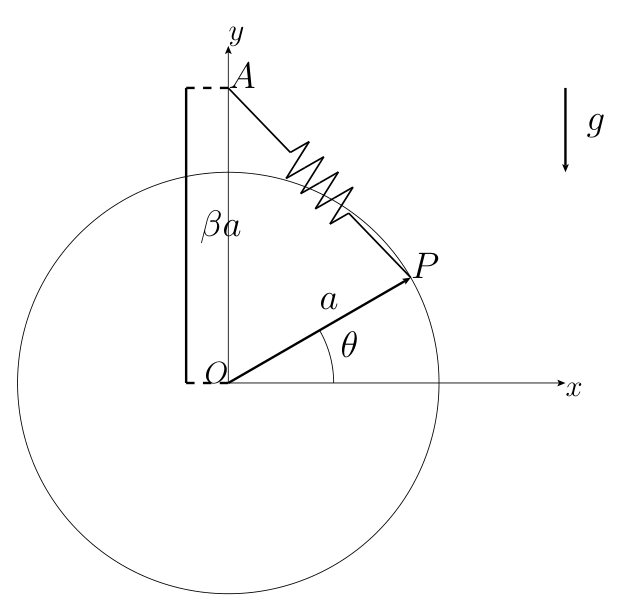
A heavy particle $P$ is constrained to move along a circumference and it is attached to a spring as shown in the figure. The mass of the particle is $m$, and the radius of the circumference is $a$. The other end of the spring is attached to a point of the $y$ axis with coordinates $(0, \beta a)$ and the constant of the spring is equal to $k$.
-
(a)
Compute the potential of the forces acting on the particle as a function of the angle $\theta$ (shown in the figure).
-
(b)
Identify the equilibrium positions.
The particle departs from the point $(a, 0)$ of the circumference with an initial velocity $\mathbf{v}_0 = v_0\mathbf{j}$.
-
(c)
Reduce the motion to integrals (i.e., quadratures).
-
(d)
If $\beta = \frac{mg}{ka}$, obtain the position of the particle as a function of time.
Consider now the situation in which an additional force acts on the particle. The force is proportional to, and in the same direction as, the instantaneous velocity. The constant of proportionality is $2m\mu$. The initial conditions are the same as before.
-
(e)
Obtain the position of the particle as a function of time.
-
(f)
Obtain the reaction of the circumference.
Worked Solution [ Click to Expand ]
Constraints, Degrees of Freedom & Coordinates
- System: a heavy particle $P$ of mass $m$ slides on a vertical circular wire of radius $a$ centred at $O$. A linear spring of stiffness $k$ and zero natural length joins $P$ to the anchor $A = (0, \beta a)$ on the $y$-axis. Gravity acts along $-\mathbf{j}$.
- Constraints: $P$ stays on the circle $x^2 + y^2 = a^2$ in the plane $Oxy$ (holonomic, scleronomic, smooth, bilateral). The wire gives a reaction normal to it, with an in-plane component and, if needed, a component perpendicular to the plane (zero here). $\text{CDOF} = 2 - 1 = 1$, with the angle $\theta$ measured counterclockwise from the positive $x$-axis.
- Initial state: $P$ starts at $(a, 0)$, i.e. $\theta(0) = 0$, with $\mathbf{v}_0 = v_0\,\mathbf{j}$, i.e. $\dot{\theta}(0) = v_0/a$.
- Parameters: $m$, $a$, $k$, $g$, $\beta$, $v_0 \gt 0$. Parts (e) and (f) use $\beta = mg/(ka)$ (the case of part (d)), and the additional force has the constant $2m\mu$.
Reference Frames & Vector Bases
- Inertial frame: $\mathcal{F}_0 = \{O; \mathbf{i}, \mathbf{j}, \mathbf{k}\}$ with $\mathbf{j}$ vertical upward.
- Polar basis: $\mathbf{e}_r = \cos\theta\,\mathbf{i} + \sin\theta\,\mathbf{j}$ and $\mathbf{e}_\theta = -\sin\theta\,\mathbf{i} + \cos\theta\,\mathbf{j}$, a rotation of $\mathcal{B}_0$ by $\theta$ about $\mathbf{k}$ (matrix $\begin{pmatrix}\cos \theta & -\sin \theta & 0\\ \sin \theta & \cos \theta & 0\\ 0 & 0 & 1\end{pmatrix}$, $\det = \cos^2\theta + \sin^2\theta = 1$; $RR^T$ has diagonal entries $\cos^2\theta + \sin^2\theta = 1$ (and $1$) and off-diagonal entries $\cos \theta\sin \theta - \sin \theta\cos \theta = 0$, so $RR^T = I$), with $\dot{\mathbf{e}}_r = \dot{\theta}\,\mathbf{e}_\theta$ and $\dot{\mathbf{e}}_\theta = -\dot{\theta}\,\mathbf{e}_r$ (Poisson).
Derivation
3.1 Kinematics
3.2 Forces
- Gravity: $-mg\,\mathbf{j}$, with $\mathbf{F}_g\cdot\mathbf{e}_r = -mg\sin\theta$ and $\mathbf{F}_g\cdot\mathbf{e}_\theta = -mg\cos\theta$.
- Spring: $\mathbf{F}_s = -k\,\overrightarrow{AP}$, with $\mathbf{F}_s\cdot\mathbf{e}_r = -ka\left(1 - \beta\sin\theta\right)$ and $\mathbf{F}_s\cdot\mathbf{e}_\theta = ka\beta\cos\theta$.
- Reaction: $\mathbf{N} = N\,\mathbf{e}_r$ (normal to the wire; $N \gt 0$ is outward). Additional force (parts e, f): $\mathbf{F}_d = 2m\mu\,\mathbf{v}$, along the velocity, as the statement says. Inertia forces: none.
- Potential. Gravity and the linear spring are conservative, so the total potential energy is the sum of $V_g = mgy = mga\sin\theta$ and $V_s = \tfrac{1}{2}k\left|\overrightarrow{AP}\right|^2$ (the work of the wire reaction is zero):
3.3 Equations of Motion
- Tangential equation (no reaction): $ma\ddot{\theta} = \mathbf{F}_g\cdot\mathbf{e}_\theta + \mathbf{F}_s\cdot\mathbf{e}_\theta + \mathbf{F}_d\cdot\mathbf{e}_\theta = -\left(mg - k\beta a\right)\cos\theta + 2m\mu a\dot{\theta}$. For $\mu = 0$ this is $ma\ddot{\theta} = -\frac{1}{a}\frac{dV}{d\theta}$, i.e. the equation of motion of the conservative problem.
- Radial equation (gives the reaction): $-ma\dot{\theta}^2 = N - mg\sin\theta - ka\left(1 - \beta\sin\theta\right)$.
- Two equations for the two unknowns $\theta(t)$ and $N(t)$. The reaction is decoupled and is computed after $\theta(t)$.
- Energy (conservative case $\mu = 0$): the reaction does no work, so $E = \tfrac{1}{2}ma^2\dot{\theta}^2 + V(\theta)$ is a first integral.
3.4 Integration and Answers
(a) Potential of the forces
(b) Equilibrium positions
- If $mg - k\beta a \ne 0$: $\cos\theta = 0$, i.e. $\theta_1 = \pi/2$ (top) and $\theta_2 = -\pi/2$ (bottom). Since $V'' = -(mg - k\beta a)a\sin\theta$, the top is a minimum (stable) if $mg \lt k\beta a$ and the bottom is a minimum if $mg \gt k\beta a$.
- If $\beta = \dfrac{mg}{ka}$: $dV/d\theta \equiv 0$, so every position is an equilibrium (neutral equilibrium).
(c) Reduction to quadratures
(d) Case $\beta = mg/(ka)$
The particle circles the wire at constant angular speed.
(e) Position with the additional force along the velocity
- Let $\Omega(t) = \dot{\theta}$; then $\dfrac{d\Omega}{\Omega} = 2\mu\,dt$, and integrating from $\Omega(0) = v_0/a$ (Barrow):
- With $w = 2\mu t'$, $dw = 2\mu\,dt'$, the antiderivative is $\int e^{2\mu t'}dt' = \frac{1}{2\mu}\int e^w\,dw = \frac{e^{2\mu t'}}{2\mu}$, and with $\theta(0) = 0$:
The force acts along the velocity, so it feeds energy to the particle and the angular speed grows exponentially.
(f) Reaction of the circumference
- With $\beta = mg/(ka)$ the terms in $\sin\theta$ cancel ($mg\sin\theta - ka\beta\sin\theta = 0$), and $\dot{\theta} = (v_0/a)e^{2\mu t}$:
$N$ is the outward component. It starts at $ka - mv_0^2/a$ and becomes more and more negative: the wire must push the particle inward with a force that grows as $e^{4\mu t}$.
Interpretation & Checks
- Dimensional check: $[ka] = \text{N}$ and $[mv_0^2/a] = \text{N}$; $\mu$ has units s$^{-1}$, so $2\mu t$ is dimensionless and $[v_0/(2\mu a)] = 1$ (rad).
- Limits: for $\mu \to 0$, $\theta \to (v_0/a)t$, the result of (d), and $N \to ka - mv_0^2/a$, the preload of the spring minus the centripetal force, constant.
- Check against the official key:
Problems.pdfhas no entry for Problem 24 in its solution keys, so the results are verified by independent derivation. Sympy confirms the radial equation $N = -ma\dot{\theta}^2 + mg\sin\theta + ka(1 - \beta\sin\theta)$ for either sign of the additional force and the reduction to $N = ka - (mv_0^2/a)e^{\pm 4\mu t}$ when $\beta = mg/(ka)$. Numerical integration of $\ddot{\theta} = 2\mu\dot{\theta}$ ($a = 1$, $v_0 = 1.7$, $\mu = 0.3$) gives $\theta(2) = 6.57366$, equal to the closed form; the damping reading gives $1.97995$, also equal to its closed form.
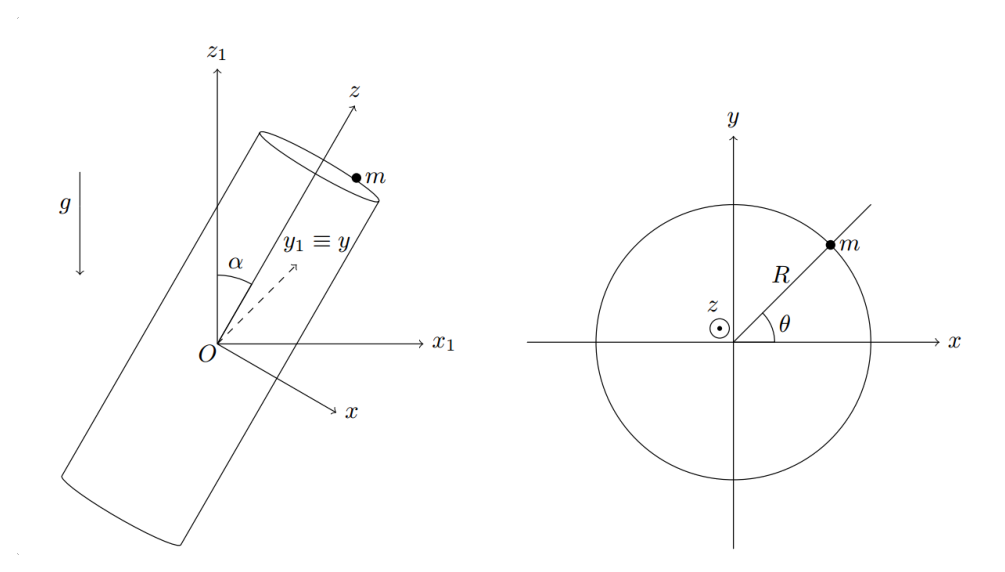
A heavy particle of mass $m$ is constrained to move without friction along the surface of an infinitely-long, circular cylinder of radius $R$. The cylinder axis ($Oz$) forms an angle $\alpha$ with the vertical direction ($Oz_1$). A sketch is shown on the left panel of the figure below. The position of the particle is completely specified by providing the coordinate $z$ along the axis $Oz$ and the angle $\theta$ as shown on the right panel. Initially, the particle is located at $z = 0, \theta = \pi/2$ and the time derivatives are $\dot{z} = v_0$ and $\dot{\theta} = \omega_0$.
-
(a)
Determine the value of $z$ as a function of time, $z(t)$.
-
(b)
Reduce the determination of the angle $\theta(t)$ to integrals of the form $\int [...] d\theta = \int [...] dt$.
-
(c)
Determine the reaction from the cylinder as a function of $\theta$.
-
(d)
For the particular case $\omega_0^2 = \frac{g\sin\alpha}{R}$, describe qualitatively the motion of the particle.
-
(e)
For the particular case $\omega_0^2 = \frac{4g\sin\alpha}{R}$, describe qualitatively the motion of the particle.
Worked Solution [ Click to Expand ]
Constraints, Degrees of Freedom & Coordinates
- System: a heavy particle of mass $m$ moves without friction on the surface of an infinitely long circular cylinder of radius $R$ whose axis $Oz$ forms the angle $\alpha$ with the vertical $Oz_1$.
- Constraint: the particle stays on the surface, $x^2 + y^2 = R^2$ in the frame of the cylinder (holonomic, scleronomic, smooth). The statement says the particle is constrained to move along the surface, so we treat it as bilateral; the sign of the reaction tells on which side the surface presses it (checked in (c)).
- Degrees of freedom: $\text{CDOF} = 3 - 1 = 2$, with the coordinates of the statement: the axial coordinate $z(t)$ and the angle $\theta(t)$ around the axis.
- Initial state: $z(0) = 0$, $\theta(0) = \pi/2$, $\dot{z}(0) = v_0$, $\dot{\theta}(0) = \omega_0$.
- Parameters: $m$, $R$, $\alpha$, $g$, $v_0$, $\omega_0$.
Reference Frames & Vector Bases
- Vertical frame: $S_1 = \{O; \mathbf{i}_1, \mathbf{j}_1, \mathbf{k}_1\}$ with $\mathbf{k}_1$ vertical upward.
- Cylinder frame: $S_2 = \{O; \hat{\mathbf{x}}, \hat{\mathbf{y}}, \hat{\mathbf{z}}\}$ with $\hat{\mathbf{z}}$ along the axis. From the figure, $\hat{\mathbf{z}} = \sin\alpha\,\mathbf{i}_1 + \cos\alpha\,\mathbf{k}_1$, $\hat{\mathbf{x}} = \cos\alpha\,\mathbf{i}_1 - \sin\alpha\,\mathbf{k}_1$ and $\hat{\mathbf{y}} = \mathbf{j}_1$, a rotation of $S_1$ by $\alpha$ about $\mathbf{j}_1$:
- Cylindrical basis: $\mathbf{e}_r = \cos\theta\,\hat{\mathbf{x}} + \sin\theta\,\hat{\mathbf{y}}$, $\mathbf{e}_\theta = -\sin\theta\,\hat{\mathbf{x}} + \cos\theta\,\hat{\mathbf{y}}$, $\hat{\mathbf{z}}$, a rotation of $S_2$ by $\theta$ about $\hat{\mathbf{z}}$ (matrix $\begin{pmatrix}\cos \theta & -\sin \theta & 0\\ \sin \theta & \cos \theta & 0\\ 0 & 0 & 1\end{pmatrix}$, $\det = \cos^2\theta + \sin^2\theta = 1$; $RR^T$ has diagonal entries $\cos^2\theta + \sin^2\theta = 1$ (and $1$) and off-diagonal entries $\cos \theta\sin \theta - \sin \theta\cos \theta = 0$, so $RR^T = I$), with $\dot{\mathbf{e}}_r = \dot{\theta}\,\mathbf{e}_\theta$ and $\dot{\mathbf{e}}_\theta = -\dot{\theta}\,\mathbf{e}_r$.
- Gravity in this basis. From $\mathbf{k}_1 = \cos\alpha\,\hat{\mathbf{z}} - \sin\alpha\,\hat{\mathbf{x}}$:
so $\theta = 0$ is the lowest generator of the cylinder ($\mathbf{e}_r$ points downward there).
Derivation
3.1 Kinematics
3.2 Forces
- Applied force: the weight $m\mathbf{g}$, decomposed in 2.
- Constraint force: the reaction of the smooth cylinder is normal to the surface, so it is radial: $\mathbf{N} = -N\,\mathbf{e}_r$ (with $N \gt 0$ when it pushes toward the axis). It has no component along $\hat{\mathbf{z}}$ or $\mathbf{e}_\theta$.
- Inertia forces: none ($S_1$ is inertial).
3.3 Equations of Motion
- Decoupling. The axial equation involves only $z$ and the azimuthal one only $\theta$ (a pendulum equation); the reaction is computed afterwards from the radial equation.
- First integral. Multiplying the azimuthal equation by $\dot{\theta}$ (chain rule, $\frac{d}{dt}\left(\tfrac{1}{2}\dot{\theta}^2\right) = \dot{\theta}\ddot{\theta}$ and $\frac{d}{dt}\cos\theta = -\sin\theta\,\dot{\theta}$):
3.4 Integration and Answers
(a) Axial motion $z(t)$
(b) Reduction of $\theta(t)$ to quadratures
- From the first integral, with $\theta = \pi/2$ ($\cos\theta = 0$) and $\dot{\theta} = \omega_0$ at $t = 0$, the constant is $\tfrac{1}{2}\omega_0^2$:
- Separating variables (Barrow's rule from $\theta(0) = \pi/2$):
with the sign of $\dot{\theta}$.
(c) Reaction of the cylinder
$N$ is the component toward the axis. If it becomes negative, the surface would have to pull the particle: possible for a bilateral constraint, but a particle resting on the inside of the cylinder would leave the surface.
(d) Case $\omega_0^2 = g\sin\alpha/R$
- Motion: since $\theta = 0$ is the stable bottom generator, the particle oscillates in $\theta$ between $-2\pi/3$ and $+2\pi/3$ about the bottom (for $\omega_0 \gt 0$ it first moves to $+2\pi/3$, then swings through $\theta = 0$ to $-2\pi/3$ and back), while it moves along the axis with the uniform deceleration $-g\cos\alpha$: $z(t) = v_0t - \tfrac{1}{2}g\cos\alpha\,t^2$. The trajectory is a wavy curve on the cylinder.
- Reaction: $N = mg\sin\alpha\left(1 + 3\cos\theta\right)$, which is negative for $\cos\theta \lt -1/3$ ($\theta \gt 109.5^\circ$), so the motion up to $\pm 2\pi/3$ (where $N = -\tfrac{1}{2}mg\sin\alpha$) needs a bilateral constraint.
(e) Case $\omega_0^2 = 4g\sin\alpha/R$
- Motion: the angular velocity never vanishes and keeps its sign, so the particle makes complete turns around the cylinder, in a helical-like trajectory whose pitch follows the axial velocity $\dot{z} = v_0 - g\cos\alpha\,t$, which decreases, vanishes at $t = v_0/(g\cos\alpha)$ and then reverses sign, so the pitch shrinks to zero and then changes sense. The reaction $N = mg\sin\alpha\left(4 + 3\cos\theta\right) \ge mg\sin\alpha \gt 0$ is always positive, so this motion is also admissible if the particle is inside a hollow cylinder.
Interpretation & Checks
- Decoupling: the axial motion is a uniformly decelerated one-dimensional motion and the azimuthal motion is that of a nonlinear pendulum of length $R$ in the effective gravity $g\sin\alpha$ (the component of gravity in the cross-section).
- Dimensional check: $[g\sin\alpha/R] = \text{s}^{-2} = [\omega_0^2]$ and $[N] = [mR\omega_0^2] = \text{N}$.
- Limits: for $\alpha \to 0$ (vertical axis) there is no azimuthal force and $\dot{\theta} = \omega_0$; for $\alpha \to \pi/2$ (horizontal axis) $\ddot{z} \to 0$.
- Check against the official key:
Problems.pdfhas no entry for Problem 29 in its solution keys, so the results are verified by independent derivation. Sympy reproduces the components of the acceleration in the cylindrical basis and those of gravity ($\mathbf{g}\cdot\hat{\mathbf{z}} = -g\cos\alpha$, $\mathbf{g}\cdot\mathbf{e}_r = g\sin\alpha\cos\theta$, $\mathbf{g}\cdot\mathbf{e}_\theta = -g\sin\alpha\sin\theta$). Numerical integration of $\ddot{\theta} = -(g\sin\alpha/R)\sin\theta$ from $\theta(0) = \pi/2$ gives the turning points $\pm 0.66667\pi = \pm 2\pi/3$ for (d), no turning point for (e), and a minimum of $N$ of $-0.5\,mg\sin\alpha$ for (d) and $+1.0\,mg\sin\alpha$ for (e).
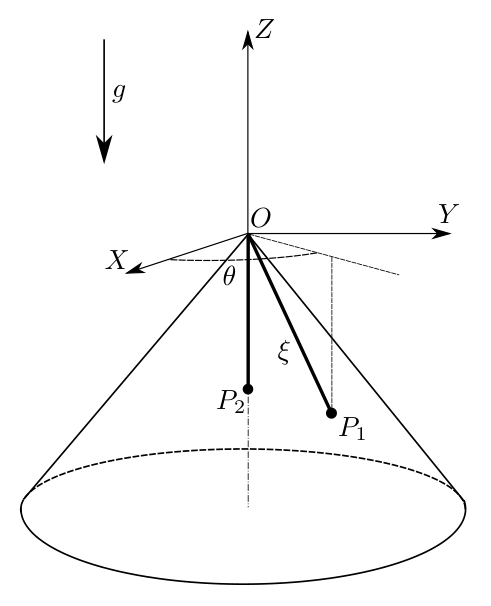
Two heavy point particles $P_1$ and $P_2$ of mass $m$ each are connected by an inextensible, massless string of total length $\ell$. Particle $P_1$ is constrained to move without friction over the surface of a cone of semiangle $\alpha$ (the particle cannot leave the surface of the cone). The string passes through an aperture at the cone vertex $O$, and it can slide through it without friction. Particle $P_2$ hangs along the cone axis, and is constrained to move along it. We define an inertial reference frame $S_0$ as shown in the figure. We call $\xi$ the length of the fraction of string between $O$ and $P_1$, and $\theta$ the angle formed between the $Ox$ axis and the projection onto the $Oxy$ plane of the $\mathbf{OP}_1$ vector. In the following, assume that the string is always tense and that the particles do not reach point $O$ during motion.
-
(a)
Write down the general expression of the position, velocity and acceleration vectors of $P_1$ and $P_2$ as a function of $\theta, \xi$ and the parameters of the problem.
-
(b)
Write down the expression of all forces that act on $P_1$ and $P_2$.
-
(c)
Write down the differential equations that, if solved, would yield the time evolution of $\theta, \xi$, the tension on the string, and any other reaction force in the problem.
-
(d)
What is the mathematical condition that the function $\xi(t)$ must satisfy for the string to remain tense all the time?
-
(e)
How fast should $P_1$ rotate in the $\theta$ direction to have a circular trajectory over a cone parallel? What is the value of the string tension and any other reaction force in the problem in that case? Give your answer as a function of $\xi$ and the parameters of the problem.
-
(f)
Taking these equations as the starting point (or based on the physical considerations of the problem) write down two first-integrals of the problem that do not depend on the string tension or any other reaction force in the problem.
Worked Solution [ Click to Expand ]
Constraints, Degrees of Freedom & Coordinates
- System: two heavy particles $P_1$ and $P_2$ of mass $m$ are joined by an inextensible massless string of length $\ell$ that passes without friction through the aperture at the vertex $O$ of a cone of semi-angle $\alpha$. $P_1$ moves without friction on the cone surface; $P_2$ hangs along the cone axis ($Oz$ vertical upward, the cone opens downward). The string stays taut and the particles do not reach $O$.
- Constraints: with $6$ coordinates for two free particles:
- $P_1$ on the cone: $1$ constraint (bilateral: the statement says the particle cannot leave the surface).
- Constant string length: $\xi + (\text{depth of } P_2) = \ell$, i.e. $1$ constraint (unilateral: $T \ge 0$).
- $P_2$ on the axis: $x_2 = y_2 = 0$, $2$ constraints.
- Degrees of freedom: $\text{CDOF} = 6 - 4 = 2$, with $\xi$ (the length of the string between $O$ and $P_1$) and $\theta$ (the azimuthal angle of $P_1$).
- Parameters: $m$, $\ell$, $\alpha$, $g$.
Reference Frames & Vector Bases
- Inertial frame: $S_0 = \{O; \mathbf{i}, \mathbf{j}, \mathbf{k}\}$ with $\mathbf{k}$ vertical upward.
- Cylindrical basis: $\mathbf{e}_R = \cos\theta\,\mathbf{i} + \sin\theta\,\mathbf{j}$, $\mathbf{e}_\theta = -\sin\theta\,\mathbf{i} + \cos\theta\,\mathbf{j}$, $\mathbf{k}$ (rotation about $\mathbf{k}$ by $\theta$, matrix $\begin{pmatrix}\cos \theta & -\sin \theta & 0\\ \sin \theta & \cos \theta & 0\\ 0 & 0 & 1\end{pmatrix}$, $\det = \cos^2\theta + \sin^2\theta = 1$; $RR^T$ has diagonal entries $\cos^2\theta + \sin^2\theta = 1$ (and $1$) and off-diagonal entries $\cos \theta\sin \theta - \sin \theta\cos \theta = 0$, so $RR^T = I$; $\dot{\mathbf{e}}_R = \dot{\theta}\,\mathbf{e}_\theta$, $\dot{\mathbf{e}}_\theta = -\dot{\theta}\,\mathbf{e}_R$).
- Cone basis: the unit vector along the generator from $O$ to $P_1$, $\mathbf{e}_\xi = \sin\alpha\,\mathbf{e}_R - \cos\alpha\,\mathbf{k}$; the unit outward normal to the cone, $\mathbf{n} = \cos\alpha\,\mathbf{e}_R + \sin\alpha\,\mathbf{k}$; and $\mathbf{e}_\theta$. The triple $\{\mathbf{e}_\xi, \mathbf{e}_\theta, \mathbf{n}\}$ is right-handed ($\mathbf{e}_\xi\times\mathbf{e}_\theta = \mathbf{n}$). In the cylindrical basis $\{\mathbf{e}_R, \mathbf{e}_\theta, \mathbf{k}\}$
and its columns have unit norm ($\sin^2\alpha + \cos^2\alpha = 1$) and are orthogonal ($\sin\alpha\cos\alpha - \cos\alpha\sin\alpha = 0$), so $[{}_1R_2][{}_1R_2]^T = I$.
Derivation
3.1 Kinematics
(a) Position, velocity and acceleration
From $\mathbf{r}_1 = \xi\,\mathbf{e}_\xi$ with $\dot{\mathbf{e}}_\xi = \sin\alpha\,\dot{\theta}\,\mathbf{e}_\theta$: $\mathbf{v}_1 = \dot{\xi}\,\mathbf{e}_\xi + \xi\dot{\theta}\sin\alpha\,\mathbf{e}_\theta$. Differentiating again (product rule) with $\dot{\mathbf{e}}_\theta = -\dot{\theta}\,\mathbf{e}_R$ and $\mathbf{e}_R = \sin\alpha\,\mathbf{e}_\xi + \cos\alpha\,\mathbf{n}$: $\mathbf{a}_1 = \ddot{\xi}\,\mathbf{e}_\xi + 2\dot{\xi}\dot{\theta}\sin\alpha\,\mathbf{e}_\theta + \xi\ddot{\theta}\sin\alpha\,\mathbf{e}_\theta - \xi\dot{\theta}^2\sin\alpha\left(\sin\alpha\,\mathbf{e}_\xi + \cos\alpha\,\mathbf{n}\right)$, i.e.
3.2 Forces
(b) Forces on $P_1$ and $P_2$
- On $P_1$: the weight $-mg\,\mathbf{k} = mg\cos\alpha\,\mathbf{e}_\xi - mg\sin\alpha\,\mathbf{n}$; the tension of the string, directed toward $O$, $\mathbf{T}_1 = -T\,\mathbf{e}_\xi$ ($T \gt 0$); and the reaction of the cone $\mathbf{N} = N\,\mathbf{n}$ (outward).
- On $P_2$: the weight $-mg\,\mathbf{k}$; the tension $+T\,\mathbf{k}$ (same string, massless, smooth aperture); and the reaction $\mathbf{R}_2$ of the guide, perpendicular to $\mathbf{k}$ (horizontal).
- Inertia forces: none ($S_0$ is inertial).
3.3 Equations of Motion
(c) Differential equations
- Decoupling. Substituting $T = m(g + \ddot{\xi})$ in the $\mathbf{e}_\xi$ equation eliminates the tension and leaves the equations of the two free coordinates:
and, once $\xi(t)$ and $\theta(t)$ are known,
- First integrals (independent of $T$ and $N$): see 3.4(f).
3.4 Integration and Answers
(d) Condition for the string to remain taut
Substituting $\ddot{\xi} = \tfrac{1}{2}\left[\xi\dot{\theta}^2\sin^2\alpha - g(1 - \cos\alpha)\right]$ from the decoupled equation of (c) gives $T = \tfrac{m}{2}\left[g\left(1 + \cos\alpha\right) + \xi\dot{\theta}^2\sin^2\alpha\right] \gt 0$ for $0 \lt \alpha \lt \pi$, so the string stays taut throughout the motion.
(e) Circular trajectory on a parallel
- Tension: $T = m\left(g + 0\right) = mg$, directed on $P_1$ as $\mathbf{T}_1 = -mg\,\mathbf{e}_\xi = mg\left(-\sin\alpha\,\mathbf{e}_R + \cos\alpha\,\mathbf{k}\right)$.
- Cone reaction: with $\xi\dot{\theta}^2\sin^2\alpha = g\left(1 - \cos\alpha\right)$:
$N \gt 0$ for $0 \lt \alpha \lt \pi$: the cone presses on the particle (which would also be admissible for a one-sided contact).
(f) Two first integrals independent of the tension and the reactions
- Azimuthal integral (first integral of the $\mathbf{e}_\theta$ equation). With the product rule, the azimuthal acceleration is $\sin\alpha\left(\xi\ddot{\theta} + 2\dot{\xi}\dot{\theta}\right) = \dfrac{\sin\alpha}{\xi}\dfrac{d}{dt}\left(\xi^2\dot{\theta}\right)$. Gravity, the tension (toward $O$) and the cone reaction all lie in the meridian plane of $P_1$, so they have no $\mathbf{e}_\theta$ component:
- Energy. The reactions do no work: $\mathbf{N}\cdot\mathbf{v}_1 = 0$ ($\mathbf{N}$ is normal to the surface) and the tension does the work $-T\dot{\xi}$ on $P_1$ and $+T\dot{\xi}$ on $P_2$, which cancel (inextensible string, smooth aperture). Gravity is conservative. The kinetic and potential energies are
where the constant $C_2$ absorbs $-2g\ell$ and the factor $2/m$.
Interpretation & Checks
- Effective potential. With $\xi^2\dot{\theta} = C_1$ the energy becomes $2\dot{\xi}^2 + W(\xi) = C_2$ with $W(\xi) = \dfrac{C_1^2\sin^2\alpha}{\xi^2} + 2g\xi\left(1 - \cos\alpha\right)$. Its minimum is at $W'(\xi_c) = -\dfrac{2C_1^2\sin^2\alpha}{\xi_c^3} + 2g\left(1 - \cos\alpha\right) = 0$, i.e. $\xi_c\dot{\theta}^2\sin^2\alpha = g\left(1 - \cos\alpha\right)$, the circular parallel of (e); and $W'' = \dfrac{6C_1^2\sin^2\alpha}{\xi^4} \gt 0$, so it is a stable minimum.
- Dimensional check: $[\xi^2\dot{\theta}] = \text{m}^2\text{s}^{-1}$ and $[g\xi] = \text{m}^2\text{s}^{-2} = [\dot{\xi}^2]$; $[T] = [N] = \text{N}$.
- Check against the official key: the key of
Problems.pdfgives two degrees of freedom, the quadratures $\xi^2\dot{\theta} = C_1$ and $2\dot{\xi}^2 + \xi^2\dot{\theta}^2\sin^2\alpha + 2g\xi(1 - \cos\alpha) = C_2$, the circular condition $\xi\dot{\theta}^2\sin^2\alpha = g(1 - \cos\alpha)$, $\mathbf{T} = mg\left(-\sin\alpha\,\mathbf{e}_R + \cos\alpha\,\mathbf{k}\right)$ and $\mathbf{N} = \dfrac{mg(1 - \cos\alpha)}{\sin\alpha}(\cdots)$. Everything agrees with the results above, with two remarks: the tension condition of the key ($\ddot{\xi} \gt g$) is an erratum (see (d)), and the key writes the direction of $\mathbf{N}$ with $\mathbf{e}_\theta$, which is tangent to the parallel and cannot be normal to the cone; the normal direction is $\cos\alpha\,\mathbf{e}_R + \sin\alpha\,\mathbf{k}$. Sympy confirms the three components of $\mathbf{a}_1$ and numerical integration of the equations of (c) ($\alpha = 40^\circ$) conserves $\xi^2\dot{\theta}$ and the energy to $3\times 10^{-14}$, with $T$ and $N$ positive throughout and $N/(mg) = 0.363970$ on the circular orbit, equal to $(1 - \cos\alpha)/\sin\alpha$.
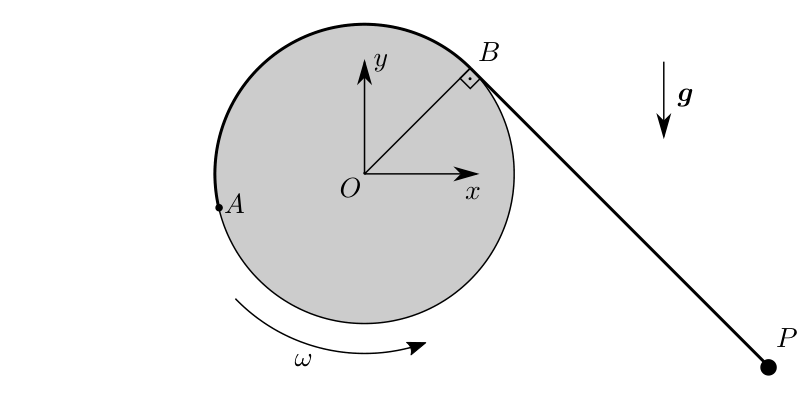
A heavy particle $P$ of mass $m$ is connected by a string of total length $l = 4\pi a$ to a cylindrical spool of radius $a$ and center at $O$ as shown in the figure. The spool rotates at a known constant angular rate $\omega$ counterclockwise. The string is massless, inelastic, thin, and remains always in tension during the motion of the particle. We define the inertial reference frame $Oxy$ as shown in the figure. The other end of the string is attached to the spool at a point $A$ of its perimeter, and we shall call $B$ the instantaneous point of tangency between the straight segment of the string (the segment $BP$) and the spool. We will denote the angle between the local horizontal (axis $Ox$) and the radius $OB$ as $\phi$. Initially, $\mathbf{OA} = -a\mathbf{i}$, and $B$ never reaches $A$.
-
(a)
Discuss the number of degrees of freedom of the motion of the particle.
-
(b)
Write down the position, velocity and acceleration vectors of $P$ with respect to $Oxy$ as a function of the constants of the problem, time, the angle $\phi$, and its derivatives.
-
(c)
Write down the mathematical expression of the forces acting on $P$.
-
(d)
Is the mechanical energy of $P$ conserved? If so, write down the equation of conservation of mechanical energy; otherwise, explain why it is not conserved.
-
(e)
Write down a closed set of equations that, if solved, would yield $\phi$ (and the other unknowns of the problem, if any) as a function of time. Note that you do not need to solve the equations.
-
(f)
Consider now that $\omega = 0$. Can you write down a first integral of motion that only involves $\phi$ and $\dot{\phi}$ (but not $\ddot{\phi}$) in this case? You may want to rethink your previous answers for this particular case.
Worked Solution [ Click to Expand ]
Constraints, Degrees of Freedom & Coordinates
- System: a heavy particle $P$ of mass $m$ hangs from a string of length $l = 4\pi a$ that unwinds from a spool of radius $a$ and centre $O$, which rotates counterclockwise at the constant rate $\omega$. The string is massless, inextensible, thin and stays taut. One end is fixed to the spool at the point $A$ of its perimeter; $B$ is the point where the straight segment $BP$ leaves the spool, and $\phi$ is the angle between $Ox$ and $OB$. Initially $\overrightarrow{OA} = -a\,\mathbf{i}$ and $B$ never reaches $A$.
- Constraints: $P$ is a particle in the plane (2 coordinates). The string of fixed length that winds on the spool ties its position to the geometry: the free length $BP$ is $s = l - (\text{wrapped arc})$, and the attachment $A$ turns with the spool, so the constraint depends explicitly on time (rheonomic, holonomic) when $\omega \ne 0$. It is unilateral ($T \ge 0$, taut string).
- Degrees of freedom (part a): $\text{CDOF} = 2 - 1 = 1$, the angle $\phi$.
- Parameters: $m$, $a$, $l = 4\pi a$, $\omega$, $g$.
Reference Frames & Vector Bases
- Inertial frame: $S_0 = \{O; \mathbf{i}, \mathbf{j}\}$ with $\mathbf{j}$ vertical upward.
- Basis at $B$: $\mathbf{u}_r = \cos\phi\,\mathbf{i} + \sin\phi\,\mathbf{j}$ (radial) and $\mathbf{u}_t = -\sin\phi\,\mathbf{i} + \cos\phi\,\mathbf{j}$ (counterclockwise tangent), a rotation of $\{\mathbf{i}, \mathbf{j}\}$ by $\phi$ (matrix $\begin{pmatrix}\cos \phi & -\sin \phi & 0\\ \sin \phi & \cos \phi & 0\\ 0 & 0 & 1\end{pmatrix}$, $\det = \cos^2\phi + \sin^2\phi = 1$; $RR^T$ has diagonal entries $\cos^2\phi + \sin^2\phi = 1$ (and $1$) and off-diagonal entries $\cos \phi\sin \phi - \sin \phi\cos \phi = 0$, so $RR^T = I$), with $\dot{\mathbf{u}}_r = \dot{\phi}\,\mathbf{u}_t$ and $\dot{\mathbf{u}}_t = -\dot{\phi}\,\mathbf{u}_r$. The straight segment leaves $B$ clockwise, toward the lower right in the figure, i.e. along $-\mathbf{u}_t$.
Derivation
3.1 Kinematics
(a) Degrees of freedom
- The particle moves in the plane (2 coordinates) but the string constraint leaves exactly one degree of freedom, $\phi$.
(b) Position, velocity and acceleration of $P$
- Velocity (product rule and Poisson's formula):
- Acceleration:
(using $\dot{s}\dot{\phi} = a\left(\dot{\phi} - \omega\right)\dot{\phi}$).
3.2 Forces
(c) Forces on $P$
- Weight: $-mg\,\mathbf{j} = -mg\left(\sin\phi\,\mathbf{u}_r + \cos\phi\,\mathbf{u}_t\right)$.
- Tension: along the straight segment, toward $B$: $\mathbf{T} = +T\,\mathbf{u}_t$ with $T \gt 0$ (since $\mathbf{r}_B - \mathbf{r}_P = s\,\mathbf{u}_t$).
- Inertia forces: none. There is no other force: the string is the only constraint.
3.3 Equations of Motion
(e) Closed set of equations
The first is the equation of motion for $\phi(t)$; the tension follows from the second once $\phi(t)$ is known.
(d) Energy
3.4 Integration and Answers
(f) Case $\omega = 0$
Interpretation & Checks
- Involute pendulum: the system behaves like a pendulum whose effective length $s = a(3\pi - \omega t + \phi)$ changes as the string unwinds.
- Dimensional check: $[a\ddot{\phi}\,s/a] = \text{m s}^{-2}$, like $[g\sin\phi]$; $[T] = \left[ma\left(3\pi + \phi\right)\dot{\phi}^2\right] = \text{N}$.
- Check against the official key: the key of
Problems.pdfgives the two equations $a\left[\left(3\pi - \omega t + \phi\right)\ddot{\phi} - 2\omega\dot{\phi} + \dot{\phi}^2\right] = -g\sin\phi$ and $ma\left(3\pi - \omega t + \phi\right)\dot{\phi}^2 = -mg\cos\phi + T$, the conservation of the mechanical energy for $\omega = 0$ and its quadrature $\tfrac{1}{2}m\left[a(3\pi + \phi)\right]^2\dot{\phi}^2 + mga\left[\sin\phi - (3\pi + \phi)\cos\phi\right] = E$. All coincide with the results above. Sympy reproduces $\mathbf{v}_P$ and $\mathbf{a}_P$ by differentiating $\mathbf{r}_P$, and numerical integration of the equation with $\omega = 0$ conserves the energy to $6\times 10^{-12}$ with $T \gt 0$.
Two heavy particles $P$ and $Q$ of mass $m$ each are connected by an inextensible massless string of constant length $L$. Part of this string rests on top of a cylinder of radius $R$ and center at $O$. The string can slide over the cylinder without friction, and remains tense at all times. Furthermore, $P$ and $Q$ are also connected by a spring of zero natural length and stiffness $k$. We define the inertial reference frame $S_0$ as shown in the figure. We denote as $A$ and $B$ the points of tangency of the string with the cylinder.
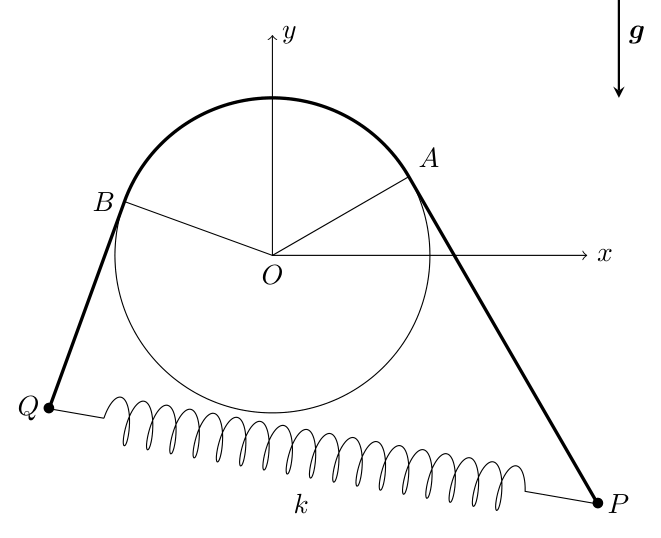
-
(a)
How many degrees of freedom does this system have? Define your own generalized coordinates to parametrize the configuration of the system. You will use them in the rest of the problem.
-
(b)
Write down the general expression of the position, velocity and acceleration vectors of $P$ and $Q$ relative to the $S_0$ reference frame as a function of your chosen coordinates and their time derivatives.
-
(c)
Write down the expression of all forces acting on $P$ and $Q$.
-
(d)
Discuss whether the mechanical energy of $P$ is conserved; if so, write down the expression of the corresponding potential energy.
-
(e)
Consider now that we restrict the motion of the system to symmetric configurations about the $Oy$ axis only. What is the number of degrees of freedom now? Find the mathematical relations that exist between your previously-defined coordinates in this case.
-
(f)
Find the approximate value of your coordinates when the system is in equilibrium and the configuration is symmetric about the $Oy$ axis. To do so, assume that the deviation from the vertical of the $AP$ and $BQ$ segments is small, and linearize the equations of motion. Find the angular frequency of the oscillations around this equilibrium configuration.
Worked Solution [ Click to Expand ]
Constraints, Degrees of Freedom & Coordinates
- System: two heavy particles $P$ and $Q$ of mass $m$ are joined by an inextensible massless string of length $L$ that rests on a fixed smooth cylinder of radius $R$ and centre $O$, and by a spring of zero natural length and stiffness $k$. The motion is planar, in $Oxy$ with $Oy$ upward. $A$ (right) and $B$ (left) are the tangency points of the string with the cylinder. The string stays taut and the spring does not touch the cylinder.
- Constraints: two free particles in the plane have $4$ coordinates. The inextensible string, taut and in contact with the cylinder, gives one holonomic constraint (unilateral: $T \ge 0$), so $\text{CDOF} = 4 - 1 = 3$. The smooth cylinder acts on the string, not on the particles.
- Coordinates: $A$ is at the polar angle $\alpha$ from $Ox$ and $B$ at the polar angle $\beta$. The straight segments $AP$ and $BQ$ have lengths $\xi_P$ and $\xi_Q$, and the string wraps the arc $AB$ of length $R(\beta - \alpha)$ on the cylinder:
The generalised coordinates are $(\alpha, \beta, \xi_P)$, with $\xi_Q = L - \xi_P - R(\beta - \alpha)$ (the four quantities $\alpha, \beta, \xi_P, \xi_Q$ are used below together with this one relation).
- Parameters: $m$ [kg], $L$ [m], $R$ [m], $k$ [N/m], $g$ [m/s$^2$]; $\ell_0 = (L - \pi R)/2$ [m] is defined in (e).
Reference Frames & Vector Bases
- Inertial frame: $S_0 = \{O; \mathbf{i}, \mathbf{j}, \mathbf{k}\}$ fixed to the cylinder.
- Bases following the contact points: $\mathbf{n}$ is the outward normal of the cylinder and $\mathbf{t}$ the unit vector along the straight string, from the tangency point to the particle (clockwise at $A$, counterclockwise at $B$):
- Changes of basis (columns are the components of $\mathbf{t}_A, \mathbf{n}_A, \mathbf{k}$ and of $\mathbf{n}_B, \mathbf{t}_B, \mathbf{k}$):
Multiplying out, $RR^T$ has diagonal entries $\cos^2 + \sin^2 = 1$ of the rotation angle (and $1$) and off-diagonal entries $\pm(\cos\sin - \sin\cos) = 0$, so it is the identity.
- Time derivatives (each basis turns about $\mathbf{k}$ at the rate of its angle):
Derivation
3.1 Kinematics
(b) Position, velocity and acceleration
$\mathbf{a}_Q$ follows from $\mathbf{v}_Q$ exactly as $\mathbf{a}_P$ from $\mathbf{v}_P$, with $\dot{\mathbf{t}}_B$ and $\dot{\mathbf{n}}_B$ of Phase 2 and $\beta$ in place of $\alpha$. In terms of the chosen coordinates $(\alpha, \beta, \xi_P)$: $\xi_Q = L - \xi_P - R(\beta - \alpha)$, $\dot{\xi}_Q = -\dot{\xi}_P - R(\dot{\beta} - \dot{\alpha})$ (so $\dot{\xi}_Q + R\dot{\beta} = R\dot{\alpha} - \dot{\xi}_P$) and $\ddot{\xi}_Q + R\ddot{\beta} = R\ddot{\alpha} - \ddot{\xi}_P$.
3.2 Forces
(c) Forces on $P$ and $Q$
- Weights: $-mg\,\mathbf{j}$ on each particle.
- String tension $T \ge 0$ (the same on both sides: the cylinder is smooth and the string massless): $-T\,\mathbf{t}_A$ on $P$ and $-T\,\mathbf{t}_B$ on $Q$, directed toward the tangency points.
- Spring (zero natural length): $\mathbf{F}_{s,P} = k\,\mathbf{d}$ and $\mathbf{F}_{s,Q} = -k\,\mathbf{d}$, with $\mathbf{d} = \mathbf{r}_Q - \mathbf{r}_P$.
- Inertia forces: none. The projections of the weight on the bases are $\mathbf{j}\cdot\mathbf{t}_A = -\cos\alpha$, $\mathbf{j}\cdot\mathbf{n}_A = \sin\alpha$, $\mathbf{j}\cdot\mathbf{t}_B = \cos\beta$, $\mathbf{j}\cdot\mathbf{n}_B = \sin\beta$.
3.3 Equations of Motion
- Decoupling. Subtracting the first and third equations removes the tension $T$; the remaining equations, with the length constraint, determine the three coordinates, and $T$ is computed afterwards.
3.4 Integration and Answers
(a) Degrees of freedom
- $\text{CDOF} = 3$ (see Phase 1): for example $(\alpha, \beta, \xi_P)$.
(d) Mechanical energy
- The tensions do zero net work. Gravity and the spring are conservative, so the total mechanical energy of the system is conserved, with the potential energy
(e) Symmetric configurations about $Oy$
- The system has $\text{CDOF} = 1$, the angle $\alpha$. The relations between the previous coordinates are $\beta = \pi - \alpha$, $\xi_P = \xi_Q = \ell_0 + R\alpha$ and $\dot{\xi} = R\dot{\alpha}$.
(f) Equilibrium and small oscillations
so $v_P = \xi\dot{\alpha}$. By symmetry $x_Q = -x_P$, $y_Q = y_P$ and $|\mathbf{r}_Q - \mathbf{r}_P| = 2x_P$:
- Equilibrium. $V'(\alpha_0) = 0$, i.e. $f(\alpha_0) = 0$ (since $\xi \gt 0$). Physically, the horizontal pull $2kx_P$ of the spring must be balanced by the horizontal component of the tension, which needs $\alpha_0 \lt 0$: the segments $AP$ and $BQ$ are slightly inclined inward. For a small deviation from the vertical, $|\alpha_0| \ll 1$, keep first-order terms ($\sin\alpha \approx \alpha$, $\cos\alpha \approx 1$, $\xi \approx \ell_0$):
and the other coordinates at equilibrium follow from the symmetry relations: $\beta_0 = \pi - \alpha_0 \approx \pi + \dfrac{2kR}{mg + 2k\ell_0}$ and $\xi_0 = \ell_0 + R\alpha_0 \approx \ell_0 - \dfrac{2kR^2}{mg + 2k\ell_0}$.
- Equation of motion. From $\frac{d}{dt}(K + V) = 0$ with the chain rule and $\dot{\xi} = R\dot{\alpha}$:
This is the $\mathbf{n}_A$ equation of 3.3 with $\dot{\xi}_P = R\dot{\alpha}$ and $\mathbf{d}\cdot\mathbf{n}_A = -2x_P\cos\alpha$.
- Linearisation. Put $\alpha = \alpha_0 + \delta$ with $\delta$ small: $\dot{\alpha}^2$ is second order and $f(\alpha) \approx f'(\alpha_0)\delta$, with $f'(\alpha) = mg\cos\alpha + 2k\left[\xi\cos^2\alpha - x_P\sin\alpha\right] \approx mg + 2k\ell_0$:
Interpretation & Checks
- Limit $k \to 0$: $\omega = \sqrt{g/\ell_0}$, the pendulum of length $\ell_0$ (the free length of each hanging segment).
- Limit $g \to 0$: $\omega = \sqrt{2k/m}$, the frequency of two particles of mass $m$ joined by a spring $k$ (reduced mass $m/2$ and stiffness $k$). In this limit $\alpha_0 \to -R/\ell_0$, which is small only if $R \ll \ell_0$; otherwise the limit lies outside the small-angle hypothesis.
- Dimensional check: $[g/\ell_0] = \text{s}^{-2}$, $[2k/m] = \text{N m}^{-1}\text{kg}^{-1} = \text{s}^{-2}$; $[\alpha_0] = [kR/(mg + 2k\ell_0)] = 1$.
- Check against the official key:
Problems.pdfgives only the spring force, $\mathbf{F}_{S,P} = -\mathbf{F}_{S,Q} = k\overrightarrow{PQ} = k(\mathbf{r}_Q - \mathbf{r}_P)$ written in its own coordinates, which is the same vector as $k\,\mathbf{d}$ above. The remaining results are verified by independent derivation and numerically ($R = 1$ m, $\ell_0 = 2$ m, $m = 1$ kg, $k = 0.3$ N/m, $g = 9.81$ m/s$^2$): the exact root of $f(\alpha_0) = 0$ is $\alpha_0 = -0.054532$ rad against $-0.054496$ rad from the linear formula, and integrating $m\xi\ddot{\alpha} + mR\dot{\alpha}^2 + f = 0$ gives $\omega^2 = 5.6482$ s$^{-2}$, equal to $f'(\alpha_0)/(m\xi(\alpha_0))$; the difference with $g/\ell_0 + 2k/m = 5.505$ s$^{-2}$ is the first-order correction $\xi(\alpha_0) = \ell_0 + R\alpha_0$ in place of $\ell_0$.
A heavy point particle $P$ with mass $m_P = 1$ moves without friction on a vertically-standing torus as shown in the figure. The particle cannot separate from the surface of this torus. The torus is defined in the Cartesian coordinates of the inertial reference frame $S_0$ by the following expressions:
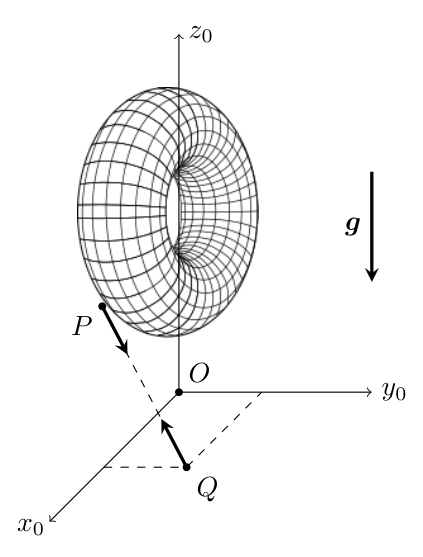
A second particle $Q$ with mass $m_Q = 2$ is constrained to move on the $Ox_0y_0$ plane without friction. The two particles $P$ and $Q$ attract each other with a force that is proportional to the distance between them. The proportionality constant of this force is $k = 2$. Initially, the particle $P$ is located at $\mathbf{r}_0^P(t_0) = 2\mathbf{i}_0 + \mathbf{j}_0 + 4\mathbf{k}_0$ with $\mathbf{v}_0^P(t_0) = -\mathbf{k}_0$ and the particle $Q$ is located at $\mathbf{r}_0^Q(t_0) = 3\mathbf{i}_0 + \mathbf{j}_0$ with $\mathbf{v}_0^Q(t_0) = -\mathbf{i}_0 + \mathbf{j}_0$.
-
(a)
Pick a minimal, valid set of coordinates to describe the configuration of the system. Indicate what is the geometrical meaning of the chosen coordinates.
-
(b)
Obtain a general expression for the position, velocity, and acceleration vectors of $P$ and $Q$ in $S_0$ using the chosen coordinates and their derivatives.
-
(c)
Obtain two independent tangent vectors and one normal vector to the torus as a function of the chosen coordinates.
-
(d)
Identify and express mathematically all the forces acting on $P$ and $Q$.
-
(e)
Find down a set of second order differential equations to determine the evolution of the chosen coordinates in time, free of any other unknowns.
-
(f)
Obtain a scalar conservation law.
-
(g)
Attending to this conservation law alone, can $P$ ever reach the highest point of the torus?
Worked Solution [ Click to Expand ]
Constraints, Degrees of Freedom & Coordinates
- System: a heavy particle $P$ ($m_P = 1$) moves without friction on the vertical torus $x_0 = (2 + \cos\phi)\sin\theta$, $y_0 = \sin\phi$, $z_0 = 4 + (2 + \cos\phi)\cos\theta$, and cannot separate from its surface. A second particle $Q$ ($m_Q = 2$) is constrained to the plane $Ox_0y_0$ without friction. $P$ and $Q$ attract each other with a force proportional to their distance, with constant $k = 2$.
- Initial state: $\mathbf{r}_P(t_0) = 2\mathbf{i}_0 + \mathbf{j}_0 + 4\mathbf{k}_0$, $\mathbf{v}_P(t_0) = -\mathbf{k}_0$; $\mathbf{r}_Q(t_0) = 3\mathbf{i}_0 + \mathbf{j}_0$, $\mathbf{v}_Q(t_0) = -\mathbf{i}_0 + \mathbf{j}_0$.
- Constraints and degrees of freedom (a): two free particles have $6$ coordinates. $P$ is on the torus surface ($1$ constraint) and $Q$ is on the plane $z_0 = 0$ ($1$ constraint), so $\text{CDOF} = 6 - 2 = 4$. A minimal set: $(\theta, \phi)$ for $P$, where $\theta$ is the toroidal angle (rotation about $\mathbf{j}_0$ of the axis of the torus, which passes through $z_0 = 4$) and $\phi$ the poloidal angle (angle around the tube, whose centre circle has radius $2$ and the tube radius is $1$); and $(\xi, \eta)$ for $Q$, its Cartesian coordinates in the plane.
- Initial values of the coordinates: from $x_0 = 2$, $y_0 = 1$, $z_0 = 4$: $\sin\phi = 1$ and $(2 + \cos\phi)\sin\theta = 2$, so $\phi = \theta = \pi/2$. The initial velocity $-\mathbf{k}_0$ gives $\dot{\theta}(0) = 1/2$ and $\dot{\phi}(0) = 0$ (shown in 3.1), and $\xi = 3$, $\eta = 1$, $\dot{\xi} = -1$, $\dot{\eta} = 1$.
- Parameters: $m_P = 1$, $m_Q = 2$, $k = 2$, $g = 9.81$ m/s$^2$.
Reference Frames & Vector Bases
- Inertial frame: $S_0 = \{O; \mathbf{i}_0, \mathbf{j}_0, \mathbf{k}_0\}$ with $\mathbf{k}_0$ vertical upward.
- Toroidal basis. With $\theta$ (rotation about $\mathbf{j}_0$): $\mathcal{B}_1 = \{\mathbf{e}_\rho, \mathbf{e}_\theta, \mathbf{j}_0\}$ with $\mathbf{e}_\rho = \sin\theta\,\mathbf{i}_0 + \cos\theta\,\mathbf{k}_0$ and $\mathbf{e}_\theta = \cos\theta\,\mathbf{i}_0 - \sin\theta\,\mathbf{k}_0$ (so $\mathbf{e}_\rho\times\mathbf{e}_\theta = \mathbf{j}_0$):
Multiplying out, $RR^T$ has diagonal entries $\cos^2 + \sin^2 = 1$ of the rotation angle (and $1$) and off-diagonal entries $\pm(\cos\sin - \sin\cos) = 0$, so it is the identity. with $\dot{\mathbf{e}}_\rho = \dot{\theta}\,\mathbf{e}_\theta$ and $\dot{\mathbf{e}}_\theta = -\dot{\theta}\,\mathbf{e}_\rho$.
- Poloidal basis. With $\phi$ (rotation about $\mathbf{e}_\theta$): $\mathcal{B}_2 = \{\mathbf{n}, \mathbf{e}_\theta, \mathbf{t}_\phi\}$ with $\mathbf{n} = \cos\phi\,\mathbf{e}_\rho + \sin\phi\,\mathbf{j}_0$ (outward normal) and $\mathbf{t}_\phi = -\sin\phi\,\mathbf{e}_\rho + \cos\phi\,\mathbf{j}_0$:
Multiplying out, $RR^T$ has diagonal entries $\cos^2 + \sin^2 = 1$ of the rotation angle (and $1$) and off-diagonal entries $\pm(\cos\sin - \sin\cos) = 0$, so it is the identity.
Derivation
3.1 Kinematics
(b) Position, velocity and acceleration
- Initial rates. At $\theta = \phi = \pi/2$: $\mathbf{e}_\theta = -\mathbf{k}_0$, $\varrho = 2$, so $\mathbf{v}_P = -\dot{\phi}\,\mathbf{e}_\rho - 2\dot{\theta}\,\mathbf{k}_0 = -\mathbf{k}_0$ gives $\dot{\theta}(0) = 1/2$ and $\dot{\phi}(0) = 0$.
(c) Two tangent vectors and one normal vector to the torus
- The two independent tangent vectors are the partial derivatives of $\mathbf{r}_P$, and the normal is their cross product:
3.2 Forces
(d) Forces on $P$ and $Q$
- On $P$: its weight $-m_Pg\,\mathbf{k}_0$; the attraction of $Q$, $\mathbf{F} = k\left(\mathbf{r}_Q - \mathbf{r}_P\right)$; and the reaction of the smooth torus $N\,\mathbf{n}$ (normal, with unknown magnitude; it does not enter the tangent projections). Explicitly,
- On $Q$: the attraction $-\mathbf{F}$ and its weight $-m_Qg\,\mathbf{k}_0$, balanced by the vertical reaction of the smooth plane (so the motion of $Q$ is horizontal). Inertia forces: none.
3.3 Equations of Motion
(e) Second-order equations for the four coordinates
- Equations of motion (with $m_P = 1$, $m_Q = 2$, $k = 2$; for $Q$, $m_Q\ddot{\xi} = -k(\xi - x_P)$ and $m_Q\ddot{\eta} = -k(\eta - y_P)$):
- Check of closure: four unknown coordinates and four equations; the reaction of the torus follows afterwards from the $\mathbf{n}$ projection (the statement says that $P$ cannot separate from the surface, so the constraint is bilateral and $N$ may have either sign).
3.4 Integration and Answers
(f) A scalar conservation law
- Initial value:
(g) Can $P$ reach the highest point of the torus?
- Answer: no. With $g = 9.81$ m/s$^2$, $E_0 = 58.74$ J and the summit needs at least $7g = 68.67$ J, a deficit of $9.93$ J.
Interpretation & Checks
- Robustness: for a general stiffness $E_0 = 2.5 + 4g + 8.5k$. At the summit $z_P = 7$ and $z_Q = 0$, so $|\mathbf{r}_P - \mathbf{r}_Q| \ge 7$ and $V_{\text{spring}} \ge \tfrac12 k\cdot 49 = 24.5k$. Reaching it requires $2.5 + 4g + 8.5k \ge 7g + 24.5k$, i.e. $2.5 \ge 3g + 16k$, false for every $k \ge 0$: the conclusion does not depend on $k$. (With $k = 2$: $58.74$ J against at least $68.67 + 49 = 117.67$ J.)
- Dimensional check: $[k|\mathbf{r}_P - \mathbf{r}_Q|^2] = \text{N m}^{-1}\text{m}^2 = \text{J}$, $[mgz] = \text{J}$ and $[mv^2] = \text{J}$.
- Check against the official key:
Problems.pdfgives the force on $P$ due to $Q$, $\mathbf{F}_P = 2\left[\xi - (2 + \cos\phi)\sin\theta\right]\mathbf{i}_0 + 2\left[\eta - \sin\phi\right]\mathbf{j}_0 - 2\left[4 + (2 + \cos\phi)\cos\theta\right]\mathbf{k}_0$ (the key writes the same vector with its own letters), identical to part (d). The rest is verified by independent derivation. Sympy confirms the two tangent vectors and the normal, the projections of $\mathbf{a}_P$ and of the forces used in (e), and numerical integration of the four equations (DOP853) conserves $E$ to $2\times 10^{-11}$ with $E_0 = 58.74$ and keeps $z_P \le 4$ over $6$ s (the summit $z = 7$ is not approached).
A heavy point particle $P$ with mass $m$ is connected with point $O$ on the upper surface of a thin square plate by a massless, inextensible string of length $\ell$. The distance between $O$ and the edge of the plate is $d$. The string hangs over the edge of the plate and can slide without friction. You can assume that the string remains tense and in contact with the plate at all times. We denote the geometric point where the string is in contact with the plate edge as $Q$. We define the inertial reference frame $S_0 : \{O, \mathcal{B}_0\}$, with $\mathcal{B}_0 = \{\mathbf{i}_0, \mathbf{j}_0, \mathbf{k}_0\}$ as shown in the figure. We define the angle $\theta$ between the $Ox_0$ axis and the string segment $OQ$, and the angle $\phi$ between a vertical plane containing the plate edge and the line perpendicular to the plate edge that passes through $P$. Initially at time $t = 0$, $\theta(0) = \phi(0) = \pi/3\text{ rad}$, and the modulus of the velocity of $P$ is $v_0^P(0) = \sqrt{\ell g}$, where $g$ is the magnitude of the acceleration due to gravity.
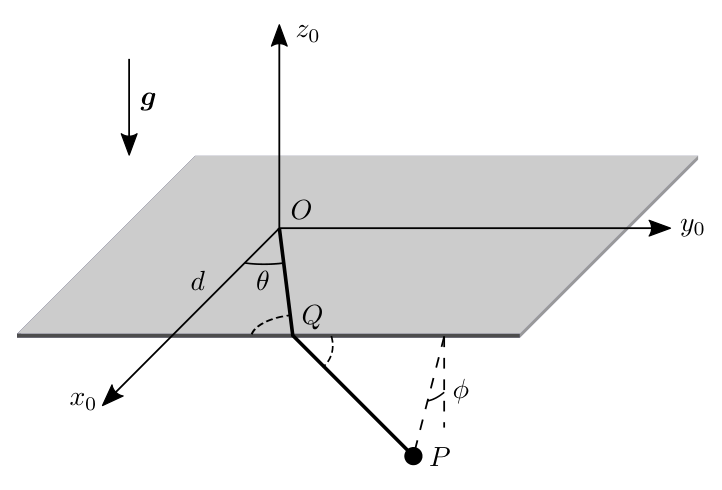
(Hint: Note that under the conditions of the problem, the two angles marked with dashed lines are equal).
-
(a)
How many degrees of freedom does the system have?
-
(b)
Obtain the general expression of a unit vector in the direction from $Q$ to $P$ as a function of $\theta$ and $\phi$.
-
(c)
Obtain the general expression for the position, velocity, and acceleration vectors of $Q$ and $P$ in $S_0$ as a function of $\theta, \phi$, their derivatives, and the parameters of the problem.
-
(d)
Identify and express mathematically all the forces acting on $P$.
-
(e)
Find a set of second order differential equations to determine the evolution of $\theta$ and $\phi$ in time, free of any other unknowns.
-
(f)
Does the tension force exert work on $P$? Provide proof of your answer.
-
(g)
Derive the general expression of the mechanical energy of $P$ in $S_0$ and compute its value initially. Is this a conserved quantity of motion? Justify your answer.
Worked Solution [ Click to Expand ]
Constraints, Degrees of Freedom & Coordinates
- System: a heavy particle $P$ of mass $m$ hangs from a massless inextensible string of length $\ell$ anchored at the point $O$ of the upper surface of a thin horizontal plate. The string passes without friction over the straight edge of the plate, at perpendicular distance $d$ from $O$, at the contact point $Q$; it remains taut and in contact with the plate.
- Geometry (read from the figure,
Problems.pdfPDF page 27). The edge is the straight line $x_0 = d$, parallel to $\mathbf{j}_0$ ($Ox_0$ is perpendicular to the edge); $\theta$ is the angle between $Ox_0$ and $OQ$, so $\mathbf{r}_Q = d\,\mathbf{i}_0 + d\tan\theta\,\mathbf{j}_0$; and $\phi$ is the angle between the vertical and the line through $P$ perpendicular to the edge, which lies in a plane normal to the edge. The statement text does not fix the direction of the edge, so this reading relies on the figure. - Constraints and degrees of freedom (a): $P$ has $3$ coordinates. The string has constant length: $|OQ| + |QP| = \ell$ with $Q$ on the edge, and $Q$ slides on the edge (the position of $Q$ on the edge is not fixed). The frictionless sliding over the edge makes the two string segments meet the edge at equal angles (the hint of the statement). Counting: the $3$ coordinates of $P$ minus the single length constraint give $\text{CDOF} = 3 - 1 = 2$; $Q$ adds no unknown, because the equal-angle condition fixes it once $\theta$ is known. These conditions leave the two independent coordinates $\theta$ and $\phi$: $\text{CDOF} = 2$.
- Initial state: $\theta(0) = \phi(0) = \pi/3$ and $|\mathbf{v}_P(0)| = \sqrt{\ell g}$.
- Parameters: $m$, $\ell$, $d$, $g$.
Reference Frames & Vector Bases
- Inertial frame: $S_0 = \{O; \mathbf{i}_0, \mathbf{j}_0, \mathbf{k}_0\}$ with $\mathbf{k}_0$ vertical upward; the plate in the plane $z_0 = 0$.
- Lengths: $|OQ| = d/\cos\theta$, so the hanging segment has length $\rho = \ell - \dfrac{d}{\cos\theta}$.
- Swing basis. The hanging segment $QP$ swings in the plane normal to the edge, i.e. about the direction $\mathbf{j}_0$. The basis $\mathcal{B}_1 = \{\mathbf{i}_1, \mathbf{j}_0, \mathbf{k}_1\}$ is the inertial basis rotated by $-\phi$ about $\mathbf{j}_0$ (by $\phi$ about $-\mathbf{j}_0$), with $\mathbf{i}_1 = \cos\phi\,\mathbf{i}_0 + \sin\phi\,\mathbf{k}_0$ and $\mathbf{k}_1 = -\sin\phi\,\mathbf{i}_0 + \cos\phi\,\mathbf{k}_0$ (columns in $\mathcal{B}_0$):
Multiplying out, $RR^T$ has diagonal entries $\cos^2 + \sin^2 = 1$ of the rotation angle (and $1$) and off-diagonal entries $\pm(\cos\sin - \sin\cos) = 0$, so it is the identity.
Derivation
3.1 Kinematics
(b) Unit vector from $Q$ to $P$
(c) Position, velocity and acceleration
(using $\rho\cos\theta = \ell\cos\theta - d$). Write $u \equiv \ell\cos\theta - d = \rho\cos\theta \ge 0$. The $\mathbf{j}_0$ component simplifies, $d\tan\theta + \ell\sin\theta - d\tan\theta = \ell\sin\theta$, so
- Velocity of $P$. The chain rule gives $\mathbf{v}_P = \mathbf{t}_\theta\dot{\theta} + \mathbf{t}_\phi\dot{\phi}$ with the tangent vectors
They are orthogonal ($\mathbf{t}_\theta\cdot\mathbf{t}_\phi = \ell u\sin\theta\sin\phi\cos\phi\,(-1 + 1) = 0$) with $|\mathbf{t}_\theta|^2 = \ell^2\left(\sin^2\theta + \cos^2\theta\right) = \ell^2$ and $|\mathbf{t}_\phi|^2 = u^2$, so
- Acceleration of $P$. Differentiating once more (product rule, with $\mathbf{t}_{\theta\theta} = \partial^2\mathbf{r}_P/\partial\theta^2$ and so on):
- Velocity and acceleration of $Q$. From $\mathbf{v}_Q = d\dot{\theta}\cos^{-2}\theta\,\mathbf{j}_0$ and $\frac{d}{dt}\cos^{-2}\theta = 2\sin\theta\cos^{-3}\theta\,\dot{\theta}$:
3.2 Forces
(d) Forces on $P$
- Weight: $-mg\,\mathbf{k}_0$. String tension: along the segment $QP$, toward $Q$: $\mathbf{T} = -T\,\mathbf{e}_{QP}$ with $T \ge 0$. The edge acts on the string, not on $P$. Inertia forces: none.
3.3 Equations of Motion
(f) Work of the tension (needed to eliminate $T$ from the equations)
- $\mathbf{v}_Q$ has only a $\mathbf{j}_0$ component, so $\mathbf{e}_{QP}\cdot\mathbf{v}_Q = \sin\theta\,\dfrac{d\dot{\theta}}{\cos^2\theta}$. With the chain rule $\frac{d}{dt}\left(\frac{1}{\cos\theta}\right) = \frac{\sin\theta}{\cos^2\theta}\dot{\theta}$, the hanging length changes at the rate $\dot{\rho} = -\dfrac{d\dot{\theta}\sin\theta}{\cos^2\theta}$. Therefore
The tension does no work on $P$ ($W_T = 0$).
- Consequence. The identity holds for arbitrary $\dot{\theta}$ and $\dot{\phi}$, so $\mathbf{e}_{QP}$ is orthogonal to both tangent vectors $\partial\mathbf{r}_P/\partial\theta$ and $\partial\mathbf{r}_P/\partial\phi$. Projecting Newton's second law on these two vectors therefore removes the tension.
(e) Second-order equations for $\theta$ and $\phi$
and the orthogonality of $\mathbf{t}_\theta$ and $\mathbf{t}_\phi$ gives
while $-g\,\mathbf{k}_0\cdot\mathbf{t}_\theta = -g\ell\sin\theta\cos\phi$ and $-g\,\mathbf{k}_0\cdot\mathbf{t}_\phi = -gu\sin\phi$. Dividing the first projection by $\ell$ and the second by $u \gt 0$:
- Tension (afterwards). Along $\mathbf{e}_{QP}$: $T = mg\cos\theta\cos\phi + m\,\mathbf{v}_P\cdot\dot{\mathbf{e}}_{QP}$, since $\mathbf{a}_P\cdot\mathbf{e}_{QP} = -\mathbf{v}_P\cdot\dot{\mathbf{e}}_{QP}$ (from $\mathbf{v}_P\cdot\mathbf{e}_{QP} = 0$).
3.4 Integration and Answers
(g) Mechanical energy
- Initial value. At $t = 0$, $|\mathbf{v}_P|^2 = \ell g$ and $\cos\theta = \cos\phi = \tfrac{1}{2}$, so $z_P(0) = -\left(\tfrac{\ell}{2} - d\right)\tfrac{1}{2}$:
It is a conserved quantity of the motion.
Interpretation & Checks
- Variable-length spherical pendulum: the system acts as a spherical pendulum whose length changes as $Q$ slides along the edge.
- Limit $d \to 0$: the edge passes through $O$, so $Q = O$, $\rho = \ell$ and $\mathbf{e}_{QP}$ is the unit vector of a spherical pendulum of length $\ell$ with $\cos\gamma = \cos\theta\cos\phi$ the cosine of its angle with the downward vertical; the energy reduces to $E_0 = mg\ell/4$, equal to $\tfrac{1}{2}m\ell g - mg\ell\cos\theta\cos\phi$ at $\theta = \phi = \pi/3$.
- Dimensional check: $[\rho] = \text{m}$; $[mg\ell] = [mgd] = \text{J}$; $[u] = \text{m}$ and every term of the two equations of motion has units m/s$^2$.
- Check against the official key: the key of
Problems.pdfanswers (f): "No, the tension does not exert work; it is easy to prove it with $\mathbf{e}_r\cdot\mathbf{v}_P^0 = 0$", which is the result of 3.3. The rest is verified by independent derivation. Sympy confirms $\mathbf{e}_{QP}\cdot\mathbf{v}_P = 0$, $v_P^2 = \ell^2\dot{\theta}^2 + (\ell\cos\theta - d)^2\dot{\phi}^2$, $z_P = (d - \ell\cos\theta)\cos\phi$, the equivalence of the two projections with the equations above, and numerically $E_0 = mg\ell/4 + mgd/2 = 7.3575$ J for $m = 1$ kg, $\ell = 2$ m, $d = 0.5$ m, equal to $\tfrac{1}{2}m\ell g + mgz_P(0) = 9.81 - 2.4525$ J.
Two heavy particles $P$ and $Q$, each of mass $m$, are connected with an inextensible, massless string of length $\ell$ as shown in the figure. Particle $P$ is constrained to stay on a paraboloid, given implicitly by equation $z = cR^2$, where $c$ is a known constant and we have introduced the usual cylindrical coordinates $\{R, \theta, z\}$. The string passes through a small hole at the origin $O$, and particle $Q$ is restricted to hang along the vertical axis. The reference frame $S_0 = \{O; \mathbf{i}_0, \mathbf{j}_0, \mathbf{k}_0\}$ is inertial. There is no friction in this problem. Assume that the string is long enough so that $Q$ never reaches $O$ and that it is always tense.
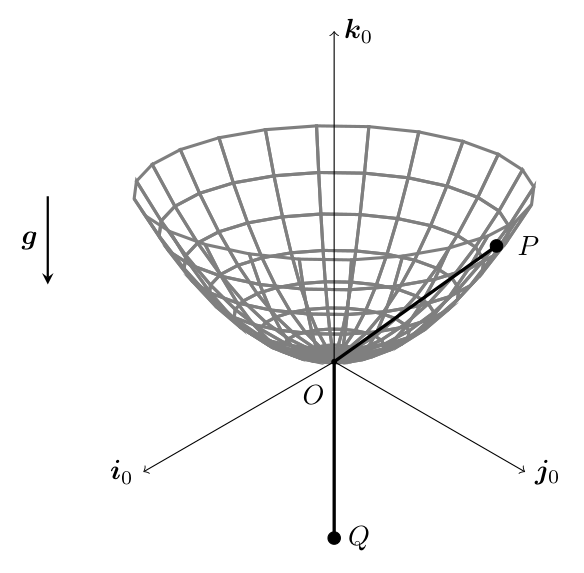
-
(a)
How many effective degrees of freedom does the system have? justify your answer.
-
(b)
Give the expressions for the position, velocity, and acceleration of $P$ and $Q$ with respect to $S_0$ as a function of $R, \theta$ and their derivatives. If you use any vector basis other than $\{\mathbf{i}_0, \mathbf{j}_0, \mathbf{k}_0\}$ to write your solution, define it first.
-
(c)
Find a normal vector and two linearly independent tangent vectors to the paraboloid as a function of $R, \theta$. They do not need to be unitary.
-
(d)
Identify and write down the general expression of all the forces acting on $P$ and $Q$, introducing new unknowns as needed.
-
(e)
Find the condition that the solution $R(t)$ must satisfy so that the string is indeed always in tension.
-
(f)
Using $S_0$ for your analysis, write down two second-order differential equations for $R$ and $\theta$, that do not depend on any other unknowns.
-
(g)
Find two scalar conservation laws (i.e., first integrals).
-
(h)
Assuming that initially $R = 1/c, \theta = 0, \dot{R} = 0, \dot{\theta} = d$, where $d \neq 0$ is a given value, write down an equation in the form $f(R) = 0$ whose roots determine the minimum and maximum values of $R$ in the subsequent motion. You do not need to solve this equation.
Worked Solution [ Click to Expand ]
Constraints, Degrees of Freedom & Coordinates
- System: two heavy particles $P$ and $Q$ of mass $m$ are joined by an inextensible massless cord of length $\ell$ that passes through a small hole at the origin $O$. $P$ moves without friction on the paraboloid $z = cR^2$ ($c \gt 0$, cylindrical coordinates $\{R, \theta, z\}$); $Q$ is restricted to hang along the vertical axis $Oz$. The frame $S_0$ is inertial, there is no friction, the cord is always taut and $Q$ never reaches $O$.
- Constraints (a): two free particles have $6$ coordinates, and there are $4$ independent constraints:
- $P$ on the paraboloid: $z_P = cR^2$ (1; bilateral, since the statement says $P$ is constrained to stay on the paraboloid).
- $Q$ on the axis: $x_Q = y_Q = 0$ (2).
- Constant cord length: $|\overrightarrow{OP}| + |z_Q| = \ell$ (1; unilateral, $T \ge 0$).
- Degrees of freedom: $\text{CDOF} = 6 - 4 = 2$, with $(R, \theta)$.
- Initial state (h): $R(0) = 1/c$, $\theta(0) = 0$, $\dot{R}(0) = 0$, $\dot{\theta}(0) = d \ne 0$.
- Parameters: $m$, $c$ [m$^{-1}$], $\ell$, $g$, $d$ [s$^{-1}$].
Reference Frames & Vector Bases
- Inertial frame: $S_0 = \{O; \mathbf{i}_0, \mathbf{j}_0, \mathbf{k}_0\}$.
- Cylindrical basis: $\mathcal{B}_1 = \{\mathbf{e}_R, \mathbf{e}_\theta, \mathbf{k}\}$ with $\mathbf{k} = \mathbf{k}_0$, the inertial basis rotated by $\theta(t)$ about $\mathbf{k}$:
Multiplying out, $RR^T$ has diagonal entries $\cos^2 + \sin^2 = 1$ of the rotation angle (and $1$) and off-diagonal entries $\pm(\cos\sin - \sin\cos) = 0$, so it is the identity. with $\dot{\mathbf{e}}_R = \dot{\theta}\,\mathbf{e}_\theta$ and $\dot{\mathbf{e}}_\theta = -\dot{\theta}\,\mathbf{e}_R$.
- Surface-adapted basis. With $s = \sqrt{1 + 4c^2R^2}$, the unit meridian tangent is $\mathbf{e}_g = (\mathbf{e}_R + 2cR\,\mathbf{k})/s$, the unit normal pointing into the bowl is $\hat{\mathbf{n}} = (-2cR\,\mathbf{e}_R + \mathbf{k})/s$, and $\mathbf{e}_g\times\mathbf{e}_\theta = \hat{\mathbf{n}}$, so
Derivation
3.1 Kinematics
(b) Position, velocity and acceleration
- Derivatives of $\rho$ (chain rule, with $w = \sqrt{1 + c^2R^2}$): $\rho' = \dfrac{d\rho}{dR} = w + \dfrac{c^2R^2}{w} = \dfrac{1 + 2c^2R^2}{w}$ and, by the quotient rule with $w' = c^2R/w$, $\rho'' = \dfrac{4c^2R\,w - \left(1 + 2c^2R^2\right)c^2R/w}{w^2} = \dfrac{c^2R\left[4\left(1 + c^2R^2\right) - \left(1 + 2c^2R^2\right)\right]}{w^3} = \dfrac{c^2R\left(3 + 2c^2R^2\right)}{w^3}$.
- Particle $P$ (product rule and Poisson):
(Notes Sec. 2.6.2: product rule on $\dot{R}\,\mathbf{e}_R$ and $R\dot{\theta}\,\mathbf{e}_\theta$ with $\dot{\mathbf{e}}_R = \dot{\theta}\,\mathbf{e}_\theta$, $\dot{\mathbf{e}}_\theta = -\dot{\theta}\,\mathbf{e}_R$, and $\frac{d}{dt}\left(2cR\dot{R}\right) = 2c\left(\dot{R}^2 + R\ddot{R}\right)$.)
- Particle $Q$: $\mathbf{v}_Q = \rho'\dot{R}\,\mathbf{k}$ and $\mathbf{a}_Q = \left(\rho'\ddot{R} + \rho''\dot{R}^2\right)\mathbf{k}$.
(c) Tangent and normal vectors to the paraboloid
3.2 Forces
(d) Forces on $P$ and $Q$
- On $P$: its weight $-mg\,\mathbf{k}$; the reaction of the smooth paraboloid $\mathbf{N} = N\,\hat{\mathbf{n}}$ (unknown magnitude $N$, normal to the surface); and the tension of the cord, directed toward the hole, $\mathbf{T}_P = -T\,\dfrac{\mathbf{r}_P}{|\mathbf{r}_P|}$.
- On $Q$: its weight $-mg\,\mathbf{k}$, the tension $\mathbf{T}_Q = +T\,\mathbf{k}$ (same cord, smooth hole), and the horizontal reaction $\mathbf{R}_Q$ of the vertical guide.
- Inertia forces: none ($S_0$ is inertial).
3.3 Equations of Motion
(f) Two second-order equations for $R$ and $\theta$
- Equation for $\theta$. Projecting on $\mathbf{e}_\theta$ (no component of the reaction, of gravity or of the tension, which lies in the meridian plane): $m\left(R\ddot{\theta} + 2\dot{R}\dot{\theta}\right) = 0$, i.e. $\dfrac{m}{R}\dfrac{d}{dt}\left(R^2\dot{\theta}\right) = 0$.
- Equation for $R$. Projecting on $\mathbf{t}_R$: the tension component is $-T\,\dfrac{\mathbf{r}_P}{|\mathbf{r}_P|}\cdot\mathbf{t}_R = -T\rho'$ (because $\dfrac{\mathbf{r}_P}{|\mathbf{r}_P|}\cdot\mathbf{t}_R = \dfrac{R + 2c^2R^3}{R w} = \rho'$) and the weight gives $-mg\,\mathbf{k}\cdot\mathbf{t}_R = -2cmgR$:
Substituting $T$ from the equation of $Q$:
with $\rho'^2 = \dfrac{(1 + 2c^2R^2)^2}{1 + c^2R^2}$.
3.4 Integration and Answers
(e) Condition for the cord to remain in tension
(g) Two scalar conservation laws (first integrals)
- Azimuthal integral (first integral of the $\theta$ equation). From the equation for $\theta$ and $a_\theta = \frac{1}{R}\frac{d}{dt}\left(R^2\dot{\theta}\right)$ (product rule: $\frac{1}{R}\left(2R\dot{R}\dot{\theta} + R^2\ddot{\theta}\right) = R\ddot{\theta} + 2\dot{R}\dot{\theta}$):
- Mechanical energy. The reaction of the paraboloid does no work ($\mathbf{N}\cdot\mathbf{v}_P = 0$), the tension does the work $-T\rho'\dot{R}$ on $P$ and $+T\rho'\dot{R}$ on $Q$, which cancel (inextensible cord, smooth hole), the guide reaction is perpendicular to $\mathbf{v}_Q$, and gravity is conservative. With $V = mg\left(cR^2 + z_Q\right) = mg\left[cR^2 + \rho - \ell\right]$:
(h) Equation $f(R) = 0$ for the extreme values of $R$
- The allowed radii are those with $f(R) \le 0$ (so that $\dot{R}^2 \ge 0$), and $R = 1/c$ is a root.
Interpretation & Checks
- Limit $c \to 0$ (flat plane): $\rho = R$, $\rho' = 1$, $\rho'' = 0$, and the equation for $R$ becomes $2\ddot{R} - R\dot{\theta}^2 + g = 0$, that of two equal particles joined through a hole in a horizontal plane.
- Bounded precessing motion: the particle moves between two parallel circles $R_{\min}$ and $R_{\max}$, with the azimuthal angle monotonic ($\dot{\theta} = d/(c^2R^2)$ has the sign of $d$).
- Dimensional check: $[c] = \text{m}^{-1}$, $[d] = \text{s}^{-1}$; $[cR^2] = [\rho] = \text{m}$ and $cR$ is dimensionless; every term of $f$ has units m$^2$/s$^2$.
- Check against the official key:
Problems.pdfhas no entry for Problem 48 in its solution keys, so the results are verified by independent derivation. Sympy confirms $\rho'$, $\rho''$, the projections of $\mathbf{a}_P$ on $\mathbf{t}_R$ and $\mathbf{e}_\theta$, and numerical integration of the two equations of (f) ($c = d = g = 1$) conserves $E$ to $2\times 10^{-12}$, keeps $T/m \ge 0.303$ and bounds $R$ between $0.482807$ and $1$, the roots of $f$ ($f(0.482807) = 0$ and $f(1) = 0$; $f \lt 0$ between them).
A double pendulum consists of two heavy point masses $P$ and $Q$, each of mass $m$, connected to the origin $O$ and to each other by two rigid, massless bars of length $\ell$ as shown in the figure. We define the inertial frame $S_0$ with origin $O$ and vector basis $\mathcal{B}_0$. We define the two angles $\theta$ and $\phi$ shown in the figure, to describe the configuration of the system.
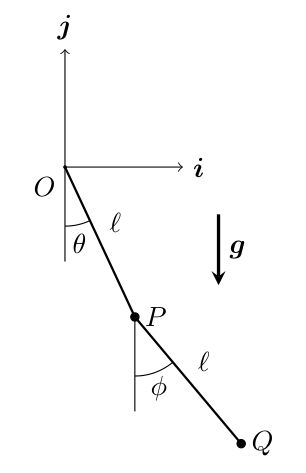
-
(a)
Write down the general expressions of the position, velocity, and acceleration vectors of $P$ and $Q$, using $\theta, \phi$ and their [derivatives].
-
(b)
Write down all forces acting on $P$ and $Q$, introducing new unknowns as needed.
-
(c)
Write down the equations of motion for $\theta$ and $\phi$, free of other unknowns.
-
(d)
Find and write down one conservation law of this problem.
-
(e)
If the initial conditions are $\theta = \phi = \pi/4, \dot{\theta} = \dot{\phi} = 0$, will $Q$ ever cross the $Ox$ axis? Justify your answer.
-
(f)
Consider now that we impose the additional constraint $\phi = 2\theta$. Compute the natural frequency of oscillation of the system under the assumption of small angles.
(Hint: The mechanical energy of an ideal harmonic oscillator of natural frequency $\omega_0$ and mass $m$ can be written as $\frac{1}{2}m(\dot{x}^2 + \omega_0^2 x^2)$).
Worked Solution [ Click to Expand ]
Constraints, Degrees of Freedom & Coordinates
- System: a double pendulum of two heavy particles $P$ and $Q$ of mass $m$ joined to $O$ and to each other by two rigid massless bars of length $\ell$. The motion is planar (the figure and the angles $\theta$ and $\phi$ describe a plane). The angle $\theta$ is that of the bar $OP$ with the downward vertical and $\phi$ that of the bar $PQ$ with the downward vertical.
- Constraints: two particles in the plane have $4$ coordinates; the rigid bars give $|OP| = \ell$ and $|PQ| = \ell$ (holonomic, scleronomic, bilateral). $\text{CDOF} = 4 - 2 = 2$, with $(\theta, \phi)$.
- Parameters: $m$, $\ell$, $g$.
Reference Frames & Vector Bases
- Inertial frame: $S_0 = \{O; \mathbf{i}, \mathbf{j}\}$, with $\mathbf{i}$ horizontal to the right and $\mathbf{j}$ vertical upward (the horizontal axis is $Ox$).
- Bar bases (rotations about the axis perpendicular to the plane; check below):
In $\{\mathbf{i}, \mathbf{j}\}$ the matrix with columns $\mathbf{e}_P, \mathbf{e}_\theta$ is $\begin{pmatrix}\sin\theta & \cos\theta\\ -\cos\theta & \sin\theta\end{pmatrix}$, with $\det = \sin^2\theta + \cos^2\theta = 1$ and orthonormal columns ($\sin^2\theta + \cos^2\theta = 1$, $\sin\theta\cos\theta - \cos\theta\sin\theta = 0$), so $RR^T = I$; the same holds with $\phi$ for $\mathbf{e}_Q, \mathbf{e}_\phi$. where $\mathbf{e}_P$ points from $O$ to $P$ and $\mathbf{e}_Q$ from $P$ to $Q$. Their derivatives are $\dot{\mathbf{e}}_P = \dot{\theta}\,\mathbf{e}_\theta$, $\dot{\mathbf{e}}_\theta = -\dot{\theta}\,\mathbf{e}_P$, and the same with $\phi$.
- Scalar products needed: $\mathbf{j}\cdot\mathbf{e}_P = -\cos\theta$, $\mathbf{j}\cdot\mathbf{e}_\theta = \sin\theta$, $\mathbf{j}\cdot\mathbf{e}_Q = -\cos\phi$, $\mathbf{j}\cdot\mathbf{e}_\phi = \sin\phi$, and
Derivation
3.1 Kinematics
(a) Position, velocity and acceleration
3.2 Forces
(b) Forces on $P$ and $Q$
- The bars are massless and rigid, so each transmits a force along its axis: $T_1$ in $OP$ and $T_2$ in $PQ$ (negative values mean compression).
- On $P$: its weight $-mg\,\mathbf{j}$, the pull $-T_1\,\mathbf{e}_P$ of the bar $OP$ and the pull $+T_2\,\mathbf{e}_Q$ of the bar $PQ$. On $Q$: its weight $-mg\,\mathbf{j}$ and the pull $-T_2\,\mathbf{e}_Q$ of the bar $PQ$ (action and reaction). Inertia forces: none.
3.3 Equations of Motion
(c) Equations of motion for $\theta$ and $\phi$
- Equation for $\phi$. Project the equation of $Q$ on $\mathbf{e}_\phi$, which is orthogonal to $\mathbf{e}_Q$ and removes $T_2$. With $\mathbf{a}_P\cdot\mathbf{e}_\phi = \ell\left[\ddot{\theta}\cos(\theta - \phi) - \dot{\theta}^2\sin(\theta - \phi)\right]$ and $\ell\left(\ddot{\phi}\,\mathbf{e}_\phi - \dot{\phi}^2\mathbf{e}_Q\right)\cdot\mathbf{e}_\phi = \ell\ddot{\phi}$:
- Equation for $\theta$. Add the two equations of motion so that $T_2\,\mathbf{e}_Q$ cancels, and project on $\mathbf{e}_\theta$, which is orthogonal to $\mathbf{e}_P$ and removes $T_1$. The right-hand side is $-2mg\,\mathbf{j}\cdot\mathbf{e}_\theta = -2mg\sin\theta$, and the left-hand side is $m\left(\mathbf{a}_P + \mathbf{a}_Q\right)\cdot\mathbf{e}_\theta$ with $\mathbf{a}_P\cdot\mathbf{e}_\theta = \ell\ddot{\theta}$ and $\mathbf{a}_Q\cdot\mathbf{e}_\theta = \ell\ddot{\theta} + \ell\ddot{\phi}\cos(\theta - \phi) + \ell\dot{\phi}^2\sin(\theta - \phi)$:
- Tensions (afterwards). Projecting on the bar directions,
At rest at $\theta = \phi = 0$: $T_2 = mg$ and $T_1 = 2mg$, the static tensions of the hanging chain.
3.4 Integration and Answers
(d) Conservation law
(e) Will $Q$ ever cross the $Ox$ axis?
- $Q$ is on the axis when $y_Q = -\ell\left(\cos\theta + \cos\phi\right) = 0$, i.e. $\cos\phi = -\cos\theta$. There the potential energy is $V = -mg\ell\left(2\cos\theta + \cos\phi\right) = -mg\ell\cos\theta \ge -mg\ell$. Since the kinetic energy is non-negative, $E \ge V$ at any point of the motion, so reaching the axis would require $E_0 \ge -mg\ell$. But $E_0 = -2.121\,mg\ell \lt -mg\ell$.
- Answer: $Q$ can never cross the $Ox$ axis (it would need a negative kinetic energy).
(f) Additional constraint $\phi = 2\theta$: small-angle natural frequency
- Comparison with the hint. The energy of an ideal oscillator is $\tfrac{1}{2}m_{\text{eq}}\left(\dot{x}^2 + \omega_0^2x^2\right)$; here $\tfrac{1}{2}(10m\ell^2)\left(\dot{\theta}^2 + \dfrac{3g}{5\ell}\theta^2\right)$, so
Interpretation & Checks
- Dimensional check: $[g/\ell] = \text{s}^{-2}$, so $[\omega_0] = \text{s}^{-1}$; $[T_1] = [T_2] = [mg] = \text{N}$.
- Comparison (not a limit of this system): for a single pendulum the frequency would be $\sqrt{g/\ell}$; the constrained double pendulum oscillates more slowly ($\omega_0^2 = 0.6\,g/\ell$) because the second mass adds inertia faster than restoring torque.
- Check against the official key:
Problems.pdfhas no entry for Problem 50 in its solution keys, so the results are verified by independent derivation. Sympy confirms that the Euler-Lagrange equations of $K - V$ are $m\ell^2$ times the two equations of (c), and gives $K \approx 5m\ell^2\dot{\theta}^2$ and $V''(0) = 6mg\ell$ for the constrained case.